
The H-1B nonimmigrant visa provides foreign professional workers with employment opportunities in the United States, and offers employers the ability to hire qualified foreign workers with specialized skills to work in “specialty occupations.” The H-1B Visa process is complex – U.S. employers and potential employees are obligated to adhere to strict Department of Labor and United States Citizenship and Immigration Service (USCIS) rules and regulations. Having an experienced H-1B visa immigration attorney is key to a successful registration and petition.
Contact VisaNation attorneys to file your H-1B registration and petition.
What is An H-1B Visa in the U.S.?
The H-1B work visa is one of many employment-based visas in the U.S. It was designed to help American employers hire international talent with highly specialized knowledge. In particular, companies can bring skilled professionals with at least a bachelor’s degree or equivalent to work in the U.S.
The H-1B visa has a special quality as it is a “dual intent” visa, meaning that although it is a temporary visa, holders have the option to obtain a green card (permanent residency).
Recommended read: H-1B Visa Guide: Ultimate Lottery, Timeline, & Process
The H-1B visa is a great immigration pathway for well-educated individuals with an employment offer from a U.S. employer. Historically, these specialty occupations have been in fields that require advanced skills such as engineering, medicine, and technology.
- Breaking news: On July 24, 2026, an appeals court denied the government’s request to keep the $100,000 H-1B fee active. The fee remains struck down and blocked from being collected while the appeal proceeds.

Learn all about how you can choose the best immigration lawyer for your needs.
H-1B Visa Eligibility Requirements
As with many U.S. visas, H-1B has very strict requirements that all applicants must adhere to. They are listed below:
Position Requirements
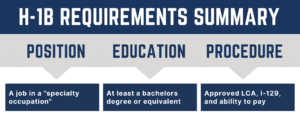
- The position offered must be filed as a “specialty occupation.” A specialty occupation requires a bachelor’s degree or an advanced level of education certification. There are distinct positions that may not mandate a bachelor’s degree due to the complexity or particular listed duties. However, most positions categorized under ‘professional’ require a bachelor’s degree.
- Examples of qualified positions: Systems analysts, data scientists, financial analysts, engineers, professors, researchers, practitioners in the medical field, accountants, attorneys, and architects. USCIS also lists services as a fashion model of distinguished merit or ability. This list is not exhausive.
Education and Degree Requirements
- The bachelor’s or advanced degree must originate from an accredited university or college. The degree is required to relate to the H-1B specialty position.
- For a foreign degree obtained outside the United States, it must be equivalent to an available U.S. degree. Educational evaluation will likely be required.
- Work experience is not a pre-requisite if holding a bachelor’s degree.
- Education requirements may be substituted with work experience. The general rule for the amount of accepted work experience: 1 year required of University = 3 years of work experience.
Hiring foreign workers can be difficult and time-consuming for many U.S.-based companies. VisaNation attorneys take the utmost care of every client and ensure the best result in every case. Get started today!
Get Experienced Legal Guidance for Your H-1B Registration and Petition
Department of Labor and USCIS Requirements
The H-1B visa requirements also entail the employer to submit an I-129 form to the USCIS once the DOL certifies the LCA.
- Prevailing Wage Determination: This is a determined average wage paid to U.S. employees in similar fields. The H-1B visa holder must receive at least the given prevailing wage.
- Employment of foreign professionals will not affect U.S. working conditions in similar fields
- The employer is obligated to internally post notice of filing for H-1B
- There cannot be an existing strike/layoff/lockout within the intended field
- Employers must be compliant with public examination processes
- If the employer terminates the H-1B employment before the designated time, the employer must pay the expenses associated with transportation back to the home country.
- The employer is not authorized to grant the foreign professional employment until the USCIS indicates approval.
H-1B Visa Requirements for U.S. Employers
- The organization is required to demonstrate funds necessary to pay the foreign professional
- Employers must submit an LCA via ETA Form 9035 to the Department of Labor
- The employer must provide an official job offer. An official job offer signifies that documented evidence can be presented to show a true business need.
What Is The H-1B Visa Lottery?
Every fiscal year, the H-1B visa is limited by an annual cap of 85,000 visas. These visas are allocated through a lottery system, which is split into two rounds.
The first round distributes 65,000 visas for registrants with a Bachelor’s degree or higher. The second round distributes 20,000 visas for those with a master’s degree or higher. Master’s degree holders go through both rounds and therefore have a much higher chance of selection.
Because the lottery is weighted, those that fall into a higher salary category earn more entries, and thus also have higher odds of selection.
How To Apply For An H-1B Visa?
- Employer Registration – Employers register for the H-1B lottery before the end of the registration period (March).
- Lottery Selection – USCIS uses wage-weighted selection to choose H-1B beneficiaries.
- LCA Filing – Employer submits a Labor Condition Application (LCA) to the DOL.
- Petition Filing – Employer gathers supporting documents and files Form I-129 with USCIS.
- USCIS Processing – USCIS reviews and adjudicates the petition.
- Visa Stamping – If approved, beneficiaries outside the U.S. apply for a visa at a U.S. consulate.
- Start Work – Upon approval, H-1B holders begin employment (typically on or after October 1).
File Your H-1B Registration and Petition with Confidence
H-1B Visa Documents and Forms
- G-28 form: If the petitioner is obtaining attorney representation or an H-1B lawyer, the petitioner must file a G-28 form. The G-28 should have all sections of the form completed. This entails a signature and printed name of the attorney and the signature of the petitioner.
- ETA-9035: The U.S. employer is required to submit Form ETA-9035 (Labor Condition Application). The Labor Condition Application is mandated to be filed online through the Department of Labor’s FLAG system
- Form I-129: The employer must have received approval of the Labor Condition Application before filing the I-129 form. After approval, the employer is obligated to file Form I-129 (Petition for a Nonimmigrant Worker), filing fee, supplementary documentation, and the approved Labor Certification Application.
- H Classification supplement: The I-129 must have a completed H Classification supplement.
- H-1B Data Collection and Filing Fee Supplement: The petitioner is required to ensure proper completion of the H-1B Data Collection and Filing Fee Supplement.
- Form I-907 (Optional): If the petitioner wishes to request Premium Processing, form I-907 must be completed. Premium processing requires a $2,965 filing fee in a separate check/money order, an I-129 receipt, and Form I-907.
Recommended read: Guide to visa documents

Do I have to Go Through the H-1B Lottery?
Some eligible employers and job positions are not subject to the annual H-1B visa cap, meaning they can apply for an H-1B visa at any time without waiting for or participating in the H-1B visa lottery.
These cap-exempt organizations include:
- Institutes of higher education nonprofit entities
- Nonprofit organizations affiliated with institutions of higher education
- Governmental research organizations
- Nonprofit research organizations
Recommended read: H-1B Cap Exemption, The Definitive Guide
Can I Bring My Family on an H-1B visa?
Yes, family members, known as dependents, including the spouse and unmarried children of the H-1B visa holder, can join them in the United States through the H-4 visa.
Can Family Members work on the H-4 Visa?
Family members on the H-4 visa do not have work authorization in the United States. However, the spouse can get work authorization if the H-1B holder has an approved I-140 (employment-based green card petition) or has been granted an H-1B status extension beyond the 6-year maximum because their PERM Labor Certification or Form I-140 was filed at least 365 days prior and remains pending.
To apply, the eligible spouse must complete Form I-765 Application for Employment Authorization using category (c)(26).
Having the right law firm behind your employment immigration application will increase your chances of success. At VisaNation, our top priority is client satisfaction and getting the best results in every case. Get started today!
How Long Can You Stay in The U.S. On An H-1B Visa?
As an H-1B non-immigrant worker, you are initially admitted for up to three years. Your time may be extended again for another three years, but generally cannot go beyond a total of six years unless you are being sponsored for a green card, an exception under sections 104(c) and 106(a) of the American Competitiveness in the Twenty-First Century Act (AC21).
Your employer will be liable for the reasonable costs of your return transportation if your employer terminates you before the end of your initial period of authorized stay. Your employer is not responsible for the costs of your return transportation if you voluntarily resign from your position. You must contact the Service Center that approved your petition in writing if you believe that your employer has not complied with this requirement.
How Soon Can I Apply For Green Card After H-1B?
An employer can sponsor a foreign employee for a green card at the same time as the H-1B, one of the key benefits of the visa. Because the visa is considered “dual intent,” there is no delay in initiating the green card process..
Alternatives to H-1B Visa
H-1B visa is not the only pathway for employment-based immigration to the U.S. Here are the alternatives:
- EB-1 visa, which you may be eligible for an employment-based, first-preference visa if you are a noncitizen of extraordinary ability, are an outstanding professor or researcher, or are a certain multinational executive or manager.
- EB-2 visa, which is suitable for foreign workers with exceptional abilities or advanced degrees, and allows for National Interest Waivers. Understanding the contrasts between EB-1 and EB-2 is also essential.
- EB-3 visa, which is commonly used to recruit foreign workers in professional, skilled, or unskilled occupations.
- EB-4 visa, which is unique and reserved for religious workers and special immigrants.
- EB-5 visa, which was created specifically for investor immigration to the United States.
- L-1 visa, which enables multinational firms to move their employees from international locations to U.S. offices.
- E-3 visa, specifically for Australian workers in specialized occupations.
- TN visa, which is only for Canadian or Mexican nationals who meet specific occupation requirements.
- O-1 visa, which is ideal for bringing in workers with extraordinary abilities to work in the United States.
- P visa, which is intended for temporary workers such as athletes, artists, and entertainers.
- R visa, which enables temporary work for foreign workers of nonprofit religious organizations.
- J-1 visa, which is designed for exchange visitors who want to study or work in the United States.
Why Choose VisaNation Immigration Law Firm
- We are a dedicated law firm with a specialization in business and employment immigration services and our lawyers have a deep understanding of the immigration process.
- We have a great track record of success in complex new H-1B and transfer/extension cases, including those filed by small employers (<50 employees).
- Efficient and Accessible H-1B Immigration Lawyers.
- Highly competitive Flat Fee for H-1B registrations and petition filing.
- Timely filing of H-1B Visa petitions and our commitment to provide you with regular updates.
We offer consultations to qualified H-1B clients, allowing you to speak with VisaNation H-1B visa lawyers. Contact us to learn how we can help you get approval for your H-1B petition in a timely and efficient manner.
Contact VisaNation attorneys for filing your H-1B registration and petition.
Why You Might Need an H-1B Visa Attorney
If you are a foreign national looking to work in the U.S. or an American company looking to employ a foreign worker, you may need an H-1B lawyer to help you navigate the complex process of obtaining an H-1B visa. Here are some reasons why you might need an H-1B lawyer:
- Complex legal requirements – The H-1B visa process involves complex legal requirements and documentation. An H-1B lawyer can help you understand the legal requirements and ensure that your application is complete and accurate.
- Competitive application process – The H-1B visa program has a limited number of visas available each year, and the application process is highly competitive. An H-1B lawyer can help you develop a strong application and increase your chances of success.
- Potential for delays and denials – The H-1B visa process can be lengthy, and there is always the potential for delays or denials. An H-1B lawyer can help you navigate these potential issues and ensure that your application is processed as smoothly as possible.
- Changing immigration policies – Immigration policies and regulations can change quickly, and it can be challenging to stay up-to-date on these changes. An H-1B lawyer can help you understand the latest policies and regulations and ensure that your application is in compliance.
H-1B Attorney Fee
Attorney fees for the H-1B vary depending on the complexity of the case. For a personalized quote, contact VisaNation.
In addition, you are responsible for the USCIS filing fees and premium processing fees associated with your case. If after your initial consultation with our law firm, you decide that an H-1B visa is not a suitable course of action, we offer a range of other immigration options.
Recommended read: H-1B visa processing fees.