Navigating H-1B visa stamping in India requires advance planning due to severe appointment backlogs and major policy shifts. Crucially, the interview waiver (dropbox) program for H-1B renewals has been effectively discontinued, requiring almost all applicants to attend an in-person consular interview. With high demand creating appointment wait times that stretch from several weeks to months, travelers are strongly advised against traveling to India for stamping without a confirmed appointment in hand.
The H-1B visa program has long been a gateway for skilled professionals, especially from India, to work in the United States. This comprehensive guide aims to demystify India’s H-1B visa stamping process, providing essential insights for Indian nationals navigating this crucial step.
From initial application steps to preparing for the visa interview and stamping procedures, this guide covers all critical aspects of India’s H-1B visa stamping process.
VisaNation attorneys specialize in H-1B and employment-based visas.
Get expert guidance to avoid delays and denials.
In this video, VisaNation attorney Shilpa Malik explains the H-1B Visa Stamping Process
What is H-1B Visa Stamping?
H-1B visa stamping is the process by which a U.S. consulate or embassy places a visa stamp in the passport of an H-1B applicant who has been approved for H-1B status, allowing them to enter and work in the United States. Stamping occurs after a successful H-1B visa interview.
For an Indian national, once the H-1B visa is stamped, the consulate typically keeps the passport to place the visa stamp.
What is the H-1B Visa Stamping Process in India?
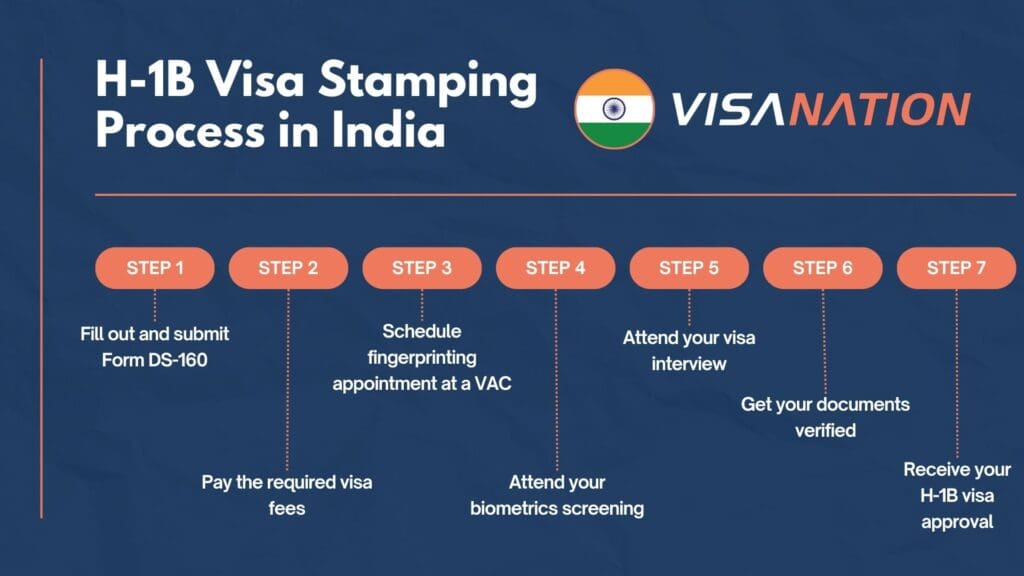
The H-1B visa stamping process in India is a multi-step procedure that requires careful attention to detail. This section provides an overview of the process involved, from the initial application to the actual stamping of the visa.
- The first step involves completing the Online Nonimmigrant Visa Application, Form DS-160. Indian H-1B applicants must accurately fill out this form, providing all necessary personal and professional details.
- Applicants must pay the Nonimmigrant Visa (MRV) Application Fee. This fee is a crucial part of the H-1B visa application procedure for Indian nationals and can be paid online or through designated bank branches in India.
- The next step is to schedule two appointments – one for the biometric screening at a Visa Application Center (VAC) and another for the visa interview at the U.S. consulate or embassy. See waiting times
- H-1B biometric screening involves capturing fingerprints and a photograph. This enhances the security of the visa issuance process.
- Preparing for the H-1B visa interview is a crucial step. Applicants must be ready to answer questions about their employer, job role, and qualifications.
- During the interview, the consulate officer will verify all the documents submitted. This includes the H-1B visa documentation requirements in India, such as proof of employment, educational certificates, and USCIS petition approval.
- If the visa interview is successful, the consulate officer will retain the passport for stamping. The H-1B visa stamping process concludes with the applicant receiving their passport with the H-1B visa, either by mail or pickup.
How Can I Collect My Documents After H-1B Stamping?
You have two options for retrieving your documents:
- Home delivery to the applicant’s chosen address. It usually takes three to seven business days after the interview for the passport with the stamped visa to be delivered, though it can vary by consulate workload. According to the Department of State, the U.S. Embassy and Consulates in India use Shree Maruti Integrated Logistics Limited for the return of documents and tracking.
- Pickup at Collection Locations, which allow you to collect your passport from a visa application center or Blue Dart location in a specified timeframe. You will need to bring the specified documents in order to retrieve the document.
What Are The Eligibility Requirements For H-1B Stamping in India?
To qualify for H-1B stamping in India, the United States Citizenship and Immigration Services (USCIS) must first approve the H-1B visa petition (I-129) filed by the sponsoring employer.
Once your petition is approved, professionals from India are eligible to move forward with the H-1B stamping process at the U.S. Embassy or Consulate in India.
The stamping process in India follows the guidelines and regulations set by both USCIS and the U.S. Department of State. Whether you’re applying for an initial H-1B visa, seeking a renewal, or changing employers, the process remains largely the same.
However, if you’re applying for a visa renewal or if you’re changing employers, there are some key differences:
-
Visa Renewal: For H-1B renewals, applicants must present documentation that verifies their current employment status.
-
Change of Employer: If you’re changing employers while on an H-1B visa, you must provide documentation that reflects your new employer’s details.
In all cases, applicants seeking an H-1B Visa stamping in India must prepare the necessary documents highlighted below.

H-1B Visa Stamping Documents Checklist For India
Gathering and organizing all required documents is essential to ensuring a smooth H-1B visa stamping process in India. This section outlines the crucial documentation needed for H-1B visa stamping, aiding Indian professionals in their preparation.
- DS-160 Confirmation: A printed copy of the DS-160 confirmation page with barcode.
- Copy of the H-1B Approval Notice: A copy of the I-797, Approval Notice for the I-29 H-1B petition by USCIS.
- Work Offer Letter: Letter from the U.S. employer with a detailed description of the position and evidence of salary.
- Passport: A valid passport with at least six months of validity beyond the intended period of stay in the U.S.
- Photographs: Recent passport-sized photographs as per U.S. visa specifications.
- Visa Appointment Confirmation: Confirmation page of the visa appointment.
- Educational Certificates: Original and copies of all relevant degrees, certificates, and transcripts.
- Prior H-1B Documents: Include previous H-1B visa stamps and I-797 approvals, if renewing or transferring.
VisaNation Tip
The H-1B visa documentation requirements in India are stringent, and applicants must ensure that no essential documents are missing. This comprehensive preparation not only aids in a smoother consular process but also reflects the applicant’s seriousness and professionalism.
VisaNation Managing attorney Shilpa Malik recommends to prepare for your H-1B visa interview, ensure you carry all applicable educational and work experience credentials so the officer has a complete picture of both the approved position and your specific qualifications. More importantly, you must thoroughly familiarize yourself with all the information in the Labor Condition Application (LCA) submitted to the U.S. Department of Labor with your petition. You should be able to clearly discuss your specific role, your employer’s business operations, their exact location, and your planned timeline for moving to the United States to begin your work.

What Are Processing Times For H-1B Stamping at Indian Consulates?
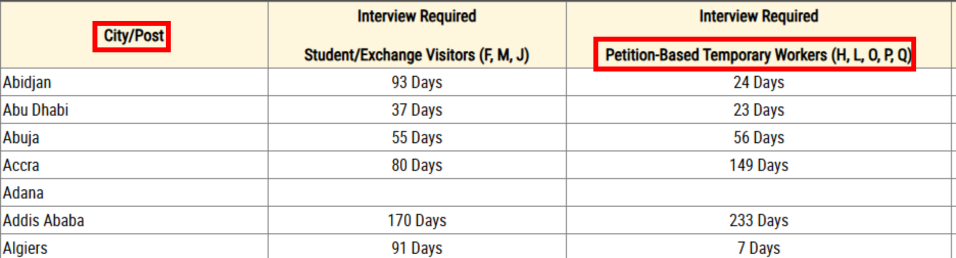
Wait Times: The H-1B visa stamping wait times in India are listed on the Department of State Global Visa Wait Times page. The dates range from 1.5 to 3 months, whereas some embassies are listed as NA.
View the column titled “Petition-Based Temporary Workers (H, L, O, P, Q)” and find your city/post of interest.
Factors Affecting H-1B Processing Times in India
Several factors can influence appointment wait times, including:
- U.S. immigration policy changes
- Public holidays
- Peak application seasons and incoming workload – the number of applications being processed at any given time directly impacts wait times.
- Staffing – the number of available consular officers who are processing H-1B visa applications plays a critical role in how quickly the applications can be processed. Staffing levels can vary.
- Individual case complexity – Each visa application is unique and has its own complexities. The time it takes to process an individual visa application can vary.
Maintain flexibility with your travel dates and consider alternate cities to secure faster appointments.
How to Book an H-1B Visa Appointment in India?
H-1B visa stamping appointments at Indian consulates and embassies can be booked by:
- Complete the DS-160 Form on the Department of State website
- Create a profile on the U.S. visa scheduling website
- Fill in relevant details on the website
- Pay the visa fee ($205.00)
- Schedule appointments for biometric screening and the visa interview
Rescheduling Appointments: While there is a provision for rescheduling, it is usually limited and should be done with consideration of the potential impact on your visa processing timeline.
Emergency Appointments: In certain urgent situations, it’s possible to request an expedited appointment. However, these are granted only under specific circumstances and require sufficient documentation to support the urgency of the application.
H-1B Dropbox and Waiving Consular Interviews in India
For those looking to renew their H-1B Visa, the availability of the interview waiver dropbox program for H-1B visas has been effectively discontinued, effective September 2, 2025.
This means that an interview will be required for H-1B renewals at the nearest embassy. The exemption that allowed children under 14 and adults over 79 to skip interviews has also been eliminated.
Domestic Visa Renewal Pilot
H-1 B stamping is currently unavailable in the United States. The pilot program for domestic renewal ended in early 2024 and has not been reactivated as of 2026.

Frequently Asked Questions
Below you will find answers to the most frequently asked questions:
Can you get my H-1B visa stamp in the USA?
Currently, visa stamping cannot be done within the U.S. You must visit a U.S. embassy or consulate abroad for visa stamping.
However, in early 2024, the U.S. Department of State conducted a pilot program allowing certain H-1B visa holders to renew their visas domestically, eliminating the hassle of traveling abroad for re-stamping. The pilot was successful, streamlining the renewal process for many applicants.
We will keep you updated with the latest news regarding the possibility of domestic H-1B visa stamping in the USA.
How can H-1B applicants from India manage visa processing delays due to administrative or security checks?
H-1B visa applicants from India dealing with processing delays due to administrative processing or security checks can take several steps to manage the situation. Firstly, it's important to stay informed about the status of the application by regularly checking online visa status portals and maintaining communication with the U.S. consulate or embassy. While waiting, applicants should also keep their employers informed about the delay, as it may affect their planned start date in the U.S. In cases of prolonged delays, seeking advice from a legal expert or an immigration attorney might be helpful to understand if any additional actions can be taken.
What are the specific requirements and process for H-1B visa stamping for Indian professionals changing their visa status (e.g., from F-1 student visa to H-1B)?
For Indian professionals changing their visa status, such as from an F-1 student visa to an H-1B, the stamping process involves showing proof of the change. This includes documentation of the new employment in the U.S., the approved H-1B petition, and evidence of maintaining legal status under their current visa. The process also includes standard H-1B stamping procedures like completing the DS-160 form, attending the visa interview, and undergoing biometric screening.
How do the process and requirements for H-1B visa stamping differ for Indian nationals applying from outside India, such as from a third country?
H-1B visa renewals now must be interviewed in the applicant’s country of nationality or residence, ending the option for third-country stamping.
What are the common reasons for H-1B visa stamping denial for Indian applicants?
Common reasons for Indian applicants' H-1B visa stamping denial include:
- Insufficient documentation
- Inconsistencies between the documents provided and the interview/information found on social media
- Criminal history
- Failure to demonstrate qualification for the H-1B position
Applicants can mitigate these risks by ensuring they have all the required documentation, including detailed proof of their professional qualifications and the legitimacy of the U.S. employer. Thorough preparation for the interview to clearly articulate their role and intentions can also reduce the chances of denial.
Is there a provision for appealing or reapplying in case of H-1B visa stamping refusal for Indian professionals?
If an H-1B visa stamping is refused, Indian professionals can reapply or, in some cases, appeal the decision. The specific approach depends on the reason for refusal. For a reapplication, address the reasons for the initial refusal in the new application by providing additional documentation or clarification as needed. Appeals are more complex and typically require the assistance of an immigration attorney, especially when refusals result from legal or administrative errors.
What is the wait time for H1B stamping in India?
The wait time for appointments for an interview and H-1B stamping in India can be found on the United States Department of State Global Visa Wait Times web page, which provides up-to-date tracking. View the column titled "Petition-Based Temporary Workers (H, L, O, P, Q)" and find your city/post of interest.