


It’s not easy to get a decent estimate of your H-1B visa lottery chances due to many complicated factors affecting your odds.
We understand this frustration, so we created this guide to explain those factors and show how they affect your chances. Within, we explore the recent policy on weighted selection, demonstrate how a higher degree impacts chances, examine the rise in lottery participation over the years, and highlight USCIS’s efforts to combat fraud. Plus, we offer practical tips to improve your chances.
Bookmark this page for the latest H-1B lottery news, odds, and results.
Don’t leave your H-1B chances to luck. Let VisaNation help.
Key Terms
H-1B visa lottery: USCIS conducts this lottery to select H-1B registrants through two distinct rounds. The regular cap provides 65,000 visas, which includes a 6,800-visa set-aside for citizens of Chile and Singapore. An additional 20,000 visas are reserved for the Master’s Cap, specifically for applicants with advanced degrees.
Weighted Selection: A final rule significantly impacting H-1B cap lottery chances, increasing the likelihood of selection for higher-skilled, higher-paid positions.
In the video below, Managing Attorney Shilpa Malik discusses how a wage-based strategy will be paramount for H-1B chances in the new wage-weighted format.
What Are Your 2026-27 H-1B Lottery Chances?
Your H-1B selection odds in the 2026-27 H-1B lottery depend on various factors, including:
- OEWS wage level and jobsite location
- Whether you have a bachelor’s degree or an advanced degree (master’s or higher).
- Demand for H-1B visas.
- Filing costs for employers, including the $100,000 H-1B fee for beneficiaries that require consular processing/notification.
- Accurate submission of your H-1B registration.
- USCIS measures addressing H-1B fraud.
See how having a master’s degree improves the odds even further.
OEWS Wage Level and Jobsite Location
The table below showcases a projection from the Department of Homeland Security on your FY 2026-2027 H-1B visa lottery chances, which vary depending on your wage level:
|
Level I |
Level II |
Level III |
Level IV |
|
|
Estimated number of beneficiaries |
89,911 |
177,216 |
37,928 |
15,657 |
|
Probability of Selection |
15.29% |
30.58% |
45.87% |
61.16% |
The new rules announced around weighted selection will have the most significant impact on H-1B cap lottery chances. Specifically, the OEWS Wage level that the employer registers the beneficiary. Each unique beneficiary will be entered into the selection pool a number of times based on the Occupational Employment and Wage Statistics (OEWS) wage level associated with the offered position:
- Wage Level IV: entered four times. Represents senior-level employees.
- Wage Level III: entered three times – Mid-level employees.
- Wage Level II: entered two times. This level represents those with a few years of work experience on top of their bachelor’s or master’s degree.
- Wage Level I: entered one time. This level represents entry-level workers – those just out of university applying for their first job.
According to expert analysis, the DHS estimates a 48 percent drop in selections for wage level I beneficiaries.
If you qualify for a wage level III or IV, your chances of selection significantly increase. The odds of selection for a level IV position is 4x higher than those of a level I. That being said, an employer cannot simply pay a higher wage; job duties and skill development must justify the higher wages.
The OEWS wage levels are also directly tied to the geographic location. A wage level in New York City is vastly different from that in Cleveland, Ohio. See the chart for reference:
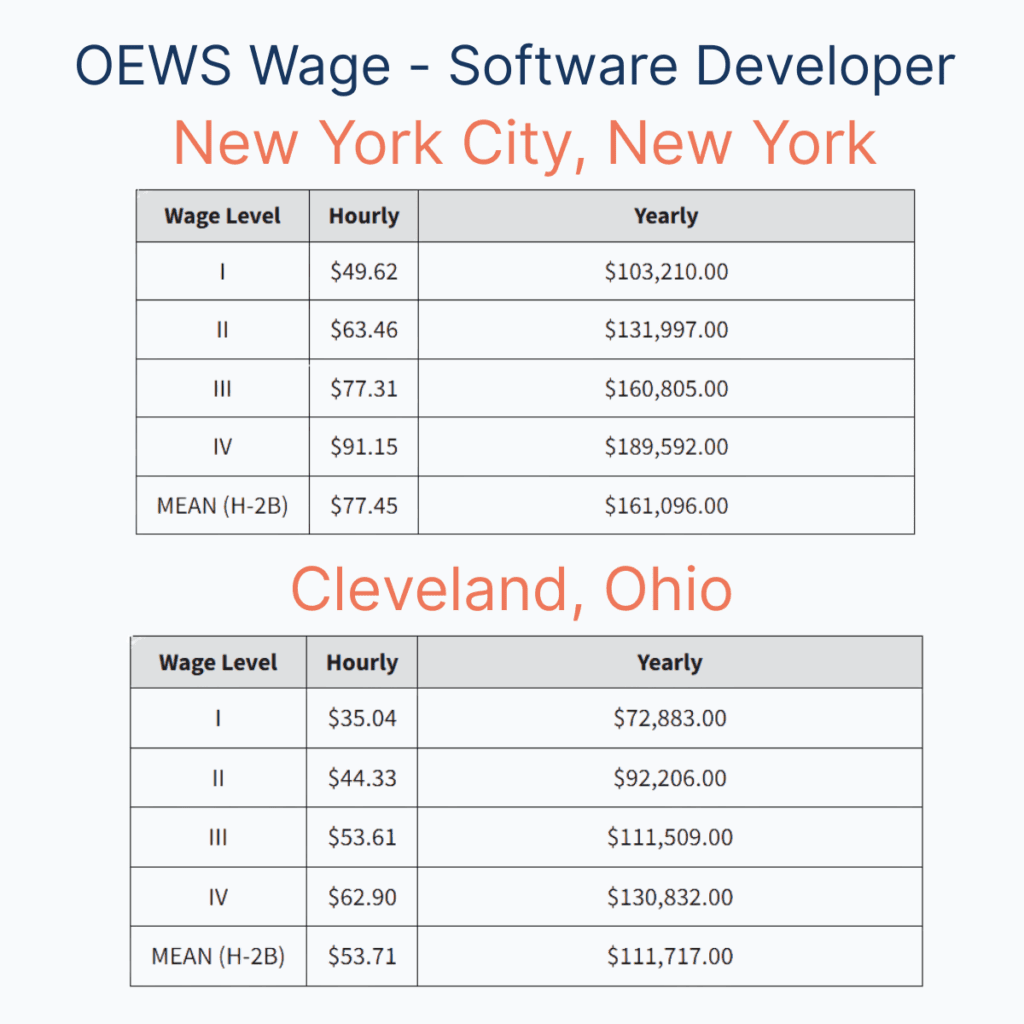
Based on the latest wage data, a level two position in NYC for a software developer would qualify for a level four position based in Cleveland, Ohio, effectively doubling the odds of selection.
Increasing Demand for H-1B Visas
The demand for H-1B visas remains one of the driving factors of the selection rate. Over the years, the visa lottery registrations have fluctuated greatly – look at the chart below:

In 2020, 269,424 eligible registrants participated in the visa lottery. Over the next three years, H-1B registrations increased significantly, peaking at 758,994 in 2023. During this phase, the odds of selection in the H-1B lottery were extremely competitive, with very low selection rates. At this point, USCIS began addressing fraud in extensive fraud in the lottery system, which brought registrations back down to 343,981 in 2025, significantly increasing odds.
In the upcoming cycle, even with wage-weighted selection, H-1B demand will remain an important factor. In our guide to H-1B lottery predictions, our firm posits that the new weighted lottery system and the $100,000 fee will bring overall registrations down even further for the FY 2026-27 lottery, with many employers exploring H-1B alternatives in the wake of so much uncertainty.
Because the $100,000 fee applies primarily to beneficiaries abroad and not to ‘Change of Status’ applicants, we expect a drop in overseas registrations, significantly improving selection odds for candidates already in the U.S.
Update: USCIS announced that registrations fell to just 211,600 in fiscal year 2027.
Degree Type (Bachelor’s vs Advanced Degree)
Aside from wage-weighted selection and demand, degree type has a strong influence on selection odds. For Bachelor’s degree graduates not from Chile or Singapore, you will be competing for 58,200 visa slots. This is because 6,800 of the 65,000 H-1b visas in the regular cap round are exclusive to Chile and Singapore – roughly 11% fewer visas.
For those with an advanced degree, in addition to the 58,200 visas in the first round, you have the chance to earn one of 20,000 H-1B visas exclusive to Master’s degrees or higher in the Master’s cap. Thus, if you have an advanced degree and a level two OEWS wage level, you have two entries in the regular cap round, and if not selected, two entries in the master’s cap round.
See the odds over the years for both bachelor’s and advanced degree holders:
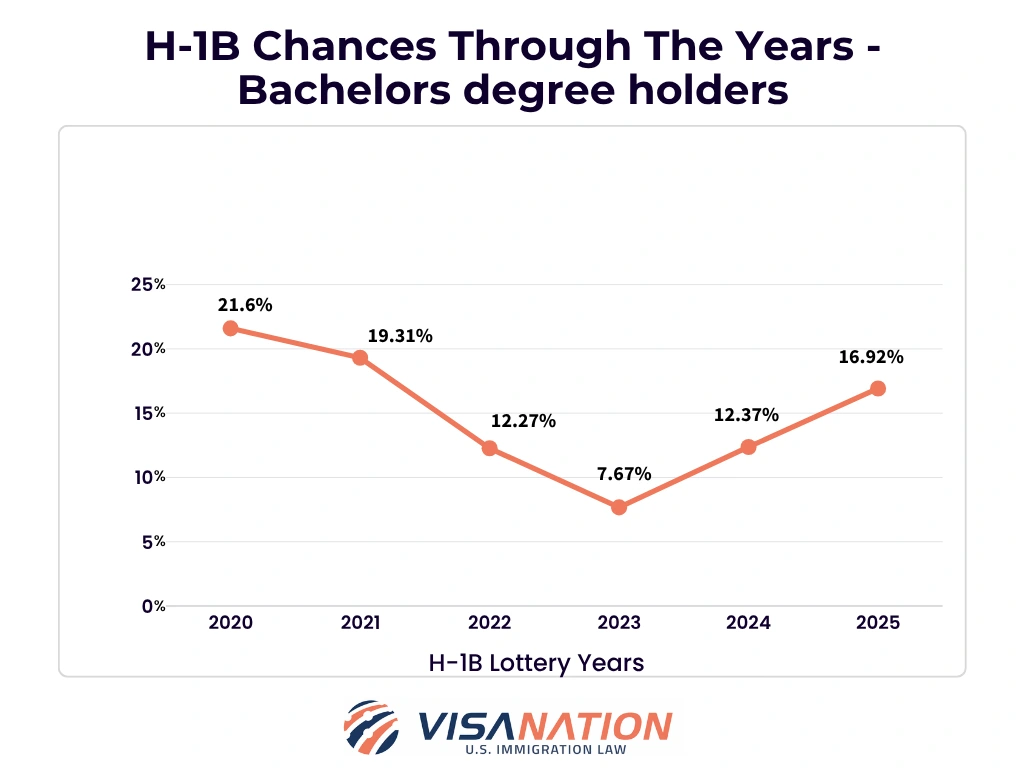

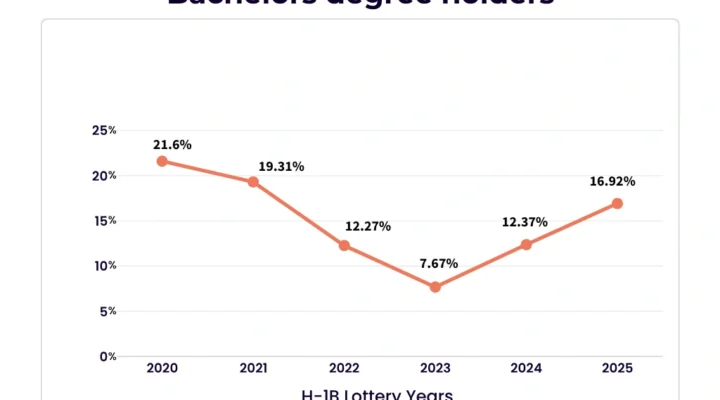
*VisaNation immigration attorneys estimate that if approximately 35% of all eligible registrations in the visa lottery hold a Master’s degree, the odds of a Master’s graduate securing an H-1B visa for applicants, excluding Chile or Singapore, would be as above.
*Disclaimer: This is an approximation, as USCIS doesn’t always release data on the breakdown of a Master’s degree vs a Bachelor’s degree.
Over the last few years, H-1B chances dropped dramatically for Master’s degree holders, but have since experienced a swift recovery over the past two H-1B lottery cycles, with odds improving to over 30%.
Similar to the Bachelor’s degree graduates, competition has impacted the odds, but a Master’s degree nonetheless greatly improves your odds of securing an H-1B visa.
The $100,000 Fee
On July 24, 2026, an appeals court denied the government’s request to keep the $100,000 fee active. The $100,000 H-1B fee remains struck down and blocked from being collected while the appeal proceeds. The Department of Homeland Security has appealed the ruling, so the policy’s future remains uncertain as the case continues through the courts.
The $100,000 H-1B visa fee, introduced in the proclamation “Restriction on Entry of Certain Nonimmigrant Workers” applies to beneficiaries located abroad who require consular processing, rather than to change-of-status applicants already residing in the United States.
VisaNation Tip
Our attorneys expect this high cost to deter overseas registrations, effectively reducing competition and improving odds for candidates already in the country. Remaining in the U.S. on a valid status (like F-1 OPT or TN) is now a massive financial advantage. Because the 100k fee applies to those abroad, maintaining status to allow for a Change of Status rather than consular processing saves the employer a fortune.
USCIS Anti-Fraud Measures
In recent years, USCIS has addressed the sharp rise in employers submitting multiple H-1B registrations for the same applicant in response to organizations exploiting the system. Between 2023 and 2024, the figures for multiple registrations rose significantly from 165,180 to 408,891, respectively. This marks an increase of 147%, with employers submitting an additional 243,711 multiple H-1B registrations.
Investigations by USCIS show the scale at 400,000 fraudulent registrations – almost half of all the registrations filed. To address fraud, USCIS has made it clear that employers attempting two entries into the registration process for one employee, in any manner, may lead USCIS to consider their registrations invalid. In such cases, USCIS has the authority to deny or revoke the approval of any H-1B lottery 2025 petitions, such as when both a passport and a travel document are submitted.
Furthermore, if an employer submits multiple registrations for a single beneficiary, all registrations for that beneficiary by the employer will be deemed invalid. USCIS holds the right to deny or revoke the approval of any petition filed for the beneficiary based on these invalid registrations.
Lastly, USCIS reiterates its power to deny H-1B petitioners or revoke an approved petition under certain circumstances. This includes instances where there is a change in the beneficiary’s identifying information from the registration to the petition, false attestation or invalidity of the underlying registration, an invalid registration fee, or when the H-1B cap-subject petition is not based on a valid registration.
Learn more about H-1B Processing Time.
What Are Your H-1B Chances After Registration Selection?
If your H-1B registration selection has been selected, your chances of petition approval are relatively high.
Our analysis of H-1B approvals and denials puts the rejection rate for H-1B petition approvals in 2025 at 2.9%. There have been 168,205 approvals in the first half of FY 2026 so far, and 5,022 denials. That makes for a 97.10% approval rate.
Hiring an experienced immigration attorney to navigate the upcoming changes is key to securing H-1B petition approval after selection.
Tips to Increase Your H-1B Lottery Odds
There are a few strategies that can help you increase your chances of getting an H-1B visa.
- Secure a High Wage Position: Under the new weighted selection rule, positions classified as OEWS Wage Level III or IV significantly boost your odds. Because these levels receive three and four entries in the lottery, securing a higher-paid offer is one of the most effective ways to increase your chances.
- Master’s Cap: The most obvious way to help your chances is to qualify for the master’s degree (or higher) cap exemption. This gives you a second chance in the Master’s cap to compete for a visa.
- Synchronize Wage Levels Across Multiple Offers. The new 2026/27 lottery rules calculate your lottery weight based on the lowest wage level submitted among all your offers. If you have multiple interested employers, ensure they are all registering you at the highest level possible to protect your overall odds.
- Apply Only Once: Submitting multiple applications might seem like a good strategy, but it can lead to rejection. If a single employer submits two applications for the same employee, both will be rejected. The USCIS also scrutinizes multiple applications from affiliated companies for the same employee.
- Ensure Your Employer Meets USCIS Requirements: A common reason for H-1B application failure is the employer not meeting USCIS standards. Verify that your employer has a good track record with successful H-1B applications, can provide the necessary documentation, and has the financial stability to pay your salary.
- Seek Immigration Consultation: Navigating the complexities of H-1B applications can be challenging. A consultation with an experienced business immigration attorney can help ensure your application is well-prepared, compliant with legal requirements, and has the best chance of success.
Read how we got our client’s H-1B approved in weeks!

Do H-1B Chances Vary by Country?
No, H-1B chances do not vary country by country? Beneficiaries from every country have the same odds. Whether you live in India, Spain, or anywhere else, your chances in the H-1B Lottery are the same.
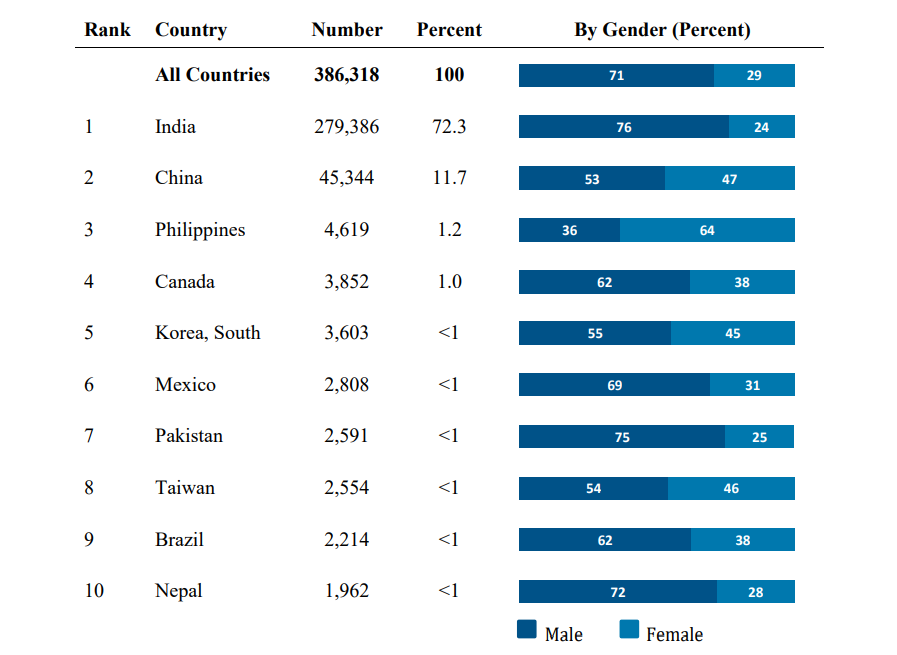
Nonetheless, USCIS has developed some interesting graphics breaking down the gender and number of registrations by country in 2022. From the chart, you can see an overwhelming majority of registrations are from India and China. Additionally, men tend to make up most of the registrations in India, China, and Mexico, but the opposite is true for the Philippines.
Frequently Asked Questions FAQs
What were the H-1B Chances in Past Lotteries?
|
Fiscal Year (FY) |
Eligible Registrations |
Selected Registrations |
Registration Selection Rate |
|
FY 2027 |
211,600 |
TBC |
TBC |
|
FY 2026 |
343,981 |
120,141 |
34.9% |
|
FY 2025 |
470,342 |
135,137 |
28.7% |
|
FY 2024 |
758,994 |
188,400 |
24.8% |
|
FY 2023 |
474,421 |
127,600 |
26.9% |
|
FY 2022 |
301,447 |
124,415 |
43.8% |
Does Premium Processing Increase My H-1B Lottery Odds?
Premium processing does not increase your H-1B probability. It is an optional service that the USCIS offers to expedite the H-1B petition processing to 15 business days rather than the standard amount of time, which can take upwards of six months.
Is the H-1B Lottery Random?
Historically, the H-1B lottery was based purely on random selection. Now, the H-1B lottery is based on wage-weighted selection in which each beneficiary receives a number of entries (up to a maximum of four) based on the Occupational Employment and Wage Statistics wage level. While there is still an element of chance, the “randomness” is now skewed.
Who is Exempt from the H-1B Cap?
To qualify as a cap-exempt registration for an H-1B visa, the applicant must either have been previously counted against the H-1B cap or be offered a position with a cap-exempt employer. Cap-exempt employers are typically:
- Higher education institutions
- Non-profit organizations affiliated with higher education institutions
- Non-profit or government research organizations
- For-profit companies are hiring individuals for specialty occupations to work at any of the above three types of entities
A non-profit organization or entity is tax-exempt and either of the following under the Internal Revenue Service (IRS): section 501(c)(3), (c)(4), or (c)(6) (see 26 U.S.C. 501(c)(3), (c)(4), or (c)(6)). Also, the IRS should approve the non-profit as a tax-exempt organization for research or educational services.
Additionally, if you are already an H-1B visa holder and want to transfer employers or extend your status, then you have already been counted against the cap, and your registration will be considered cap-exempt.
Keep in mind that transferring your status from one employer to the next has a caveat. If you originally came to the U.S. through a cap-exempt employer, transferring to another cap-exempt employer is not a problem. However, if you decide to transfer to a cap-subject employer, you will need to go through the lottery process.
Check out Top H-1B Transfer Denial Reasons.