


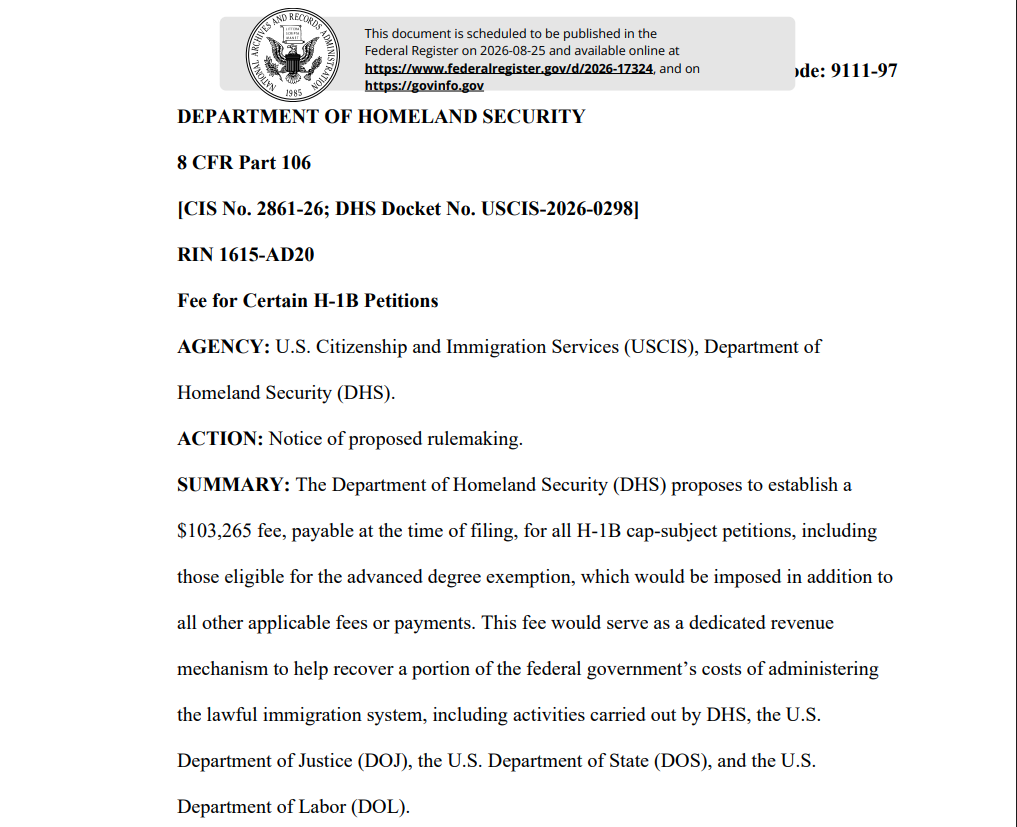
The U.S. Department of Homeland Security (DHS) has issued a Notice of Proposed Rulemaking (NPRM) titled “Fee for Certain H-1B Petitions.” The rule proposes a new $103,265 fee for employers participating in the H-1B cap process.
This comes shortly after a separate $100,000 payment requirement established via presidential proclamation, which impacted the FY 2026 lottery, that was vacated by a federal court. The federal government is currently appealing that decision.
Key Details
- If it passed, employers would have to pay a $103,265 fee per petition at the time of filing.
- The fee applies to all H-1B cap-subject petitions, including those eligible for the advanced degree exemption (master’s cap).
- It does not apply to cap-exempt filings, such as those submitted by institutions of higher education or non-profit research organizations.
- The proposed charge would be assessed in addition to all existing statutory H-1B filing fees.
Purpose
According to the DHS, this is a cost-recovery mechanism to offset operational costs across DHS, the Department of Justice (DOJ), the Department of State (DOS), and the Department of Labor (DOL).
However, according to VisaNation Attorney Shilpa Malik
“It is completely detached from economic reality. It would place H-1B sponsorship beyond the reach of most small and midsize employers, restrict access to critical global talent, and make it even more difficult for the United States to compete for highly skilled professionals.”
“The chilling effect of the original policy was already apparent. Only 85 payments were reportedly made under the initial $100,000 fee before a federal judge declared it unlawful. The government’s request to suspend that ruling while the appeal proceeds was also denied.”
What Are The Next Steps?
The proposal is scheduled for official publication in the Federal Register on August 25, 2026. The proposed fee is not currently in effect.
Before become a reality, the following steps need to be completed:
- A 30-day public comment window opens upon official publication. Submissions can be made electronically through Regulations.gov.
- DHS must evaluate public comments before determining whether to publish a final rule establishing an effective date and transition provisions.