


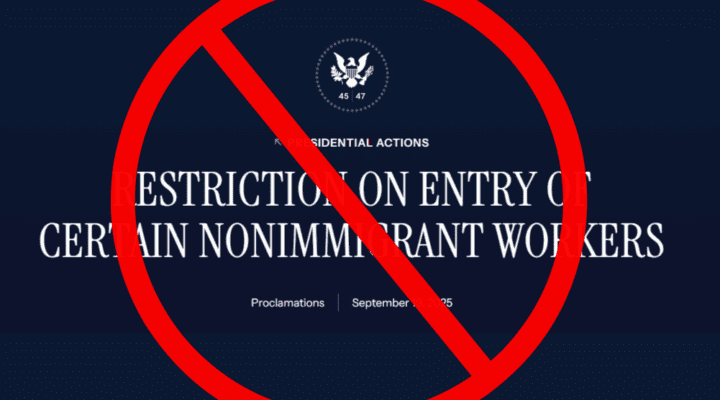
On Monday, June 8th 2026, Judge Leo Sorokin declared a $100,000 fee for employers’ H-1B visa applications unlawful in U.S. District Court in Massachusetts. The presidential proclamation imposed in September, the “RESTRICTION ON ENTRY OF CERTAIN NONIMMIGRANT WORKERS” resulted in a major reduction in participation in the H-1B visa lottery. Its aim was to reduce reliance on foreign labor and encourage companies to hire and train domestic U.S. workers.
While applicants within the United States were largely shielded from the fee, U.S. sponsors faced an insurmountable fee for beneficiaries living abroad that required consular processing. This led to a drop in eligible registrations from 343,981 in FY 2026 to 211,600 in fiscal year 2027.
Before the $100,000 fee, U.S. sponsors could hire foreign beneficiaries for between $2,225 and $3,595 in government filing fees, depending on the size of the company. The $100,000 fee was paid 85 times by U.S. sponsors by February 15, 2026.
Latest News:
- Breaking news: On July 24, 2026, an appeals court denied the government’s request to keep the $100,000 fee active. The $100,000 H-1B fee remains struck down and blocked from being collected while the appeal proceeds.
Why Was The H-1B 100,000 Fee Blocked?
Judge Leo Sorokin deemed the fee an unlawful tax that Congress never authorized.
“Here, the substance and application of the $100,000 payment reveal that it is a tax, regardless of what the payment is called” – Judge Leo Sorokin
The case was State of California et al v. Mullin, U.S. District Court for the District of Massachusetts, No. 25-cv-13829.
The administration’s legal counsel stated that the proclamation was legal because the president’s authority under immigration law is broad. However, the opposition countered that this interpretation meant the executive branch could circumvent Congress on taxation policy.
Update:
A Massachusetts district court has temporarily paused its June 8 order vacating the $100,000 H-1B proclamation fee policy
What Does This Mean?
Because Judge Sorokin struck down the $100,000 fee as an unlawful tax, U.S. employers can file H-1B petitions for beneficiaries living abroad requiring consular processing without facing that massive financial penalty.
Filings are now restored to the standard, much lower government fee structure, typically ranging between $2,225 and $3,595 depending on the size of the organization.
Our team advises following this case closely because further developments are likely, with possible government appeals or alternative restrictions.
An Opportunity for Nonprofits
Many nonprofits, including institutions of higher education or nonprofit research organizations, qualify for cap-exempt status. This means they do not have to wait for the annual April H-1B lottery or worry about cap limitations.
Nonprofits can now file petitions at any time of the year, free of both the lottery constraints and the struck-down $100,000 fee. Prior to this ruling, nonprofits had to file an NIE, or National Interest Exception (NIE).
VisaNation Law Group attorneys will continue monitoring the situation and provide updates and analysis in response to new information.