

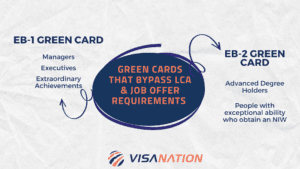
Obtaining an employment-based green card can be a long and intensive process that usually requires job offers, labor certifications, and petitions. Each different preference level has its benefits as well as its disadvantages. Fortunately, the EB-2 National Interest Waiver (NIW) enables advanced degree holders and people with exceptional ability to circumvent both the labor certification and job offer requirements by allowing them to self-petition.
Get an assessment from a qualified immigration attorney
What is The EB-2 NIW?
EB-2 petitioners can avoid two major requirements of the EB-2 visa, the PERM Labor Certification process and employer sponsor requirement, by establishing through the I-140 petition that the work they plan to conduct in the United States is in the national interest. The National Interest Waiver (NIW) allows a foreign national to self-petition and file an I-140 on their own behalf without an employer’s involvement or the lengthy labor certification application if they meet the strict eligibility requirements.
EB-2 National Interest Waiver Requirements
For almost two decades, the Matter of New York State Department of Transportation (NYSDOT) severely limited the availability of national interest waivers. This case established a three-prong test for determining whether a foreign national is eligible for a national interest waiver. In 2016, the Administrative Appeals Office (AAO) revised the framework to be more inclusive for a broader range of potential scenarios, commonly referred to as the Matter of Dhanasar standard.
To qualify for the National Interest Waiver, a petitioner must show:
1. Substantial Merit and National Importance
The first NIW requirement is that the applicant must show that their endeavor has substantial merit and national importance. This merit can be shown in business, science, technology, health, culture, or education. There does not need to be quantifiable evidence of economic impact, though it may help your case.
Meeting this requirement does not create a blanket approval, and the U.S. government shall review applications on a case-by-case basis.
2. Ability to Advance the Proposed Endeavor
The second NIW requirement is that the foreign national must be able to advance the proposed endeavor. This means the AAO will look at factors such as:
- Educational background
- Experience, skills
- Record of similar successes
- Current progress
- Plan for success
Petitioners don’t need to prove that their endeavor will succeed, but rather that they can make it succeed.
3. U.S. National Interest in Waiving the Job Offer Requirement
The final NIW requirement is that the applicant present evidence that the U.S. would benefit on balance to waive the job offer criteria for an EB-2. “On balance” means that the overall benefit to the U.S. from waiving the standard job offer and labor certification process is greater than the benefit the U.S. would get if it did not waive those requirements. Additionally, to qualify for the NIW, you must meet the basic requirements of the EB-2 green card.
Learn how to qualify for EB2 without an Advanced Degree.
Watch the video below to hear from VisaNation Attorney Quindemil. She breaks down everything you need to know about the NIW, including how it differs from other EB-2 categories and the crucial three-prong test required to qualify.
How to File EB-2 NIW
There are several steps to file an EB-2 NIW:
1. Determine Eligibility, ideally with an experienced attorney
2. Gather Supporting Documents
3. File I-140 and pay the accompanying fees (listed below)
4. Await the USCIS decision
5. File Form I-485 Application to Adjust Status (if in the U.S. and your priority date is current) or undergo consular processing if abroad.
6. Biometrics, medical, and interview appointment
7. Receive a green card
EB-2 NIW Green Card Processing Time
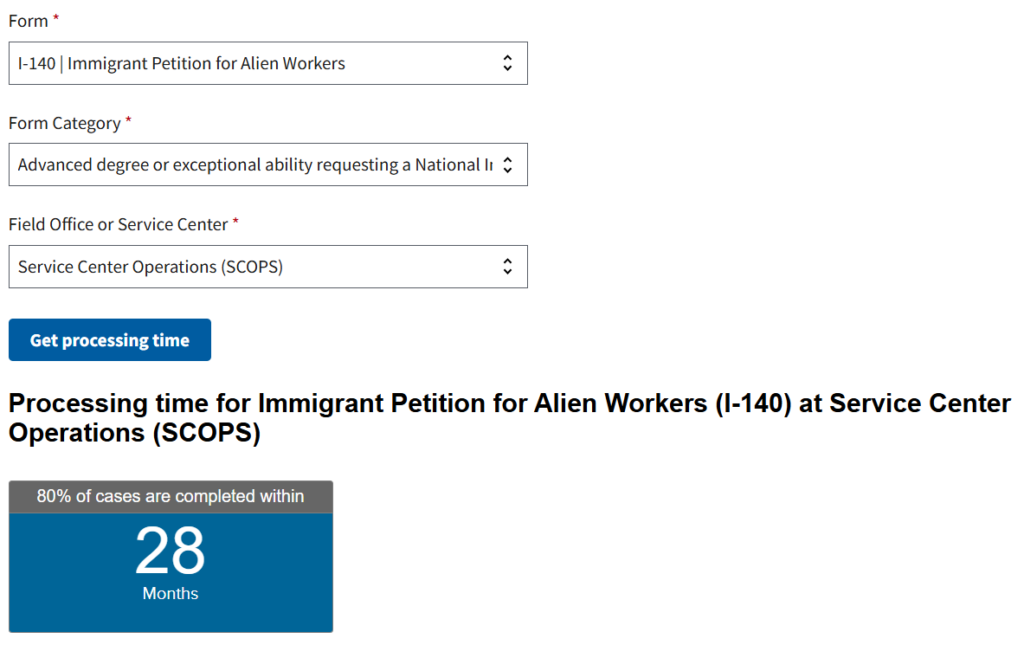
The processing time for the I-140 for the NIW category is currently 28 months according to USCIS data, which suggests that over the past six months, 80% of cases are completed within this timeframe. Check the latest processing times by visiting the official E-Gov website. The processing time can vary as USCIS evaluates each application and supporting evidence on a case-by-case basis.
Is Premium Processing Available for the EB-2 NIW?
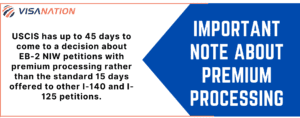
Yes, premium processing is available for EB-2 NIW petitions. This reduces the I-140 processing time to 45 days.
Learn about how to use EB-2 NIW self-petition in this guide!
Learn about navigating the NIW process for pilots.
How Do Priority Dates and Final Action Dates Factor into the EB-2 NIW Timeline?
After successfully securing an EB-2 NIW approval with a National Interest Waiver, you still need to wait until your priority date is current before a green card is available. The priority date is the day that the USCIS receives your I-140 petition. You must check the monthly visa bulletin released by the Department of State to see if your priority date matches the final action date given in the EB-2 category for your country of origin. For some countries, the priority date takes several years to become current, but it can take no time for others.
Once your date is current, you can either adjust your status (8-12 months) if you are in the U.S. under a valid non-immigrant status or go through consular processing if you live abroad. Adjusting your status requires filing an I-485 form and waiting for approval. Consular processing involves making an appointment with a U.S. Consulate or Embassy in your home country and participating in a one-on-one interview with a consular officer.
In either case, you will have your NIW green card after approval!
EB-2 National Interest Waiver Documents Checklist
As a recap, here’s a list of the documents required:
- Form I-140
- Evidence supporting that the applicant has an advanced degree or exceptional ability
- Petition letter, ideally drafted by an EB-2 NIW green card lawyer
- Letters of recommendation (see below)
- Affidavits from leaders in your field
- Evidence of past achievements, mentions, or recognition
- Documentation showing that a labor certification would adversely affect the national interest
- Proof of 2+ years of experience in the area
- An up-to-date resume
- Evidence of memberships, publication citations, conferences, or other articles

You must file all of these documents concurrently with your petition to be eligible for the NIW green card. If your petition is approved, you can move on to the next step only if your priority date is current.
All About NIW Letters of Recommendation
Letter Requirements
Letters of recommendation or support letters help reinforce your NIW case if they can demonstrate national interest and show that you have had an impact within your respective field, which highlights your work’s benefits. These letters can be from high-level managers, former employers, and colleagues, or anyone else familiar with the benefits of your work.
However, it is essential to note that the USCIS will place different weight on letters of recommendation depending on who wrote them. For example, letters from peers and colleagues will hold less weight than letters written by esteemed contemporaries who did not have a hand in your work.
EB-2 NIW Letter Sample
There is no minimum or maximum number of recommendation letters that are required. If you choose to include them, they should be underneath Form I-140 in your package. Once received, USCIS will examine these letters of recommendation in addition to the credentials of their writers. Accompanying these letters should be a list of the individuals who wrote the letters and their titles, and employers.
See a sample of an NIW letter here:

How to Prove That You Have Exceptional Ability
To put the NIW into perspective, we need to understand the purpose of the PERM Labor Certification. The PERM is designed to protect American jobs and mitigate the amount of job outsourcing. This is why U.S. employers must offer the prevailing wage and determine that no qualified U.S. workers are available to take the position.
Your endeavor must be beneficial enough to warrant waiving this protective policy. In essence, this is what the regulations mean when they say that the U.S. must benefit “in the balance.” The positive impact of your endeavor must outweigh the benefits of the PERM.
If you do not possess an advanced degree or its equivalent, then you must provide evidence that you have exceptional ability to qualify for your EB-2. Here are some items that qualify:
- Letters from past or current employers proving that you have a minimum of ten years of experience working in your field full-time.
- Licensing or certification that enables you to practice your trade.
- Evidence of having an exceptional salary that relates to your ability.
- Maintaining membership in a professional association that requires an exceptional ability for membership.
It is important to note that this list is not exhaustive, and there may be many items that could serve to prove your exceptional ability. If you believe that you qualify, but do not see your evidence listed here, be sure to retain the services of an immigration attorney to learn if your proof fulfills the requirements.

EB-2 NIW Cost and Filing Fees
The filing fees for the EB-2 NIW are as follows:
- I-140 Immigrant Petition for Alien Worker: $715
- I-485, Application to Register Permanent Residence or Adjust Status: $1,440 (applicable if adjusting status from a valid non-immigrant status while living in the U.S.)
- DS-260 filing fee: $325 (Applicable if applying from outside the U.S.)
- Premium processing fee (optional): $2,965
- Legal fees (optional): An EB-2 NIW lawyer can provide expertise in preparing and filing the required and evidence for an approved NIW.
Get an assessment from a qualified immigration attorney
What If My NIW Is Denied?
Like anything else in immigration law, there is always the possibility that your petition will not be approved. If you’ve experienced an NIW denial or are looking to avoid it, here are some common reasons:
- Filing too much evidence – VisaNation attorneys suggest that if you bog USCIS officers down with excessive documents, your evaluating officer will likely miss the most critical evidence. Quality is more important than quantity, and the narrative of the cover letters and evidence must be expertly crafted.
- Not advocating your case well – remember it’s not enough to simply state your qualifications. You also need to argue them in a way that makes you eligible according to the regulations and legal precedent. As can be seen by the higher rejection rates of FY 2025, the levels of scrutiny of EB-2 NIW petitions can change, and petitioners must adapt.
- Insufficient reference letters – Ensure your letters of recommendation are from experts who can back up their information with facts about your work and the impact it has had on the field.
If your NIW was denied, you can choose to make a legal motion to reopen or reconsider your case, you can appeal to a third party (the Administrative Appeals Office), or you can consult your immigration attorney to see if there is another green card option available to you.
The legal motions of reopening or reconsidering are essential appeals to the evaluating officer. In a motion to reopen, you are asking the officer to take a second look at your case in light of new evidence that has come to light. For a motion to reconsider, you demonstrate that the evaluating officer was incorrect in their decision to deny your NIW green card case. It is important to note that these are delicate legal procedures and should not be attempted without the help of an immigration attorney.
Check out this guide on Changing Jobs After NIW Approval.
EB-2 NIW Approval Rates
In FY 2025, the approval rate of EB-2 NIWs has been lower relative to previous years:
- Q1 saw an approval rate of 62.7%
- Q2 saw an approval rate of 67.3
- Q3 saw an approval rate of 54%
- Q4 saw an approval rate of 35.66%
In comparison, FY 2024 saw approval rates of 71%. This indicates that the NIW approval is becoming increasingly challenging as USCIS officers scrutinize petitions more closely.
With that being said, you do improve your chances of approval by having an immigration attorney handle your case. They’ll be able to check that all the proper criteria are met and ensure that the necessary paperwork is submitted.
NIW Green Card FAQs
Look at some of the most frequently asked questions VisaNation NIW green card lawyers receive during consultations and other inquiries.
Q. What is the difference between regular EB-2 and EB-2 NIW green card petitions?
The difference is that you need an employer to sponsor a regular EB-2 visa, while you can sponsor your EB-2 NIW yourself. The employer must also obtain a labor certification before submitting an I-140 petition on your behalf. On the other hand, an NIW allows you to file your I-140 directly to the USCIS.
Q. Are labor certifications necessary for NIW cases?
PERM Labor Certifications are not required for those categorized as beneficial to the national interest, although they are required for other EB-2 beneficiaries. Based on our experience, a letter accompanied by the NIW from the interested sponsor can benefit the visa case.
Q. What is usually considered an advanced degree?
The terms outlining an advanced degree (as characterized by USCIS) include a United States master’s degree or higher, or a foreign equivalent degree.
Q. What if I only have a bachelor’s degree?
Bachelor’s degrees are also considered equivalent to a master’s when the individual has five years of progressive experience to add. The experience must be in the specialty or field you are applying for.
Q. Do I have to possess an advanced degree and exceptional ability to qualify for an NIW?
No, you only need to meet the requirements for one of the two criteria. Though meeting the USCIS definitions of the two National Interest Waiver requirements will be advantageous, it is not compulsory. With either of the two and a convincing petition, prepared by an experienced EB-2 immigration lawyer, your odds of approval are greatly improved.
Q. I haven’t published any articles in journals in my field. Can I still apply for EB-2 NIW?
Yes, you can still apply for an NIW even if you don’t have any published work. The published article requirement is just one of the many criteria the USCIS gives. If you have the academic qualification and/or years of industry experience stipulated for NIW, you may still qualify without the evidence of a published article.
The same applies to the “Awards and Professional Membership” criteria. It is not mandatory to have all these before you can qualify. The USCIS allows those with “comparable evidence of eligibility” that is not exactly as listed on the website to file an NIW petition. The most important thing is how compelling the petition is.
Q. Must I live in the U.S. to apply for an NIW?
You are not required to reside in the U.S. to apply for an NIW. However, if you are not in the U.S. when you petition for your EB-2, you cannot adjust your status to that of a legal permanent resident. Instead, you must go through consular processing for your green card.
Q. Is there a minimum number of letters of recommendation needed?
While no minimum number is required, the more evidence you submit that demonstrates qualification, the stronger your case will be.
Q. Can I apply for an NIW if I have a pending labor certification with the DOL?
Yes, you may still apply for NIW even if you have a labor certification pending. Two different organizations handle the PERM labor certification and the NIW. While your labor certification is filed with the DOL, the agency that will process your NIW is the USCIS. So, one does not stop the other. It is another way to boost your chances for approval, in that if your labor certification is denied, you will still hope to possibly get the NIW petition approved.
Q. Can I apply for an NIW if denied a labor certification?
Assuming you meet the qualifications for an NIW, your previous denial should not impact the outcome. There are several reasons for your PERM to be denied, including simply being a qualified U.S. worker available to take your employer’s position. Cases such as these should not be detrimental to your NIW case.
Q. Do I need a job offer to be eligible for an NIW?
Because the NIW is a way to circumvent the job offer requirement, you do not need one to apply.
Q. Do I need an advanced degree to apply for an NIW?
While having an advanced degree for an NIW is not a strict requirement, having one can go a long way in helping your EB-2 NIW case. In place of an advanced degree, a bachelor’s degree with five years of relevant experience in your field may also suffice. In the absence of either of these, you will need to demonstrate exceptional ability to qualify for the EB-2 green card.
Q. What is the EB-2 NIW Processing Time?
According to USCIS data, the EB-2 NIW processing time is 20.5 months. However, it is always possible to take longer if USCIS issues you a Request for Evidence (RFE). If you receive an RFE, it is essential that you take it to an immigration attorney for help with your prompt response. For an official resource detailing the USCIS NIW processing time, you can visit their website on AAO processing times.
Q. What is EB-2 NIW RFE?
The USCIS issues requests for additional evidence (RFE), requesting more information from a visa applicant. It is usually given when the USCIS is not convinced that an NIW applicant meets the criteria needed to prove that they are qualified for the visa. This should not be mistaken for denial or rejection.
The recipient of an RFE will only be required to provide some items that appear missing in their petition. If you receive an RFE, you will be given a timeframe for the requested information. It is always best to consult an immigration lawyer to help look into the details of the request and guide you on how to answer it. you must handle an RFE carefully, as there will be no second chance.
Q. Is an EB-2 NIW the only avenue for getting an employment-based green card without a labor certification?
No, there is also the EB-1, the first preference employment-based green card. Like the EB-2 NIW, EB-1 applicants do not need a labor certification. Also, if you qualify for the extraordinary ability subcategory of the visa, you will not need a job offer or employer, and can self-sponsor your petition.
Q. Which should I go for between the EB-1 and the NIW?
The answer will depend on which green card you qualify for the most. Note that the two categories are completely different visas. Each has its peculiarities. Also, the overall approval rate for the EB-1 is higher. This, perhaps, is the reason why many people choose an EB-1 even when they have the credentials that may qualify for both.
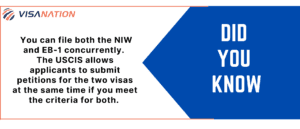
But if you are still unsure which to settle for, you can file the NIW and EB-1 concurrently. The USCIS allows applicants to submit petitions for the two visas simultaneously if they meet the criteria for both. This will be an opportunity to improve the likelihood of getting approval from at least one of the two categories. It is possible to receive approvals for the two petitions. But then, you should weigh your options and make an informed decision.
Recommended Article: EB-1 Green Card Guide
How VisaNation Can Help
Our VisaNation Law Group NIW green card lawyers can assist clients in determining whether they are eligible based on the criteria listed above. We can also help you guide the type of evidence you need to prove your endeavor’s positive impact on the U.S. economy.
Our team has extensive experience with complex employment immigration cases and can assist you with any complexities that may arise with your NIW case.
Book a consultation today for a comprehensive evaluation of your eligibility for an EB-2 NIW green card.