


How the 2026 Public Charge Rule Applies to Your Immigration Case
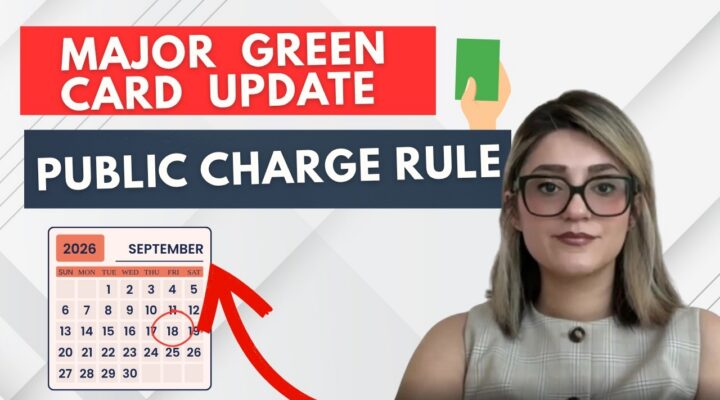
The Department of Homeland Security (DHS) recently published a new “Public Charge” file rule on July 20 that rescinds the 2022 public charge regulation effective September 18, 2026. But what exactly is this rule, and how does it actually impact different types of immigration applications?
Here is a breakdown of what the policy means, how it is evaluated, and what you need to know to navigate the changes.
What is a “Public Charge”?
The Immigration and Nationality Act (INA) classifies being a “public charge” as a ground of inadmissibility, but it doesn’t strictly define the term. Because the original INA left the definition open, the policy’s scope has fluctuated over the years, allowing different administrations to interpret the rule as broadly or narrowly as they see fit.
Simply put: if an immigration officer believes a green card applicant is likely to become dependent on certain government benefits or subsidies, they have the authority to deny the visa. Traditionally, this was demonstrated by the receipt of direct cash assistance for income maintenance, or by long-term institutionalization at the government’s expense.
The first Trump administration significantly broadened the definition in 2019. Under that rule, immigration officials began weighing an applicant’s use of non-cash public benefits. Programs like the Supplemental Nutrition Assistance Program (SNAP/Food Stamps), most forms of Medicaid, and federal housing assistance were penalized, introducing a strict threshold for receiving public subsidies.
The Biden administration’s 2022 final rule rolled back the 2019 expansion and largely restored the historical understanding of the policy. DHS clarified that the use of non-cash supplemental benefits would not be penalized. An applicant would only be considered a public charge if they were likely to become primarily dependent on the government through cash assistance or long- term institutional care.
The 2026 rule, issued under the second Trump administration, shifts the policy once again returning to, and arguably exceeding, the 2019 approach. Rather than replacing the 2022 rule with a new set of detailed standards, DHS is removing the structured framework entirely. USCIS is expected to issue formal guidance detailing how officers will assess public charge, and immigration experts anticipate that adjudicators will once again weigh the use of various public benefits and health programs as negative factors.
How is the Public Charge Rule Evaluated?
Regardless of the specific rule in effect, immigration officers evaluating applicants against the public charge ground of inadmissibility must consider the “totality of the circumstances.”
This means the government official examines multiple factors to make a forward-looking decision, including the applicant’s:
- Age and health
- Family status and size
- Assets, resources, and financial status
- Education and skills
Application to Employment-Based Petitions
Employer-Sponsored Visas (EB-1B, EB-1C, EB-2, EB-3)
For employer-sponsored categories, meeting the public charge requirement is relatively straightforward because your primary evidence is already built into the immigration petition.
Because your employer is sponsoring you, USCIS looks at your approved Form I-140, your permanent job offer letter, and your agreed-upon salary to confirm that you will earn enough income to support yourself and your household. For the most part, filing an Affidavit of Support is not necessary, as the initial I-140 is already accompanied by documents proving the employer’s ability to pay.
Self-Petitioned Visas (EB-1A Extraordinary Ability & EB-2 NIW)
If you are filing a self-petitioned application, such as the EB-1A or EB-2 NIW, you do not have a sponsoring employer, which means you must establish financial self-sufficiency on your own.
Self-petitioners generally present strong cases of self-sufficiency through their personal backgrounds, and their education and credentials are not normally scrutinized for public charge issues unless they use public subsidies.
What You Should Do Now
Because the public charge landscape is shifting and officer discretion is expanding, timing matters more than usual. If you are eligible to adjust status, filing before September 18, 2026 means your application will be reviewed under the current 2022 standard. If you or a family member currently receives public benefits, speak with an attorney before the effective date to understand how continued receipt could affect your case.
Frequently Asked Questions
Will the new rule apply retroactively?
No. The Final Rule expressly indicates that it applies prospectively and will not retroactively penalize applicants. DHS acknowledges that many individuals made decisions regarding public benefits based on the protections and guidance of the 2022 Public Charge Rule.
Therefore, DHS has confirmed that the receipt of previously excluded means-tested public benefits before the effective date of the new Final Rule (September 18, 2026) will not be treated as a negative factor.
Those past benefits will be evaluated consistently with the 2022 protections. However, if an applicant continues to receive these newly scrutinized benefits on or after the effective date, DHS will consider that ongoing receipt as part of the “totality of the circumstances.”
Will there be a new form edition?
Yes. Along with the implementation of the new rule on September 18, 2026, the government is introducing a revised edition of Form I-485 (the application to register permanent residence or adjust status).
Does receiving public benefits automatically result in the denial of a green card?
No. Receiving public benefits does not automatically result in the denial of a green card application.
As mentioned previously, USCIS applies the “totality of the circumstances” test when conducting a public charge assessment. This means that USCIS considers multiple factors together rather than making a decision based on a single issue.
As a result, not every applicant who has received public benefits will be found inadmissible as a public charge or have their green card application denied. However, the receipt of certain public benefits may be considered as one factor in the overall determination, depending on the type of benefit, the applicable law, and the applicant’s immigration category.
Because the public charge rules are complex and vary depending on the specific circumstances of each case, it is strongly recommended that applicants avoid relying on public benefits that could affect their immigration case whenever possible and consult with a qualified immigration attorney before applying for or using such benefits.
Does taking FMLA leave count as a public benefit?
No. The public charge test evaluates the use of specific means-tested government assistance programs (such as Supplemental Security Income or TANF) and government-funded long-term institutional care.
The Family and Medical Leave Act (FMLA), by contrast, provides unpaid, job-protected leave through your employer. It is an employment right, not a public assistance welfare program, and therefore does not impact a public charge determination.
Does the new rule apply to me if I pursue consular processing instead of adjustment of status?
Receiving green cards outside of the United States is governed by the Department of State (DOS), while adjustment of status is governed by USCIS (DHS).
Since these are separate agencies, the Department of State follows its own public charge guidance and policies, although they are based on the same statutory ground of inadmissibility.