



Let’s face it: navigating the H-1B visa lottery can be overwhelming. Between the yearly updates, legal jargon, and complicated application requirements, it’s no surprise that both employers and potential employees find themselves lost in a sea of confusing information. For this very reason, thousands of applications are denied every year.
To help you prepare for the H-1B visa cap-filing season, this guide aims to demystify the H-1B visa lottery process, breaking down every step in a way anyone can follow.
Bookmark this guide as your one-stop shop for all your H-1B visa information, news, and updates.
File your H-1B registration and petition with VisaNation
H-1B Cap Latest 2026-27 News
- Breaking news: USCIS announced that the initial registration period for the fiscal year 2026-27 H-1B cap lottery will open at noon Eastern on March 4 2026 and run through noon Eastern on March 19, 2026.
- The DHS announced a final rule officially implementing weighted selection for the 2026-2027 H-1B lottery. Historically, the H-1B lottery has been completely random. Now, the selection process will be weighted by the OEWS wage level:
-
Level 4 Wages: 4 entries in the lottery.
-
Level 3 Wages: 3 entries.
-
Level 2 Wages: 2 entries.
-
Level 1 Wages: 1 entry
-
- Premium Processing fees will increase from $2,805 to $2,965 effective March 1, 2026.
- President Trump has signed a new proclamation introducing a $100,000 fee for H-1B petitions filed on or after September 21, 2025. This fee applies directly to beneficiaries who are
- outside the United States and do not have a valid H-1B visa
- or are inside the U.S., but the petition requests consular notification, port of entry notification, or pre-flight inspection.
- Most nonimmigrant visa applicants, including those seeking to renew their H-1B visas, are now required to attend an in-person interview at a U.S. embassy or consulate in their home country. Dropbox renewal appointments have been eliminated for the H-1B holders.
- A new version of the I-129 form went into effect on January 17, 2025. That will be the only version accepted for any H-1B filings.
Key Terms
- H-1B Visa – The H-1B visa is a foreign worker visa that allows U.S. employers to hire foreign workers in specialty occupations. It is typically valid for an initial period of three years, and can be extended for a maximum of six years.
- Registrations – The first step in the H-1B visa application process, whereby employers submit basic information about an applicant to enter them into the H-1B lottery.
- Petitions – A detailed application that the employer submits to USCIS if the applicant’s registration is selected in the lottery.
H-1B Cap Explained
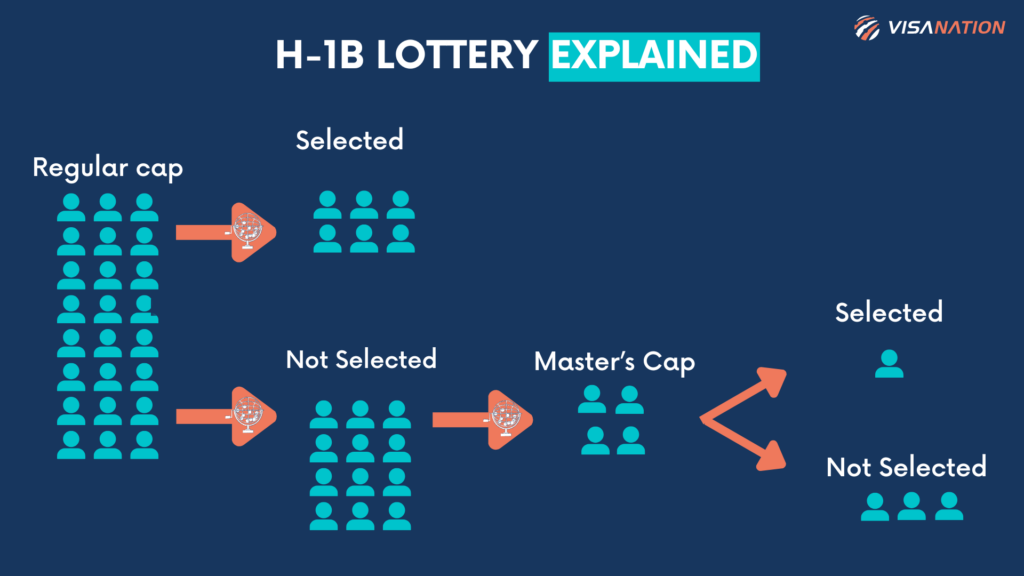
Every year, USCIS conducts a lottery to select eligible applicants when the number of H-1B visa applications exceeds the annual limit. The H-1B visa lottery process is conducted in two rounds:
- In the first round, the regular H-1B cap, USCIS uses weighted selection to choose 65,000 eligible applicants, which includes foreign workers with a Bachelor’s degree or higher.
- USCIS sets aside 6,800 of these H-1B visas exclusively for residents of Chile and Singapore.
- Then comes the H-1B Master’s Cap – a second lottery round with an additional 20,000 visas available exclusively to applicants with a U.S. Master’s degree or higher from eligible universities or institutions.
VisaNation Tip
Master’s cap applicants have the benefit of going through both rounds of the lottery. Read how this impacts your odds in our definitive guide of your chances of getting an H-1B visa.
In recent years, the H-1B lottery has run additional round when USCIS does not receive enough completed petitions from the first round of selections to reach the annual numerical cap.
New H-1B Wage-Weighted Selection Rules
The H-1B lottery has shifted from a purely random selection to a weighted system that favors higher-skilled and higher-paying jobs. An applicant’s chance of selection is now tied to the Occupational Employment and Wage Statistics (OEWS) wage level of the offered position. A higher wage level means more entries in the lottery and a greater chance of selection.
The OEWS wage levels are as follows:
- Wage Level I: Entry-level positions = One entry in the selection pool.
- Wage Level II: Qualified workers = Two entries in the selection pool.
- Wage Level III: Experienced workers = Three entries in the selection pool.
- Wage Level IV: Fully competent workers = Four entries in the selection pool.
This weighting applies to both the regular H-1B cap and the master’s cap.
VisaNation Tip
Because OEWS wage levels are determined by the specific geographic area of employment, a salary may represent a higher “value” in different labor markets:
For example, a salary that is a Level I in a high-cost hub like New York City or may qualify as a Level III in a market like San Antonio or Columbus, effectively tripling the candidate’s entries in the selection pool. However, to avoid petition denial or revocation, employers must ensure that the actual worksite and wage levels remain consistent with the initial registration and Labor Condition Application (LCA), and be prepared to justify the business necessity of the specific location.
Additionally, employers cannot simply “bump up” a salary to get more entries without updating the job duties. The wage level must match the Standard Occupational Code (SOC) and the actual complexity of the role. A mismatch between the registration wage and the actual petition filed later could lead to denials or RFEs.
Importantly, if a single beneficiary has multiple registrations submitted by different employers, the beneficiary’s weighting in the selection pool would be based on the lowest wage level among all those registrations.
Moreover, if a salary range is used, the lower end of that range will be used to determine the beneficiary’s weighting in the lottery pool.
In the video below, watch Visanation CEO Vishal Rai and Managing Attorney Shilpa Malik break down the weighted selection processes, along with how it relates to the master’s cap.
How to Register for the H-1B Lottery?
Employers seeking to file H-1B cap-subject petitions on behalf of an employee for the FY 2027 H-1B cap must first electronically register their company through a USCIS Organizational Account. USCIS uses this online pre-registration system to make the H-1B lottery manageable.
Employers must then register their beneficiaries (foreign-born workers) through the USCIS online registration system during the registration window (March 4 – March 19th 2026)
During the registration process, employers and their representatives/attorneys need to submit basic information about each beneficiary, including:
- Full legal name
- Date of birth
- Country of birth
- Country of citizenship
- Passport number
- Educational qualifications
- Years of work experience
- Evidence of eligibility for the H-1B specialty occupation
- SOC Code
- Area of intended employment
Then, the employer will need to pay the associated $215 H-1B registration fee. This includes organizations that are eligible for the advanced degree exemption.
Each employer can only submit one entry per H-1B employee. If their submission is selected, the employer must attest that they’ll file a complete H-1B petition.
H-1B Cap-Exempt Applications
Certain employees do not need to go through the H-1B registration process, including:
- Professionals who have had H-1B status and are changing employers with time still left in their 6-year H-1B allocation.
- Professionals who have been counted against the cap and need an extension of their approved status.
- Those who work for cap-exempt organizations (not-for-profits, educational organizations, etc.)
What Are the H-1B Visa Eligibility Requirements?
To qualify for an H-1B visa, there are a few eligibility criteria to be aware of:
- The job must be in a “specialty occupation.” This generally requires a bachelor’s degree or higher.
- The applicant’s degree must be from an accredited institution, or if it’s from outside the U.S., it needs to be equivalent to a U.S. degree.
- No degree? You can substitute your education with work experience; however, three years of experience equals one year of university education.
H-1B Visa Lottery Dates and Deadlines (2026-2027)
The dates for the FY 2027 H-1B visa lottery:
- March 4, 2026 – Registration Period Opens
- Time: 12:00 noon Eastern Time
- March 19, 2026 – Registration Period Closes
- Time: 12:00 noon Eastern Time
- No further registrations will be accepted after this deadline.
- March 20- March 27, 2026 – H-1B Selection Process
- By March 31, 2026 – Results released by this date
- USCIS will notify petitioners and representatives through their USCIS online accounts regarding selected beneficiaries.
- April 1 – June 30, 2026 – Petition Filing
- Organizations have a 90-day window to submit petitions on behalf of their selected registrations.

VisaNation Tip
Employers should begin identifying as soon as possible prospective employees who have not had H-1B status in the past but may need to have it starting October 1, 2026. Individuals to keep in mind might include:
- Students or interns who have an F-1 visa status working under OPT and want to change to H-1B
- Some L-1 Intracompany Transferees who are not qualified for green cards as EB-1 multi-national managers
- Certain E-3 visa holders
- Spouses in H-4, L-2 or E-2 status
- Foreign nationals not selected in past H-1B cap seasons
Learn about H-1B dependent employer qualifications.
What Are the H-1B Visa Fees?
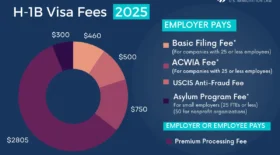
There are a variety of expenses associated with the H-1B visa process. The table below shows the minimum costs for an H-1B visa that progresses to the petition stage.
|
Fee |
Amount |
Responsible for Fee |
|
$100,000 H-1B Supplemental Fee |
$100,000 - only for new H-1B petitions for beneficiaries outside the U.S. or those who require consular processing. |
Employer |
|
H-1B Lottery Registration Fee |
$215 |
Employer |
|
I-129 Petition Filing Fee |
$780 or $460 (small employers/nonprofits) |
Employer |
|
Public Law 114-113 Fee |
$4,000 (only if 50+ employees) |
Employer |
|
Premium Processing (optional) |
$2,805 (increased to $2,965 effective March 1, 2026) |
Employer or Employee |
|
USCIS Anti-Fraud Fee |
$750 (less than 25 employees) $1,500 (more than 25 employees) |
Employer |
|
ACWIA Education and Training Fee |
$500 |
Employer |
|
Asylum Program Fee |
$600 (if 26+ employees) |
Employer |
|
Attorney Fee |
Variable |
Employer |
VisaNation Law Group’s Legal Fees
Since the stages are tiered, only certain companies will eventually file the complete petitions:
- Stage one: $300 for the initial registration process, which includes all required preliminary case analyses.
- Stage two: $2,600 will be due if the case is selected in the lottery for filing, including all form/support letter preparation plus case filing within the timeframe.
$100,000 H-1B Visa Fee
Effective September 21, 2025, a $100,000 fee is required for all new H-1B petitions filed by employers for beneficiaries located outside the U.S. or those required to go through consular notification. Notably, this fee is typically not required for individuals already in the United States who are applying for a change of status (such as from F-1 to H-1B), an extension, or an amendment.
VisaNation Tip
Remaining in the U.S. on a valid status (like F-1 OPT or TN) is now a massive financial advantage. Because the 100k fee applies to those abroad, maintaining status to allow for a Change of Status rather than consular processing saves the employer a fortune.
Visa Integrity Fee
The Visa Integrity Fee is a mandatory $250 fee paid by non-immigrant visa applicants at the time of visa issuance at a U.S. consulate abroad. This fee does not apply to Adjustment of Status (AOS) filings made within the United States, as it is strictly tied to the physical issuance of a visa at an embassy. The fee is refundable for those who maintain legal status and depart the U.S. on time, and is an important consideration for consular applicants in the upcoming 2026-2027 lottery cycle.
What Happens After the H-1B Cap Lottery Selection?
Once the H-1B filing window closes, all registrations initially display the status “submitted.” After, one of the following status apply:
- Submitted – A registration status may continue to show “submitted” after the initial selection process has been completed. “Submitted” registrations will remain in consideration for selection until the end of the fiscal year
- Selected – means that you have been selected to file an H‐1B cap‐subject petition.
-
Not Selected: Your registration was not chosen for this fiscal year.
- Invalidated – Failed Payment: Due to a failed attempt, your registration is considered invalid
-
Processing Submission: Your registration is still being reviewed by USCIS.
If USCIS determines that additional selections are needed to meet the annual cap, it will conduct subsequent selection rounds from the pool of ‘Submitted’ registrations. After October 1stst the remaining “submitted” registrations will change to “not selected.”
If your Registration is Selected in the H-1B Cap:
- The employer must file the I-129 H-1B petition with all supporting evidence during the 90-day filing period allowed by the USCIS.
- Next, the package is sent to a service center for approval or rejection.
- USCIS assigns a tracking identifier called an E.A.C. number to each petition.
If you receive an H-1B selection notice, contact our office so we can begin your comphrenesive H-1B petition! When preparing your petition, we will ensure that a copy of the official selection notice is included, per USCIS requirements.
It’s also important to note that only the employer listed on the notice is authorized to file the petition on behalf of the beneficiary. Also, the beneficiary’s passport or travel document used in registration should be included in the H-1B petition.
Any discrepancy or variance must be explained in the H-1B filing such a company legal name change or renewal of the passport or travel document. Don’t leave your H-1B to chance. Speak to a VisaNation attorney!

What is an E.A.C. number?
The EAC case number is a 13-digit code assigned to every visa application, including the H-1B. The unique code represents the location, year, day, and case number.
The first three letters of your petition’s E.A.C. number indicate the service center location processing your petition. For example, W.A.C. would mean the Western Adjudication Center in California. The two numbers that appear next correlate to the year followed by the working day. The last five numbers indicate your case number. An example would look like this: WAC-18-021-56974.
What if My H-1B Visa is Denied?
USCIS often denies H-1B visas to those it deems unqualified. However, you can optimize your approval chances if USCIS selects your registration in the 2026-2027 H-1B cap lottery by taking the proper precautions.
There are essentially two refusal states: rejection and denial.
The first step in the review process involves having an immigration officer look over your case to determine whether all of your information is complete, consistent, accurate, you have provided enough evidence and documentation and your employer has paid the appropriate fees to the right places.
If your petition does not pass this phase, USCIS will likely reject it without a refund. Fortunately, you can simply re-file.
If your petition passes this phase it will go on to phase two, which means that the officer will determine if your evidence, background, occupation, and qualifications meet the H-1B visa requirements. If not, then you may experience an H-1B denial. In this case, re-filing may not be the solution.
It is occasionally possible for petitioners to file legal motions for an unfavorable outcome. Petitioners can either make a motion to reconsider or a motion to reopen.
Occasionally, the USCIS will send a Request for Evidence (RFE) rather than deny your petition outright. If the evaluating officer feels that some supporting documentation would make your case clear, an R.F.E. is usually the way to go. If you receive an R.F.E., you will need to respond within the given time window—usually up to three months.
Alternatives to the H-1B Visa
If you’ve determined that you are not eligible for an H-1B visa, consider some of these H-1B alternatives & options for sponsorship:
- O-1 visa is suitable for individuals who have extraordinary ability or achievement in fields of science, arts, education, business, athletics, or motion picture and television. Even recent PhDs can sometimes qualify with a 1–2 year strategy
- L-1 visa for intracompany transfers, allowing multinational companies to transfer employees from an overseas office to a U.S. office.
- TN visa was created under NAFTA agreement (now the USMCA agreement), which allows certain citizens of Canada and Mexico to enter the U.S. under the non-immigrant TN status.
- If your goal is to start or invest in a business in the U.S., the E visa may be a viable option.
What to Expect in the H-1B Cap
There have been many significant updates from USCIS that will have a significant impact on the 2026-2027 H-1B Lottery.
- Expect significantly fewer registrations in the upcoming H-1B lottery if the $100,000 visa fee is not struck down by the courts by the time the lottery occurs. This $100,000 fee poses a high barrier to entry for those looking to hire international talent. This barrier is expected to reduce the competition for the H-1B visas for those who will be registered, particularly for high-income positions. A reasonable range would be approximately 250,000 to 330,000 registrations.
- The newly introduced weighted selection will dramatically increase selection odds for those who qualify for level III and IV positions based on SOC code and worksite location. In contrast, entry-level positions will face low selection rates.
- Big tech will continue to file, but in a far more selective manner, focusing on senior, highly specialized roles that naturally sit at higher wage levels. Their volume will decrease, but their success rate per filing may improve.
- The sharpest impact will be felt by IT outsourcing firms and employers that historically relied on high-volume, entry-level filings. That model is becoming economically unsustainable under the new framework.
H-1B Rules Introduced In Recent H-1B Cap Seasons
- Trump introduced a $100,000 Fee for H-1B visas. The proclamation mandates that new petitions for H-1B specialty occupation workers who are currently outside the United States must be accompanied by a payment of $100,000. The proclamation also calls for revising prevailing wage calculations.
- USCIS announced new rules in the 2024-2025 lottery, aiming at reducing potential fraud in the H-1B cap registration and lottery process:
- A beneficiary-centric selection process
- Linking registrations to valid passports or travel documents
- The final rule also emphasizes anti-fraud measures, invalidating registrations with duplicate entries and allowing USCIS to deny or revoke petitions for various reasons.
- More than one employer can register for the same beneficiary, so long as each employer only files one registration
- The H-1B registration fee increased to $215
- USCIS launched organization accounts, allowing collaborative preparation of the H-1B visa lottery registration and petitions. Legal reps and organization reps will have separate online accounts that need to be linked.
- The U.S. Department of the Treasury approved an increase in the daily credit card transaction limit from $24,999.99 to $99,999.99 per day for H-1B registrations and petitions submitted online using one credit card for the FY 2026 H-1B cap season.
- Online tools cannot be used for physical filings
- Physical filings will continue to be accepted
H-1B Visa Sponsors
Finding the appropriate H-1B visa sponsor is often one of the biggest challenges. One viable source for finding a suitable sponsor is an H-1B Visa Sponsor Database. You can filter your search by city or zip code and see information detailing what sorts of jobs they have filed in past years. We expect more employers to seek H-1Bs this year due to the labor shortages in the U.S. and the increases in demand for specific industries due to the pandemic.
Read how our team got an H-1B approved in weeks for an Indian Programmer!

H-1B Visa Frequently Asked Questions (FAQs)
Below are some H-1B visa FAQs that we commonly receive.
When is the 2026 H-1B Visa application deadline?
The application deadline to submit registrations for the 2026-27 H-1B visa lottery is March 19, 2025, at noon Eastern Timenoon Eastern Time. For other time zones:
- Pacific Time (PT): 9:00 AM
- Central Time (CT): 11:00 AM
- Mountain Time (MT): 10:00 AM
What is USCIS doing to address fraud?
Hear what our attorneys think in this editorial piece, "Is the H-1B Multiple Registration Fraud Crisis an Opportunity?"
If I would like to work in the United States, could I just apply for an H-1B visa by myself?
You must have a job offer from a U.S. company or organization to apply for an H-1B visa. If you are a business owner, you will need to set up an entity within your company that controls your employment. That entity must file the petition on your behalf. Learn more in these top filing tips.
How does premium processing work?
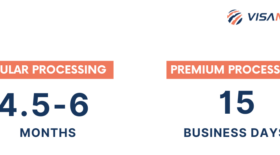
Purchasing premium processing only reduces the processing time for your I-129 petition. Once the receipt is confirmed by USCIS, the processing time is reduced to 15 business days. It does not make you cap-exempt, nor does it guarantee you a spot in the lottery. If your petition happens to be selected, then your start date will still be on or after October, like all other applicants.
If I have an Associate's (two-year) degree plus one year of work experience as an engineer, can I qualify for the H-1B visa?
You must have at minimum a U.S. bachelor's (four-year) degree or its equivalent to qualify for the H-1B visa. Regarding work experience, three years of working is equal to one year of university. For example, if you had six years of work experience plus two years of college, you could qualify if your work experience and the degree are relevant to your occupational title.
I currently have a job with a public school system as a teacher. Are schools subject to the annual quota?
Generally, public K-12 schools are subject to the H-1B annual quota. They are only cap-exempt if the school district has a formal affiliation with an institution of higher education or is a nonprofit entity related to a government research organization.
Because this exemption is not automatic, it is best to have legal counsel review the district's specific affiliation agreements.
Are there provisions for the continuity of H-1B petitions if there is a restriction on the company?
There is continuity in this case. An amended H-1B petition isn't required when a new entity takes over the originally approved employer's interests and responsibilities, whereas the conditions of employment are the same.
Under section 105 portability provisions, how does my employer complete the I-9 verification requirement?
This example is comparable to the 240-day grace period of 8 C.F.R. section 274.12(b)(20), which permits employment with the same employer for up to 240 days after an extension petition is filed.
Can I file multiple or duplicate petitions? What happens if I do?
Employers may not file more than once or file duplicate H-1B visa petitions for the same employee. USCIS will deny multiple or duplicate petitions filed by an employer for the same H-1B worker to ensure fairness.
Will USCIS refund my fees for filing twice?
You will not receive a refund for these filing fees. The only time that USCUS will issue a refund is if:
- USCIS has asked for an unnecessary form that required a fee
- You submitted a fee that was greater than what is listed
- USCIS fails to process a petition filed with premium processing in the 15 business day time period
Where do I mail my H-1B petition?
Your lawyer should have the correct service center's information to file with, which will depend on the beneficiary's work locations specified on the petition application. You can find the correct mailing address for the service center named on your Registration Selection Notice through this USCIS address page.
What is the H-1B visa 2026 lottery date?
The H-1B visa 2026-27 lottery selections will occur from March 4 - March 19. USCIS states they intend to notify prospective petitioners and representatives of their nominations by March 31.
What are the advantages of preparing early?
There are many advantages to preparing early. As with most situations in life, when you plan ahead of time, you're better able to respond to challenges down the road. Employers can begin considering which one of their workers might require H-1B cap-subject filings. Foreign nationals and their respective employers should work side-by-side throughout the process to meet all criteria.
What has the average denial rate been?
The average H-1B denial rate in FY 2025 was 2.15%
Why work with an attorney for the H-1B registration process?
First, the USCIS will not consider a cap-subject H-1B petition filed adequately unless the petition is based on a valid, selected registration for the same beneficiary and the appropriate fiscal year.
Proper H-1B registration includes ensuring the candidate is classified correctly under the master's or bachelor's cap. Only specific individuals qualify for the master's cap despite having U.S. master's degrees. In addition, only a certain number of years of work experience equals a bachelor's degree. Applicants cannot make corrections after submitting H-1B registrations. USCIS will deny incorrect H-1B registrations if the case is selected for filing.
Second, although petitioners can register multiple aliens during a single online submission, a petitioner may only submit one registration per beneficiary in any fiscal year. Suppose a petitioner submits more than one registration per beneficiary in the same fiscal year. In that case, all registrations filed by that petitioner relating to that beneficiary for that fiscal year will be considered invalid.
Third, petitioners have a small window to ensure the cases have the proper strategies and all documents required. Having an adequate case foundation at the outset is essential, whether the case is ultimately selected or not.
Hiring a qualified attorney to ensure that stage one of the process is handled correctly will prevent issues if the case is selected for filing.
What is the length of stay on an H-1B visa?
USCIS grants the visa for up to three years with the option to extend it to a maximum of six years. There are special cases where the government may give a stay longer than six years. This is usually in conjunction with a pending I-140 petition so that you can maintain your status while your green card case is pending.
What fees are my employer responsible for?
Per immigration law, the employer is responsible for paying:
- Registration Fee
- ACWIA Education and Training Fee
- USCIS Anti-Fraud Fee
- Public Law 114-113 Fee, if applicable
- Asylum Program Fee, if applicable
- Attorney fees, if applicable
Is premium processing an option for H-1B visas?
Yes, you have the option to elect for premium processing at a cost of $2,805. This fee will increase to $2,965 effective March 1, 2026. The employer or employee can pay this fee.
Could I avoid being subject to the cap if I filed for premium processing?
Filing for premium processing does not make you exempt from the cap. Premium processing is simply a way to expedite the process.
Who is responsible for setting the H-1B Visa 2026 cap amounts?
Congress determines the current annual cap for the H-1B visa category. Also, remember that USCIS sets aside 6,800 visas for citizens of Chile and Singapore following the Free Trade Agreement.
Certain H-1B workers who perform services for the Commonwealth of the Northern Mariana Islands (CNMI) and Guam may also be exempt from the cap under certain circumstances.
What is a Labor Condition Application (L.C.A.)?
A Labor Condition Application is what your employer must certify and send when filing your petition. USCIS will also accept a copy of this document. Always be mindful of the L.C.A. processing times and plan your documentation accordingly.
To get an L.C.A., your employer must make all of the four attestations required for this application:
- The H-1B employee will be paid the prevailing wage for the requested position based on the position's geographic location.
- The H-1B employee's employment will not negatively impact the current employees working for the employer.
- The employees currently working for the employer have been notified of the intent to hire the H-1B employee.
- The location in which the H-1B employee will be working is not under a strike or a lockdown.
Ultimately, the L.C.A. protects the current employees from incursions on their employment. By attesting that your employment is not to subvert or replace current employees' work, this tells the USCIS that your employment will benefit the U.S. job economy rather than damage it.
Note that if USCIS certifies an application for multiple workers, you must provide the name and case receipt number of any worker who previously used the L.C.A.
Does USCIS permit more than one sponsor for my H-1B Visa?
According to current regulations, if you as a foreign worker intend to perform services for more than one employer, each one must file a separate petition. However, if USCIS approved both petitions and you select one employer but later decide to leave that employer for the second one, no new petition is necessary.
However, if you choose to transfer your employment to an employer that has not yet filed a petition, you will need to have that employer file a new petition on your behalf.
How do I speed up or expedite my H-1B transfer?
An H-1B transfer must follow the same process as you would for filing a new petition. However, one big difference between the regular H-1B filing and a transfer is that a transfer is not subject to the cap since it already has an H-1B status. Because of this, premium processing may be an effective way to shorten your H-1B transfer processing time in 2026.
Can I work for my employer anywhere in the country once USCIS approves my status?
When USCIS approved your H-1B visa, they considered the specific employment location, qualifications, and prevailing wage for the area.
If the worksite changes, you must submit an amendment with certification for the new location during your employment. In some situations, you may be exempt from filing the amendment, but it's best to contact your lawyer if the terms of your job suddenly change.
Is there a reason some H-1B petitions take longer than others?
Many people have questions regarding this topic. Say, for example, you submit two petitions at the same time. That doesn't mean USCIS will necessarily approve it within the same time frame.
Why? Each USCIS service center has a different workload for H-1B visas, so it's hard to know when USCIS will process the paperwork. For short-on-time cases, it's best to consider premium processing.