




Hundreds of thousands of skilled immigrants compete for the highly sought-after H-1B visa each year. Since so many people register each year, USCIS places an annual limit on the number of H-1B visas issued and conducts an annual lottery to select the registrations. The competition for H-1B visas is fierce, and only a small percentage of applicants are chosen yearly. The demand for H-1B visas exceeds the supply, making it crucial to have a well-prepared and error-free application. An experienced immigration attorney is best equipped to help you increase the chances of selection.
In this guide, learn how to prepare for the H-1B visa lottery, learn the key updates, hear our predictions for the upcoming season, and keep the page bookmarked for results.
Contact VisaNation attorneys for filing your H-1B registration and petition.
How to Prepare for the 2026-2027 H-1B Visa Lottery
The H-1B registration period is from March 4 to March 19, 2026 – you would benefit significantly by beginning preparations as soon as possible. Registration involves submitting the beneficiary’s information along with a non-refundable $215 fee, which is much simpler and less expensive than filing the H-1B petition. The employer is responsible for paying the $215 registration fee.
H-1B Registration System
The lottery will continue to be based on unique beneficiaries, rather than the number of registrations made for them. However, it has been updated with a Weighted Selection system that will be used for the first time in the history of the H-1B lottery. With the new wage-weighted selection rule, the wage level of the position dictates how many entries the beneficiary has in the lottery. Ultimately, this system favors higher wage levels. Importantlym when a beneficiary has multiple registrations submitted by different employers, the beneficiary’s weighting in the selection pool will be based on the lowest wage level among all those registrations.
The agency has implemented several integrity measures in the registration process, including requiring the beneficiary’s passport info or travel document info and prohibiting the beneficiary from being registered under more than one personal identifier document.
USCIS will retain the right to deny or revoke any H-1B petition that’s been approved where the beneficiary has changed their personal identifying information. Thus, a beneficiary can have multiple registrations sent from different employers, but an employer cannot submit multiple registrations for the same beneficiary under multiple proposed job titles.
The online H-1B registration portal allows employers to submit one registration per beneficiary they are sponsoring. Start by creating a USCIS online account.
Every year, USCIS conducts a lottery of the submitted petitions and selects 65,000 from the regular H-1B cap and 20,000 from the Master’s cap, as in previous years.
Chilean and Singaporean citizens have 6,800 visas set aside as part of the Free Trade Agreement. On or before March 31, USCIS changes the registration statuses to reflect the winners. Those selected needed to have petitions filed and have been approved to obtain an H-1B visa. If USCIS chooses your registration, the soonest the employer can file your complete H-1B petition is April 1st, 2026 with a June 30, 2026 deadline.

Documents Required for All Registrations:
- Employer’s name, FEIN (identification number), address, contact information, and employer’s lawyer’s contact information
- SOC code and areas of employment.
- Beneficiary’s name, birthdate, home country, where they maintain citizenship, passport number, and gender
- The beneficiary’s academic transcripts or degrees, and a detailed, up-to-date CV.
Important H-1B Lottery Updates
The H-1B lottery for the fiscal year 2026-2027 comes with significant updates crucial for applicants and employers to understand:
1. Wage-Weighted Selection
One of the big changes from previous years, as outlined in an official USCIS rule, is the implementation of weighted selection. Instead of a lottery based on random selection, OEWS wage levels will determine the number of entries each registrant receives in the lottery, ranging from one entry (entry-level) to four entries (Level IV, the highest wage level). Learn more details about weighted selection in our comprehensive 2026-2027 H-1B cap guide.
2. $100,000 Fee for New H-1B Petitions Requiring Consular Processing
On September 19 2025, the trump administration introduced a Proclamation, Restriction on Entry of Certain Nonimmigrant Workers, a massive $100,000 fee targeting H-1B petitions for workers hired from abroad (any petitions that require consular notification). This fee will impact employers at the petitioning stage unless the Proclamation is paused or overturned by one of three major pending court challenges:
- Chamber of Commerce v. DHS
- California v. Noem,
- or Global Nurse Force v. Trump.
This 100,000 fee is required for new H-1B petitions for beneficiaries who require consular processing, port of entry notification, or preflight inspection notification. This includes those who live in a foreign country without a valid non-immigrant status, as opposed to those who live in the United States on a valid status like an F-1 student visa, who must adjust status rather than undergo consular processing.
3. H-1B Employment Start Date Policy Updates
Previously, employers were required to request a start date of October 1 of the applicable fiscal year. However, DHS has revised this requirement, permitting employers to request start dates beyond October 1, aligning with existing USCIS policy.
This change was implemented to provide greater flexibility to employers in planning and managing their workforce needs. By eliminating the restrictive regulatory text found at 8 CFR 214.2(h)(8)(iii)(A)(4), DHS has clarified that while October 1 remains the earliest possible start date for a given fiscal year, employers can now request later start dates that better align with their operational requirements.
It’s imperative to follow all the submission rules to ensure the greatest chances of approval.
4. Beneficiary-Centric Selection Process
USCIS continues to implement the beneficiary-centric selection process introduced in FY 2025. Under this system, each unique beneficiary is entered into the lottery once, regardless of the number of registrations submitted on their behalf. This approach aims to enhance fairness and reduce multiple registrations for the same individual.
5. Enhanced Online Filing System
USCIS introduced organizational accounts to facilitate the collaborative preparation of H-1B registrations and petitions. These accounts allow multiple representatives within an organization to work together on filings, streamlining the process. An organizational account is required to submit registrations for the FY 2027 H-1B cap selection process.
6. Increased Credit Card Transaction Limit
To accommodate the higher registration fee, the U.S. Department of the Treasury increased the daily credit card transaction limit from $24,999.99 to $99,999.99 for the H-1B cap season.
7. Self-sponsoring H-1B Visa
A major policy shift enacted in January 2025 allows H-1B beneficiaries who own a business, even with a controlling interest, to self-sponsor their H-1 B visa. This recent groundbreaking policy is significant for entrepreneurs, allowing beneficiaries to self-sponsor their H-1B status. It removes a major barrier for those who want to start or own a business in the U.S. and work for their company in H-1B status. Now, with this flexibility, entrepreneurs can legally establish and grow their businesses without having to find a separate employer to sponsor their H-1B.
This opens new doors for self-starters and innovators looking to establish themselves in the U.S. and contribute to its entrepreneurial landscape. This shift could also have wider implications for the startup ecosystem, making it easier for foreign-born innovators to bring their ideas to life in the U.S. It’s especially beneficial for those with controlling ownership interests, as they previously faced the challenge of finding an external sponsor or could not fit the traditional employer-employee model.
Are you a busienss owner interested in self-sponsoring for an H-1B Visa? Speak with VisaNation
8. Specialty Occupations
On January 17, 2025, a new H-1B rule went into effect, strengthening the definition of specialty occupations. This rule provides greater authority to the U.S. Citizenship and Immigration Services (USCIS) to deny or revoke approvals for employers who do not cooperate during site visits. It also streamlines approvals for extension petitions where deference to past decisions is warranted.
H-1B Lottery 2026-2027 Predictions
As we approach the 2026-2027 H-1B lottery, several factors, including political dynamics, increased registration fees, technological advancements, and anti-fraud measures, are poised to influence the number of registrations and the overall landscape of the program.
Prediction 1: Fewer Registrations, But Far More Intentional Filings
High-volume, speculative registrations are giving way to fewer, higher-stakes filings. Employers are shifting toward fewer filings that reflect genuine business necessity, defensible wages, and roles that are critical to operations.
With the possibility of the $100,000 H-1B fee standing in court, along with the new weighted selection format, we expect registrations to continue to drop. Additionally, the political climate has affected countries that have high participation rates in the lottery, due to the adjudicative hold placed on 39 countries and 75 countries on the immigrant visa processing pause.
The prospect of such a substantial fee is likely to lead many businesses to seek more financially feasible alternatives. Furthermore, under the weighted selection system, applicants in entry-level (Level I) positions now have a 75% lower chance of selection compared to Level 4 candidates. Consequently, many organizations that previously relied on entry-level talent may no longer be willing to pay the $250 registration fee.
Prediction 2: USCIS Will Continue Apply Anti-Fraud Measures
Following the FY 2025-2026 H-1B lottery, the US Department of Labor launched “Project Firewall”, an H-1B initiative created to protect the rights, wages, and job opportunities of highly skilled American workers.
USCIS is specifically ensuring that SOC codes and wage level determinations align through both the registration and petitioning stages to ensure that employers cannot game the system to have a higher chance of hiring their intended H-1B employee. The new rules grant USCIS explicit authority to deny or revoke petitions if it finds discrepancies between the registration data and the actual H-1B petition filing.
Prediction 3: Advanced Tech Demand Will Concentrate Selection Among a Smaller Talent Pool
Demand for AI, data engineering, cybersecurity, and advanced software roles remains strong, even as total registrations decline. Competition will become more concentrated around highly specialized candidates commanding Level III and IV wages, raising the bar for generalist and early-career professionals.
Prediction 4: Conservative Wage Positioning Will Invite More Scrutiny
Attempts to place roles just above Level I wages to balance cost and selection odds are likely to backfire. Positions that appear under-leveled relative to job duties are increasingly vulnerable to RFEs and post-approval challenges as USCIS tightens alignment between wages and role complexity.
Prediction 5: High-usage Countries Like India Will Feel the Shift First
High-usage countries such as India will feel the impact first and most sharply. For countries with historically high H-1B usage, particularly India, the combined effects of wage weighting, increased fees, and long green card backlogs will materially change employer behavior. Indian nationals with advanced degrees, niche expertise, and senior compensation profiles may see improved selection outcomes. At the same time, early-career professionals and traditional entry-level roles will face diminishing opportunities under the H-1B framework.
Maintaining long-term H-1B status for Indian nationals while waiting through multi-year EB-2 and EB-3 backlogs is becoming increasingly difficult to justify for employers.
Estimated H-1B Registrations for 2026-2027
Given these factors, we expect a drop in registrations compared to 2025-2026, but still a strong overall demand due to ongoing labor shortages in tech.
Projected Range: 200,000 –350,000 registrations
What to Do After Your H-1B Registration is Selected
If a beneficiary is chosen, all organizations that submitted a registration for that beneficiary will be notified and can file a petition for them during the petition filing period. USCIS plans to use passport information to identify beneficiaries.
Next, the officer will examine your case and determine whether you qualify for the H-1B. If your H-1B petition fails at this stage, USCIS will issue a denial. You will need extensive work to fix the petition. If it passes, USCIS will notify you, and you will be able to start working on or after October 1, 2025.
Understanding Your H-1B Status Under the H-1B Visa Lottery
There will be one of four statuses in the online portal indicated next to your case. They are explained below:
- Selected: If you see the word “Selected” as your status, that means USCIS chose your H-1B petition in the lottery, and your sponsor can file an I-129. Be aware that there may be staggered filing deadlines for different registrants to ease the processing flow.
- Submitted: This status means you have successfully submitted your petition. It does not mean USCIS has chosen you. It can have this status until as late as the end of the fiscal year. All registrations that have not been denied will read “Selected” or “Submitted” next to their status.
- Not Selected: The lottery did not pick your registration. It will read this status until October 1, 2025.
- Denied: If a sponsor submits more than one registration for the same beneficiary, USCIS will automatically mark all petitions from this sponsor as denied.
After the sponsoring employer is notified that their H-1B registration has been selected, it’s time to file the complete H-1B petition with all accompanying evidence. Again, we recommend you do this alongside a qualified immigration attorney to ensure all fields and documents are correctly included. Applicants should send the entire packet of information to the service center. Once they receive it, you’ll be issued a 13-digit USCIS case number.
If you are selected in the 2026-2027 H-1B visa lottery, contact VisaNation attorneys for filing your H-1B petition.
Form I-797C, Notice of Action is issued by USCIS to communicate information about receipt, rejection, transfer, reopening, or an upcoming appointment should you be selected in the lottery. In the example below (disclaimer – names, IDs and personal information have been changed for privacy), you’ll see it has the title Fiscal Year 2025 Selection, and then under it has the company, employer identification number, the person the registration was submitted on behalf of, and the confirmation number.
If selected, the next paragraph will say, “This registration was selected toward the number projected as needed to reach the congressionally mandated cap (regular cap).” In the next sentence, you will see what dates the company needs to file the corresponding H-1B petition. Be aware that no other beneficiary apart from the one identified in the I-797C may have a petition submitted. The petition should also include the start date of October 1, 2025.
Understanding H-1B Petition Receipt Numbers: Service Center Codes
Are you wondering what the numbers mean? The first three letters are the service center processing your H-1B petition. For example, if the Nebraska Service Center handles your case, the first three letters will be LIN. If the Texas Service Center handles your case, the letters will be SRC. Next, EAC indicates the Vermont service center. The last center is WAC for the California Service Center. The following numbers are the year, followed by the day, and the case number is the last five digits. An example number would look like SRC-15-021-93822. You can always check your USCIS case status at any time.

H-1B Application Deadline (FY 2026-2027) and Filing Tips
To help you prepare, take a look at these H-1B 2026-2027 application deadlines and helpful tips for filing your petition correctly while maximizing your chances of selection.
1. Timing is Key
The H-1B is unique in that there are specific dates that you must respect to qualify. Take note of the following H-1B 2026-2027 application deadline dates for the lottery system:
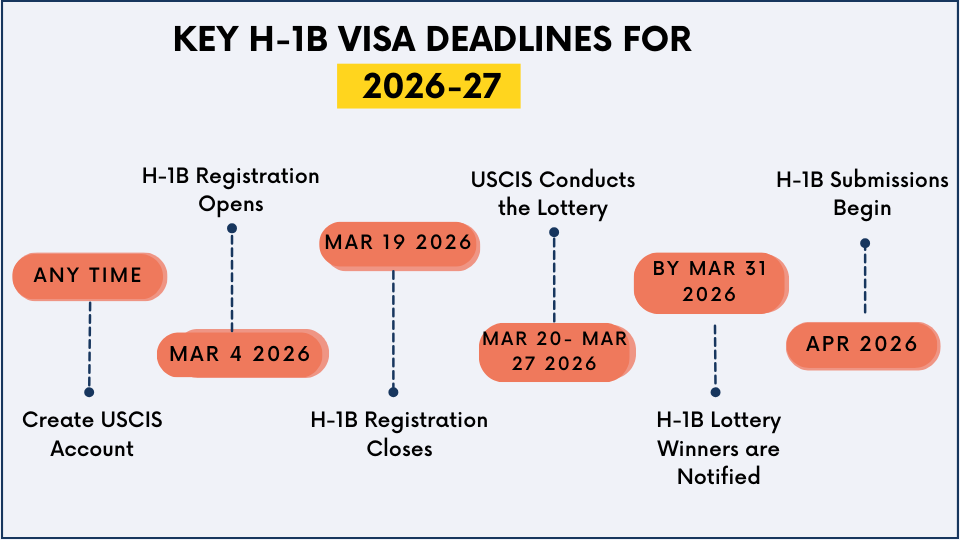
March 4 2026: Sponsors can submit H-1B registrations for their beneficiaries through their accounts at 12 p.m. Eastern Time.
March 19 2026: The USCIS will stop accepting registrations at noon Eastern Time.
March 20-27 2026: The H-1B Lottery selection process takes place.
March 31 2026: The USCIS will send selection notifications by March 31, 2026, via users’ USCIS online accounts to prospective petitioners and representatives by this date.
April 1st 2026: This is the earliest date for the H-1B cap-subject petition to be filed.
June 30 2025: Deadline to submit H-1B petitions under the regular lottery.
October 1 2026: The beneficiaries of approved H-1B petitions can work as H-1B employees as of this date.
2. Part-Time Work
The H-1B visa is not limited to full-time workers. If you only work part-time, this visa option may be for you.
3. Avoid Common H-1B Mistakes
To ensure that your H-1B petition has the best chance of approval, avoid these common pitfalls that tend to result in rejections:
- Ensure the SOC code, salary, and worksite location remain consistent in both the H-1B registration and petition. USCIS is paying close attention to these details as part of its actions to decrease fraudulent H-1B activities.
- If the employer’s FEIN is not recognized in the DOL FLAG system for an LCA, a pre-verification must occur. This can delay your ability to file the LCA and subsequently delay your petition approval by several days.
- Verify the filing location (lockbox) that will be receiving your petition. Sending it to the wrong center can seriously delay approval.
- Be sure to use an approved delivery method to submit your petition. USPS, FedEx, and UPS are all bonded delivery services that you can use.
- Work with your immigration attorney to ensure that your job description is thoroughly described in your petition.
- Combining your fee payments into one check may incur processing delays.
- USCIS no longer accepts checks, money orders, or cashier’s checks for most H-1B filing fees, requiring mandatory electronic payments via credit card (Form G-1450), direct debit from a U.S. bank account (Form G-1650/ACH), or potentially wire transfer for large amounts.
- Ensure that your I-129 start date is correct and does not contain any mistakes or typos.
- Make sure that the employer pays all mandatory fees. Should the USCIS learn that the employee paid these fees after the visa has been issued, there is a possibility the H-1B could be revoked.
4. Consider Alternatives to the H-1B Visa
If you and your immigration lawyer conclude that you do not qualify for the H-1B visa or another option would serve you better, here are some alternatives:
- If you are a Canadian or Mexican citizen, a TN visa may be a better option. This visa class has a limited list of eligible occupations but offers an easier application process and unlimited renewals.
- The J-1 visa allows people from various occupations to participate in a sponsored program. These include, but are not limited to, students, doctors, nannies, camp counselors, and professors.
- Under the L-1 visa, an employer can have executives, managers, or specialty employees from an office outside the U.S. to one within its borders. This can also be an excellent way to start a new branch or subsidiary in the U.S.
- The O-1 visa allows people with extraordinary achievements in their field to work in the U.S. for a period of up to three years with the possibility of extension.
Contact VisaNation attorneys for filing your H-1B registration and petition.
Possible H-1B Program Reforms in 2026-2027
One potential change to the H-1B lottery in 2026 is an overhaul outlined in the H-1B and L-1 Visa Reform Act of 2025 that, if passed, would shift the priority of the H-1B cap program to a ranked prioritization system in which the priority is given as follows:
- Those with an advanced STEM degree from a U.S. institution
- Applicants will be paid the highest prevailing wage levels based on the latest Occupational Employment Statistics survey (Skill Level 4).
- Graduates with any other U.S. advanced degree
- Petitions where the employer will pay the median wage for Skill Level 3.
- U.S. Bachelor’s STEM graduates
- Other U.S. Bachelor’s Degrees
- Schedule A: Shortage occupations
- Petitions from employers who meet strict compliance standards, such as good standing in E-Verify and no labor law violations in the past 5 years.
- Any other valid petitions that do not fall into the categories above.
H-1B Lottery Visa Fees in 2026-2027
Each H-1B registration requires a $215 registration fee that USCIS will not refund, even if you’re not chosen in the lottery. If USCIS selects a registration, the employer needs to subsequently file Form I-129 and pay the following H-1B visa fees:
|
Fee |
Amount |
Responsible for Fee |
|
$100,000 H-1B Supplemental Fee |
$100,000 - only for new H-1B petitions for beneficiaries outside the U.S. or those who require consular processing. |
Employer |
|
H-1B Lottery Registration Fee |
$215 |
Employer |
|
I-129 Petition Filing Fee |
$780 or $460 (small employers/nonprofits) |
Employer |
|
Public Law 114-113 Fee |
$4,000 (only if 50+ employees) |
Employer |
|
Premium Processing (optional) |
$2,805 (increases to $2,965 effective March 1, 2026) |
Employer or Employee |
|
ACWIA Education and Training Fee |
$750 (less than 25 employees) $1,500 (more than 25 employees) |
Employer |
|
USCIS Anti-Fraud Fee |
$500 |
Employer |
|
Asylum Program Fee |
$600 (if 26+ employees) |
Employer |
|
Attorney Fee |
Variable |
Employer |
VisaNation Attorney Fees
H-1B attorney fees differ tremendously depending on the firm. Since the stages are tiered, only certain companies will eventually file the complete petitions. VisaNation Law Group’s legal fees are tiered as follows:
- Stage One: $300 for the initial registration process, which includes all required preliminary case analyses.
- Stage Two: $2,600 will be due if the case is selected in the lottery for filing, including all form/support letter preparation plus case filing within the timeframe.
- If applicable, $500–$1,600 will be the cost of a Request For Evidence (RFE) response, should one later be issued on the case.
- Dependents H4: $550
Only after USCIS confirms that your registration has been selected in the cap lottery can you retain VisaNation for filing.
*April 1st is the earliest date that selected FY 2025-2026 H-1B cap-subject petitions may be filed.
H4 Dependent Fees (if applicable):
- Form I-539 (Application to Extend/Change Nonimmigrant Status):
- Paper Filing: $470
- Online Filing: $420
- Form I-765 (Application for Employment Authorization):
- Fee: $410
- Note: This fee is required for H-4 dependent spouses seeking employment authorization
The process of going from an H-1B visa to a green card should remain the same for the 2026 season. Learn more in this H-1B to Green Card complete guide!

Looking Ahead: H-1B Registration Trends
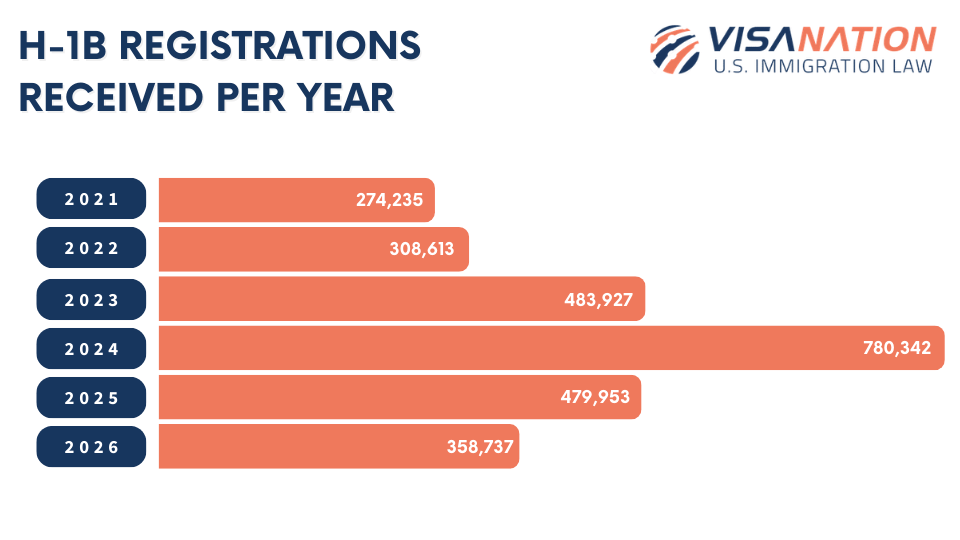
The United States benefits greatly from overseas talent to fill labor shortages across industries. According to the American Immigration Council the median wage for H-1B workers in 2022 was $108,000. Contrast that to the median wage of U.S. workers of $45,760. Below is a chart comparing the H1B registrations received year-over-year beginning from 2021 and extending to the last fiscal year. You can see a significant increase in 2024, the most registrations by far.
FAQs
Our attorneys are often asked many questions about the H-1B lottery. Below, we have compiled a list of the answers to the most commonly asked questions about this topic:
If I file for a beneficiary in the master’s cap, assuming they will have earned their qualifying degree by that time, but they fail to do so, and my registration has been selected, what happens?
Failing to earn a qualifying master’s degree or higher when filing the H-1B petition will lead to a denial.
“If a registration is submitted requesting consideration under the INA 214(g)(5)(C) advanced degree exemption because the beneficiary has earned, or will earn prior to the filing of the petition, a master’s or higher degree from a U.S. institution of higher education, and the registration is selected under the advanced degree exemption, the beneficiary must be eligible for the advanced degree exemption at the time of filing the I-129 petition.”
Can I appeal my H-1B registration, which is marked as an invalid duplicate?
You can’t appeal H-1B registrations USCIS marked invalid due to being a duplicate. For this reason and many more, it’s highly advised to file with the help of a qualified H-1B lawyer.
How can I stay updated on the H-1B changes?
The best way to stay updated is to subscribe to our monthly newsletter and work with a qualified immigration professional throughout the process.
How will I know if my H-1B registration has been selected?
According to USCIS, on March 31, you can log onto your USCIS online portal, which should show that the status of your H-1B registration has changed, though it may also have stayed the same.
What is a Request for Evidence (RFE)?
A Request for Evidence is when USCIS needs more information to decide whether to approve it or deny it. Therefore, it’s critical to respond to the RFE within the specified time window. There are three ways you and your lawyer can respond to one.
The first approach is a full response. Then, as the name implies, you submit all the requested evidence to USCIS along with your response.
The second approach is a partial response, and these tend to be the most common. With this response, you only submit some of the evidence USCIS requests, either because it would be better for your case not to submit it all, or you do not have access to the evidence they are asking for.
The third approach is no response. You and your legal counsel should always discuss the best method to respond to RFEs together.
Is there a grace period if I lose my H-1B job?
If you lose your job under H-1B status, USCIS will grant a 60-day grace period that starts on the day that your H-1B sponsored employer no longer employs you. You can either find a new sponsor, change your immigration status, or leave the United States entirely in this time frame.