A green card application denial is a devastating immigration setback that no visa applicant wants to experience. A denial can be particularly painful for the EB-2 green card, due to the time, effort, and money invested into the process. However, knowing the common errors that lead to green card denial will help you prevent mistakes in your petition. Also, if your EB-2 visa application has been denied, this article provides you with some options to explore to reverse the decision. Learn how to handle a case where your I-140 is denied and the next steps!
Speak with a Qualified EB-2 Attorney
✅ Backed by a 4.9 ⭐ Google rating and 18+ years of immigration law experience.
What Are the EB-2 Denial and Approval Rates?
According to FY 2025 data for Q1-Q3, EB-2 I-140 petitions have a denial rate of 18.1% (10,965 denials out of 60,494 total decisions). The approval rate for EB-2 I-140 petitions was 81.9% (49,529 approvals out of 60,494 total decisions).
EB-2 NIW AND Perm Approval Rates
Between the two categories, NIW and standalone EB-2 (PERM-based applications), EB-2 NIW applications had a higher denial rate at 38.8% (approval rate of 61.2%), compared to PERM-based applications, which had a denial rate of 1.3%. (approval rate of 98.7%).
EB-2 and EB-2 NIW Approval Rate | |||
Category | Approved | Denied | Approval Rate |
EB-2 (PERM) | 32,923 | 446 | 98.7% |
EB-2 (NIW) | 16,606 | 10,519 | 61.2% |
EB-2 Total | 49,529 | 10,965 | 81.9% |
💡 VisaNation Tip
Our legal team has reported that EB-2 NIW applications are currently under increased scrutiny, with data over the last fiscal year showing a steep increase in denials. The increasing scrutiny by USCIS adjudicating officers requires a strategic adjustment. When choosing an attorney, it’s important to work with an immigration specialist who has a proven track record in self-petitioned cases and a high success rate in responding to complex Requests for Evidence (RFEs).
VisaNation Managing Attorney
Common Reasons for EB-2 Denial: The Three Key Stages
Your EB-2 visa application can be denied for several reasons, including ineligibility as an applicant, errors made during the application process, or issues related to inadmissibility. If USCIS denies your EB-2 visa application, the denial letter will state the specific reason. However, if you are just about to or are in the process of filing your petition, you should learn the common denial reasons you might encounter and how to avoid them.
As the EB-2 green card application involves several stages, an applicant can experience a denial at any one of these stages:
- The Permanent Labor Certification Process
- The I-140 petition, and National Interest Waiver (NIW) if applicable
- Adjustment of Status Application
Stage One: PERM Labor Certification Denial Reasons
The EB-2 visa application generally requires that petitioners (employers) complete the U.S. Department of Labor (DOL) PERM certification process. The PERM ensures that no willing and qualified U.S. workers are available for the position in question.
Prevailing Wage Issues
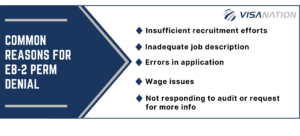
Prospective U.S. employers must pay the prevailing wage or higher based on the prevailing wage determination. The labor certification application may be denied if the employer fails to specify a wage that is at least the required prevailing wage.
The employer can prevent this by requesting a prevailing wage determination from the DOL and entering in that amount or higher on the ETA 9089.
Inaccurate Job Description or Requirements
The job description and requirements the employer provides must accurately reflect the position’s duties and required qualifications. The labor certification may be denied or audited if the job description is unclear or the requirements are unreasonable or unrelated to the position.
Audit Shows Insufficient Recruitment Efforts
The DOL sets specific guidelines that require employers to conduct thorough recruitment efforts to demonstrate that no qualified U.S. workers are available for the job. The DOL may deny the labor certification if an audit shows recruitment efforts were insufficient or failed to meet the regulatory requirements. Due to random and targeted audits or requests for information, carefully documenting how the employer followed every step of recruitment is paramount to avoid a denial.
Inconsistencies or Errors in the Application
Incorrect information, missing documents, or failure to follow proper procedures can lead to the denial of the labor certification.
Failure to Demonstrate a Bona Fide Job Opportunity
If the job opportunity is not genuine or there is evidence of misrepresentation or fraud, the labor certification will be denied.
Failure to Respond to an Audit or Request for Evidence
The labor certification may be denied if the employer doesn’t respond to an audit or doesn’t provide information within the specified timeframe.
Failure to Respond to the Email Questionnaire
After submitting the ETA 9089 form, the DOL may send an email directing the petitioner to answer some questions about the application. Your employer must reply to the questionnaire within seven days of receipt. If your employer fails to do so within the given timeframe, the PERM certification application will likely be denied.
Inadequate Documentation
The employer is responsible for providing supporting documents to establish the job requirements, recruitment efforts, and other necessary information. If the documentation provided is insufficient, incomplete, or does not meet the DOL’s standards, the labor certification may be denied.
Improper Filing of the ETA 9089 Form
If the information on the ETA 9089 does not match the job offer’s information, this might lead to denial.
Failure to Adhere to Advertising Guidelines
Prospective employers sponsoring an EB-2 visa must advertise the position in major publications. They must strictly follow the advertisement guidelines. One of the requirements is that the employer publishes the ads in a major newspaper on two different Sundays. The PERM application can be denied if a petitioner fails to comply with those instructions or any others.
It also protects the applicant’s interest by ensuring the employer pays the prevailing wage for that position. DOL must grant you the PERM labor certification application before you can continue with other EB-2 application processes. The only exception to this is if you qualify for an NIW.
Stage Two: I-140 Denial Reasons
Failure to Detail the Beneficiary’s Work Experience
In the ETA 9089 form, you must include the EB-2 visa beneficiary’s skills, work experience, and other information showing your eligibility for the position. Additional information, such as your place of birth and academic qualifications, must also be provided to help the adjudicating officer determine your eligibility.
Employer Fails to Prove They Have The Ability to Pay The Prevailing Wage
During the PERM process, the employer simply attests that they will pay the required prevailing wage. It is USCIS, during the I-140 stage, that demands proof. They will scrutinize the employer’s federal tax returns, audited financial statements, or annual reports to confirm that the company has had the financial ability to pay the proffered wage from the PERM’s filing date (the priority date) onwards.
The Position Does Not Qualify for the EB-2 Category
A position is only qualified for the EB-2 visa category if it requires a doctorate, master’s degree, or bachelor’s degree with at least five years of relevant work experience. Any inconsistency between the wording in your PERM certification and the I-140 petition can lead to a request for evidence or even a denial.
For instance, if it was stated in the PERM application that the position only requires a bachelor’s degree and that your employer will accept a three-year bachelor’s degree, such a position will likely not be considered qualified for the EB-2 visa. A three-year bachelor’s degree will be considered not equivalent to a U.S. four-year bachelor’s degree. Many EB-2 green card applications are denied based on this common error.
Beneficiary Does Not Qualify for the Position
In the I-140 stage, the petitioner must include supporting documentation that proves to USCIS that the beneficiary has the qualifications for the position as stated in the PERM process, such as a specific diploma/transcript and a detailed CV outlining experience in the intended field. USCIS officers will carefully compare the attestations made in the ETA 9089 form with the evidence in the I-140. If there is any discrepancy or if the documents are not convincing, they will likely deny the I-140.
Stage Two A. National Interest Waiver Denial Reasons
The National Interest Waiver (NIW) is a special feature of the EB-2 visa application that allows applicants to circumvent the PERM Labor Certification requirement and avoid having a sponsoring employer. You must prove that you possess exceptional field ability and must meet the other eligibility criteria. You must also demonstrate that the United States will greatly benefit if USCIS waives the labor certification requirement. With an approved NIW, you can self-petition for your I-140 without the employer sponsorship, as the NIW waives the labor certification requirement.
While the points below are not a comprehensive list of all the NIW denial reasons, they are good to remember for your case.
Failure to demonstrate national importance
The applicant must prove that their work is of substantial intrinsic merit and has a national impact or significance. If the evidence presented does not convincingly establish the national importance of the applicant’s work, the NIW may be denied.
Inadequate evidence of exceptional ability
To qualify for an NIW, applicants must demonstrate exceptional ability in their field. If the evidence provided does not sufficiently establish exceptional ability, the NIW may be denied.
Doesn’t show a substantial benefit to the United States
Applicants must demonstrate that their work will substantially benefit the United States by promoting economic growth, improving healthcare, advancing scientific research, or addressing national security interests. If the evidence provided fails to establish a substantial benefit to the country, the NIW may be denied.
Insufficient documentation or support letters
The applicant is responsible for providing comprehensive documentation and support letters from experts in their field who can attest to the applicant’s qualifications and the national importance of their work. If the documentation or support letters are lacking or do not meet the required standards, the NIW may be denied. Discuss this more in-depth with your immigration attorney to strengthen your support letters.
Inconsistencies or errors in the application
Mistakes or inconsistencies in the application, such as inaccurate information, missing documents, or failure to follow the proper filing procedures, can lead to a denial of the NIW.
Failure to meet the legal requirements or submit the required documents
USCIS has specific requirements for NIW applications, including submitting the required forms and supporting documents. If the applicant fails to meet these requirements or neglects to submit essential documents, the NIW may be denied.
Myths About National Interest Waivers
One common myth you may have heard is that if you have a work permit and have applied for an adjustment of status at the same time, then USCIS will approve your EB-2 NIW. This is not the case, and your application can still get denied since the adjustment of status application will most likely have an application for work authorization and travel accompanying it.
It is very likely that the EAD and travel permits get processed first, so you receive those before your EB-2 NIW petition is even processed. If USCIS denies the EB-2 NIW, then USCIS will terminate your work authorization, and you’ll get a letter from USCIS stating the reason for the denial. The best way to ensure a favorable outcome is to work with a qualified immigration specialist from VisaNation.
Another myth you may have heard is that you can qualify for an NIW with a degree and many years of work experience. These alone are not sufficient. You still need to pass the three-prong test mentioned above.
Stage Three: Adjustment of Status Denials
Even if your PERM labor certification and I-140 are approved, your EB-2 application can still be denied at the Adjustment of Status stage.
Just like most other employment-based green card applications, an employer will sponsor your EB-2 visa. After the I-140 is approved and the priority date is current, applicants may be eligible to apply for permanent residency. However, if your I-140 is denied based on ineligibility for the EB-2 visa, all other related applications filed for that visa category will also be denied, including the I-485 (Adjustment of Status), I-765, and I-131 forms.
Inadmissibility Issues
Common grounds for inadmissibility include:
- a criminal history
- unlawful presence
- medical ineligibility
- or security concerns.
Failure to Maintain Lawful Status:
With some exceptions, an applicant must have maintained a continuous, lawful immigration status in the U.S. to be eligible to adjust their status. Unauthorized employment or overstaying a previous visa can lead to denial.

What to do if your EB-2 Visa is denied?
Whether you have already received a denial letter or you are still processing your application, the good news is that your EB-2 visa denial doesn’t necessarily mean the end of the process. There are certain provisions that you can explore to get a favorable decision.
However, it is best that you involve an experienced immigration attorney when doing this. You need an expert to help you argue your case as to why you deserve a favorable decision. The following are some of the available routes to take after a denial:
1. File a Motion
You can file a motion requesting that the USCIS reopen or reconsider your case. A motion to reopen must be based on new facts and supported by documentary evidence. This means that you now have different evidence from what was previously submitted.
A motion to reconsider is used to establish that the officer based their decision on an incorrect application of the law. You must submit your motion to reconsider with relevant precedent, statutory provision, adopted decision, or a statement by the USCIS. Both motions to reopen and reconsider may be combined in your request.
2. Appeal the Decision
You can also appeal the decision if you feel it was wrongfully made. Your appeal will be reviewed by the USCIS office issuing the denial.
The office will determine whether to make a favorable decision and grant your request or uphold the denial. If the office does not reverse the decision, it will forward your appeal to the Administrative Appeals Office (AAO) for review.
You may have your case resolved at the USCIS office’s initial review or the appellate review by the AAO.
3. Explore Other Visa Types
You may want to try other visas if you have tried the above avenues and the denial is not overturned. Though not ideal, it may be the only way to obtain your green card.
If you haven’t committed any crime or contracted any infectious disease that can make you inadmissible, you can explore the EB-3 or a family-based green card.

Avoiding Overstay After EB-2 Green Card Denial
If you experience an EB-2 denial, it’s important to maintain your immigration status and avoid overstays. If you are on a non-immigrant status like the L-1 or H-1B, it’s critical to check how much time you have remaining on your I-94.
However, if your nonimmigrant status has already expired and you were staying in the U.S. because you had a pending green card application (I-485), the situation is much more urgent. It’s important to speak with a qualified immigrant attorney to understand your options and avoid accruing unlawful presence after the denial.
How VisaNation Can Help
Over the past year, the denial rate of EB-2 applications has increased. A top reason is that many applicants would rather go through the visa process alone instead of hiring professionals from the beginning. No matter how qualified or exceptional you may be, USCIS will deny your EB-2 visa if your application doesn’t meet the standard. Especially with the increased scrutiny these applications are facing, your best bet is to hire a professional EB-2 immigration lawyer to avoid an I-140 denied situation.
VisaNation Law Group’s team of highly experienced green card attorneys has a long track record of EB-2 visa successes. They can help you gather evidence, prepare reference letters, and file petitions for you. Also, they can help you appeal the decision if your application has already been denied.
Speak with a Qualified EB-2 Attorney
✅ Backed by a 4.9 ⭐ Google rating and 18+ years of immigration law experience.