



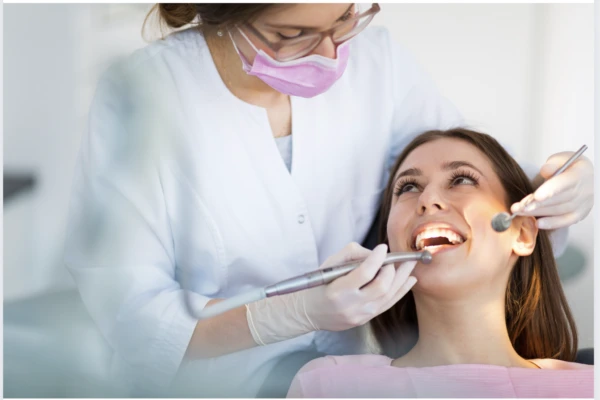
The U.S. faces a growing shortage of dental professionals, according to the Health Resources and Services Administration (HRSA). Immigrant dentists play a critical role in filling this gap, especially in underserved communities. If you’re a foreign-trained dentist, there are several U.S. immigration pathways available to live and work in the United States. This guide will explore your options and how to navigate the process.
Are you a dental professional seeking immigration support? Contact VisaNation
U.S. Work Visa for Dentists: What Are the Options?
The first thing you should ask yourself is: Do I want to immigrate to the U.S. permanently or temporarily? This will help you decide whether to get an immigrant visa (green card) or a non-immigrant visa (temporary work visa). In many cases, dentists and other immigrants get a nonimmigrant (temporary work) visa and use it to transition to permanent residency (green card) later on.
Take a look at some of the more suitable options for a U.S. work visa for dentists:

H-1B Visa for Dentists
The H-1B visa is the most common U.S. work visa for dentists because of its accessibility. To qualify, you only need to have a job offer for a specialty position in the U.S. and have at least a bachelor’s degree in a field related to your occupation. If you are a dentist seeking to work for a network or professional group based in the U.S., then this visa may seem perfect.
Because the H-1B is so popular, hundreds of thousands of people petition for it each year. This led to USCIS placing an annual limit on the H-1B visas issued annually. USCIS holds a lottery to randomly select H-1B petitions from two different cap groups.
- The first round is for everyone with a bachelor’s degree or higher, with 65,000 under the regular cap.
- The second round is the master’s cap, which is for those with advanced degrees. When selecting petitions, the USCIS randomly selects 20,000 from this category,
Because so many people petition in the regular cap, the odds of selection can be relatively low. However, because you are a dentist and therefore likely have an advanced degree, you will have two shots at an H-1B visa: one during the regular cap and another under the master’s cap, increasing your chances significantly.
VisaNation Tip
Additionally, you may be eligible to apply for a role through a cap-exempt organization. These organizations can sponsor an H-1B applicant throughout the year due to a special status. Examples would be an institution of higher education that employs dentists in faculty, clinical, or research roles or a nonprofit that hires a dentist to perform clinical research at a nonprofit medical research center. Via this route, you do not need to compete in the competitive H-1B lottery.

Eligibility Requirements
These requirements must be satisfied for the H-1B dentist classification:
- Hold a D.D.S. or D.M.D.
- Obtain a credential evaluation if your degree is from outside the U.S.
- Pass the National Board Dental Examination (NBDE)
- Hold a valid state dental license in the state where you intend to work
- State-specific clinical exams (if applicable)
Check the specific state licensure requirements for the most up-to-date information.
The H-1B visa has some restrictions on dates. Your employer cannot petition until April 1st of the year you wish to work. Also, if your petition is selected and approved, you cannot begin working until October 1st. If you do obtain an H-1B visa, you can stay in the U.S. for up to six years.
Because the H-1B is a dual intent visa, you will be able to pursue your green card while on H-1B status.
TN Visa
If the H-1B cap lottery causes you concern, then the TN visa might be a better option. While it serves as a more versatile visa than the H-1B, the TN Visa is exclusive to citizens of Canada and Mexico.
- Being a legal permanent resident of either country is not sufficient.
- There is a limited list of occupations that qualify for the TN. Fortunately, dentistry is on the list.
If you are a dentist with Canadian or Mexican citizenship, you will need to show that you either have the appropriate professional degree or a state/provincial license to practice dentistry in the U.S.
Once issued, you will be able to stay in the U.S. for three years with the opportunity to extend your visa an unlimited number of times in three-year increments. (TN visas a issued in 1-year increments but can be extended.)
Requirements
To be eligible for a TN for dentists, you must have one of the following qualifications:
- Doctor of Dental Surgery or Doctor of Medicine in Dentistry Degree
- Doctor en Odontologia or Doctor en Cirugia Dental
- State/provincial license
Be prepared to show evidence that you have your degree or licensure in dentistry from Canada/Mexico/U.S.
However, the TN visa is not a dual intent visa, meaning that you must maintain the intention of returning home after your stay is over.
VisaNation Tip:
Pursuing a green card while on TN status could result in consequences to your current status and future immigration opportunities. While getting a green card in this situation is possible, it is not advised without the help of an attorney.
J-1 Visa
The J-1 visa is a common U.S. work visa for dentists because it is suitable for medical students. Rather than have a sponsoring employer, J-1 holders have a sponsoring program that dictates their employment and length of stay in the U.S.
However, like the other visas, there is a catch. Once you complete your J-1 visa stint, you will need to fulfill the home residency requirement, which requires J-1 holders to spend two years in their home country after their stint before obtaining another visa or green card.
To circumvent the home residency requirement, one can obtain a J-1 visa waiver. You can qualify for this if you:
- Get a “no objection” statement from your home country’s government
- Have a U.S. federal agency request that the home residency requirement be waived
- Demonstrate that you would likely experience persecution if you returned to your home country
- Show that returning to your home country would cause extreme hardship to a U.S. citizen (or lawful permanent resident) spouse or child
- Request by a designated State Public Health Department or its equivalent (Conrad State 30 Program)
If you are interested in getting your green card, then you can apply at any time during or after your J-1 visa period of stay, even if you are subject to the home residency requirement. However, you will not be able to have your status adjusted until you either fulfill the requirement or obtain a waiver.
EB-2
One common green card option for dentists is the EB-2 green card. As the second-highest preference level in employment-based green cards, the EB-2 has relatively high requirements. Applicant must either:
- An advanced degree (U.S. master’s or foreign equivalent) in his or her field
- Possesses exceptional ability in their field.
Fortunately, there is a good chance that you have an advanced degree to practice dentistry, thereby qualifying you for the EB-2.
EB-2 NIW
Perhaps the best option for a U.S. work visa for dentists is the EB-2 with a National Interest Waiver (NIW). While the EB-2 requires a sponsoring employer to offer you a job and acquire a PERM on your behalf, the NIW allows you to waive those requirements and self-petition without the need of an employer.
This is perfect for dentists who wish to start their own practice in the U.S.
To qualify for the NIW, you must prove three things:
- That your work will benefit the nation’s health, education, culture, society, job market, economy, etc.
- That you are uniquely qualified to advance your work and make it succeed. This can be proven through your degree, your experience in dentistry, your past successes, and a comprehensive business plan for the practice you plan to open in the U.S.
- The U.S. would benefit more from waiving the PERM and job requirement than enforcing it.
VisaNation Tip
A successful NIW petition relies on the dentists showcasing to USCIS how their proposed endeavor substantially benefits the United States. Simply filling a shortage is not enough – a dentist must be ready to evidence that their work will have signficant impact, such as providing dental services to rural or low-income communities that lack access to proper dental care, introducing innovative dental research on new dental treatments or technologies, or improving the quality and affordability of dental care across the U.S.
To apply for the NIW, you need to indicate it on your EB-2 petition along with a petition letter, an employment certification form, and letters of recommendation from peers and distinguished contemporaries in your field. NIW applicants must still meet the EB-2 qualifications as well.
EB-3 Green Card
The EB-3, like the EB-2 category, is for those who are professional and skilled workers. The EB-3 requires at least a U.S. baccalaureate degree (or foreign equivalent) and a job offer with labor certification. In most instances, an EB-2 or NIW is more ideal due to longer wait times and fewer benefits with EB-3.
Choosing the best path to residency in the U.S. requires careful planning and the assistance of a qualified immigration professional. There are several options that all come with their respective pros and cons. In the best-case scenario, if your goal is to live permanently in the United States, then you will be able to with a dual intent visa. If you’re ready to take the next steps, contact us to learn about the process in depth.
- H-1B Visa: Competitive, dual intent, allows eventual green card transition.
- TN Visa: Quick and renewable, but only for Canadians/Mexicans and not dual intent.
- J-1 Visa: Often used for training, but requires home residency or waiver.
- EB-2 / EB-3: Green card pathways requiring job offers, degree, and labor certification.
- EB-2 NIW: Self-petitioning green card option ideal for dentists setting up a U.S. practice.
How VisaNation Can Help
While there are many visa options in the U.S. for foreign dentists, selecting the right choice based on your situation can be difficult. If you are a dental professional who wishes to preserve his or her practice through a U.S. work visa for dentists, our legal team can support you. Whether for an H-1B or an EB-2, the best way to ensure that your petition is optimized for approval is to hire an immigration attorney.
We recently represented a Periodontist from Taiwan seeking an H-1B visa to work across three different dental offices in New York. The complexity of the case lay in proving that the “specialty occupation” and valid employer-employee relationship existed across all separate locations. By presenting a comprehensive legal argument that detailed her advanced surgical duties and the petitioner’s direct supervision structure, we secured the H-1B approval despite the multi-site challenges.