The K-1 visa (fiancé visa) is for U.S. citizens who wish to bring their foreign national fiancé(e) to the U.S. so they can marry and begin their life together here. However, both the U.S. citizen (sponsor) and the foreign fiancé(e) (beneficiary) must meet certain criteria before they can even apply!
Reunite with Your Fiancé(e) Sooner
What is a K-1 Fiancé Visa?
A K-1 fiancé(e) visa is a visa that allows a foreign-citizen fiancé(e) to travel to the U.S. and marry their U.S. citizen spouse. Once the visa is issued, the couple must marry within 90 days of the foreign fiancé(e) entering the U.S.
Sponsor Eligibility Criteria
Several requirements must be met for a K-1 visa application to be approved:
1. Sponsor must have U.S. citizenship
The K-1 sponsor must be a U.S. citizen. A lawful permanent resident cannot sponsor a K-1 visa. Both the U.S. citizen sponsor and the foreign fiancé(e) must be at least 18 years old to file for a K-1 visa.
2. Must be legally free to marry one another
This means you both meet all the legal obligations that are required to get married in the United States. This includes terminating previous marriages if either of you has been previously married.
The previous marriage must have been legally terminated by divorce, annulment, or death. You will need to provide proof to support this before you can be deemed qualified for K-1 visa sponsorship.
Find out how to get a green card without sponsorship.
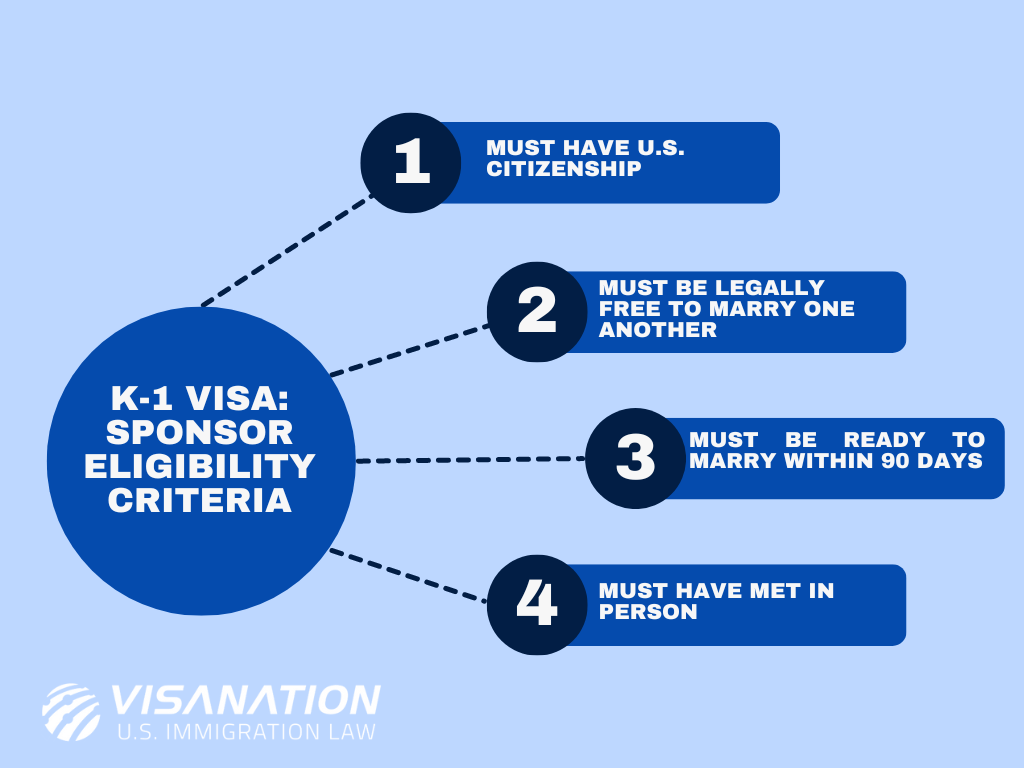
3. Must be ready to marry within 90 days
You and your fiancé(e) must be ready to marry within 90 days of his or her admission into the U.S. on a K-1 visa. You must provide a signed statement showing your intention to get married within that period.
It will also be helpful to have other evidence to back this up, such as a courthouse wedding appointment. If you have already printed your wedding invitations and made payments associated with the wedding, you can include copies of the invitation card and receipts of payments for wedding items as supporting documents to prove this requirement.
There is a validity period of four months to use the K-1 visa to travel to the U.S. and enter.
Find out how much a K-1 visa costs.
4. Must have met in person
You and your fiancé(e) must have met each other in person at least once within the two years leading up to your petition. You will need to provide proof of this meeting with evidence such as photographs, hotel reservations, plane tickets, etc.
NOTE: Phone conversations, social media chatting, video calls, and other meetings by electronic means will not count as meeting in person. However, you may request a waiver for the “meeting in person requirement” if you can show that meeting your fiancé(e) in person would:
- Violate the strict customs of your fiancé(e)’s foreign culture; or
- Result in extreme hardship to you, the U.S. citizen sponsor.

Not sure where to start with your K-1 application? We can help
K-1 Visa Income Requirements for Sponsor
To qualify, you will need to sign a Declaration of Financial Support showing your readiness and financial ability to provide your foreign fiancé(e) with the needed financial support. The Declaration of Financial Support document for the K-1 visa is officially known as the I-134. In the form, your income must indicate your ability to provide for yourself, your sponsored fiancé(e), and any other dependent member of your household. Check out this I-134 – Declaration of Financial Support.
The minimum required income is 100% of the United States Department of Health and Human Services (HHS) minimum poverty guidelines. Currently, the minimum requirement if you live in any of the 48 contiguous states is $21,640 for a household size of two. For each additional person, just add $5,680 to get the accurate figure.
|
Number of People in Family |
100% of HHS Poverty Guidelines |
|
2 |
$21,640 |
|
3 |
$27,320 |
|
4 |
$33,000 |
|
5 |
$38,680 |
|
6 |
$44,360 |
|
7 |
$50,040 |
|
8 |
$55,720 |
However, if you live in Alaska or Hawaii, the amounts differ slightly. This is due to the higher cost of living in those two states. Here are the full details of the income requirements for a K-1 visa sponsor.
Can I Use A Co Sponsor for a K-1 Visa?
If you don’t meet the K-1 income requirement, you can generally add a co-sponsor to assist with the filing.
It’s important to prepare your financial evidence early, as delays in gathering documents can impact your case timeline.
K-1 Visa Sponsor: Processing Timeline and Steps
The process for bringing your foreign fiancé(e) to the United States involves different stages with different immigration agencies. They are the U.S. Citizenship and Immigration Service (USCIS), the Department of State (DOS), and the agency for Customs and Border Protection (CBP). Each stage of the K-1 fiancé(e) visa process is explained below:
Step 1: File 1-129F, Petition for Alien Fiancé(e)
This is the first form to be filed by the U.S. citizen fiancé(e). The I-129F is filed to petition the USCIS to recognize the relationship between you and your fiancé(e). You must prove the validity of your relationship with documentary evidence showing you have a genuine relationship with your foreign fiancé(e). You must submit the supporting documents listed below with the form:
- Proof of your U.S. citizenship – a copy of your passport, naturalization certificate, or birth certificate
- Copy of your fiancé(e)’s passport
- Proof of a past meeting in person within the past two years before filing the petition
- Written and signed sworn statements by each partner describing the nature of your relationship, as well as your intention and readiness to marry within 90 days of your fiancé(e)’s arrival in the United States
- One passport photo of you and one passport photo of your fiancé(e)
- If your fiancé(e) has visited the U.S. before, you may also submit a copy of their previously issued I-94 arrival-departure record
Immigration can be a daunting process for someone who is doing it for the first time. With numerous forms and documents to submit, mistakes can be very costly. Need experienced help? At VisaNation, we make sure that your application is flawless.
It’s Time to Reunite with Your Fiancé in the U.S.
Step 2: DS-160 for K-1 Nonimmigrant Visa Application
The U.S. embassy or consulate where your fiancé(e) lives will receive the approved I-129 from the NVC. Your fiancé(e) will then need to apply for a K-1 non-immigrant visa at the embassy or consulate. You will receive a message from NVC stating the scheduled date and location of the K-1 visa interview for your fiancé(e) in that country.
Before the interview date, the foreign fiancé(e) will need to complete the DS-160 application online, otherwise known as the Online Nonimmigrant Visa Application. He or she will need to print the confirmation page of the form and keep it as one of the documents for the K-1 visa interview. The DS-160 must be submitted along with the following supporting documents:
- These documents are the responsibility of the sponsored fiancé(e):
- Two passport photographs
- Valid passport
- Birth certificate
- Sealed immigration medical exam form. (See the complete immigration medical examination guideline.)
2. The following documents are the responsibility of the K-1 visa sponsor:
- I-134 Declaration of Financial Support
- Most recent tax return
- Copy of the approved I-129F from the USCIS
It is within the discretion of DOS to either approve or deny your fiancé(e) a K-1 visa. If the application is approved, the foreign fiancé(e) will be issued a visa, which will allow him or her to travel to the U.S. and seek admission at a port of entry.
K-1 Visa Processing Times
VisaNation is currently seeing K-1 fiancé(e) cases processed from start to finish within 12-15 months.
The USCIS will review your I-129F petition and issue either an approval or a denial notice. USCIS reports that the I-129F petitions are processed in 11.5 months. If your petition is denied, the notice will contain the reason for the denial.
The processing time usually depends on the workload at the service center handling your case. Once your petition is approved, the USCIS will forward the approved I-129 to the DOS National Visa Center (NVC), which will oversee the next stage of your fiancé(e) visa application.
Step 3: The Foreign Fiancé(e) Seeks Admission at Port of Entry
Upon arriving at the port of entry, the fiancé(e) will be interviewed by a CBP officer, who will decide whether to admit him or her. If your fiancé(e) is granted admission into the U.S., then you both can commence wedding arrangements, which must take place within 90 days of the arrival.
K-1 Visa to Green Card
After your marriage, your spouse can apply for a marriage-based green card via the adjustment of status petition (AOS). The AOS process is the next step for your fiancé(e) to become a lawful permanent resident. This is very important, especially if you both wish to settle down and live together as one family in the U.S.
This process will also involve a series of documentation and interviews for the two of you. Here are the steps to apply:
- File the Petition: Your foreign spouse will file the I-485, Adjustment of Status petition
- Submit Affidavit of support: The sponsor will need to provide evidence that they can financially support the foreign spouse by submitting the Form I-864 Affidavit of Support
- Attend the Biometrics appointment: The foreign spouse will need to provide fingerprints, photos, and a signature.
- Go to the interview: The foreign spouse will attend an interview, where they will answer questions about your relationship.
- Receive the Green Card: We are currently seeing marriage AOS applications approved within 4-12 months of filing.
The transition from a K-1, fiancé visa to a green card differs from a standard marriage-green card in that you don’t need to file a separate I-130 form. The I-129F form already establishes the relationship between the two of you. Therefore, once you are married within the 90 days, you can apply for a green card!

K-1 Visa Eligibility FAQs
What are the K-1 visa sponsor requirements?
What are the approval rates for marriage green cards?
So far in FY 2025, nearly 86% of family-based adjustment of status petitions, which include marriage petitions have been approved.
What does a NOID mean?
A NOID is a Notice of Intent to Deny a petition, which doesn't mean a denial, but you need to respond to notice to avoid getting the petition denied.
Why would a marriage green card be denied?
Common reasons for a marriage green card denial include: Lack of proof of genuine marriage, errors in forms or fees submitted, failure to meet financial requirements, previous marriage not ending, inadmissibility for health/criminal reasons, or poor interview performance.
What happens if USCIS denied my marriage application?
If USCIS denied your marriage application, then you should seek legal advice, as an attorney will need to evaluate the reason behind the denial and what the next possible steps are. This doesn't mean the end of the road for you!
Do they check for previous marriages when applying for a marriage green card?
Yes, USCIS looks at previous marriages when you are applying for a marriage green card. If your previous marriage was not legally terminated, then this will raise issues in your marriage-based green card application.
How long do marriage green cards last?
If the marriage was under two years, then you will be issued a conditional two-year green card, and if the marriage was over two years, then you will be issued a 10-year green card.