

Nurses play an invaluable role in society. They serve as the backbone of the U.S. healthcare system and are integral to the health and wellness of Americans. As such, many hospitals experience high demand for qualified workers, yet face gaps in the domestic labor force; as a result, some turn to the H-1B visa to fill these positions.
File your H-1B registration and petition with VisaNation
What Are the Eligibility Requirements for Nurses?
In general, to qualify for an H-1B visa, a nurse must:
- Have an education level of a bachelor’s degree or higher, or equivalent specialized experience (3 years work experience = 1 year of education)
- Obtain a nursing license by completing a nursing program and passing the National Council Licensure Examination (NCLEX).
- Fill a position that requires qualifications standard within the nursing industry.
- Have specialized responsibilities eligible for an H-1B visa, such as:
- addiction nurses
- cardiovascular nurses
- critical care nurses
- emergency room nurses
- genetics nurses
- neonatal nurses
- nephrology nurses
- oncology nurses
- pediatric nurses
- perioperative nurses
- rehabilitation nurses
This is not an exhaustive list. There may be other specialist positions available at hospitals that meet H-1B eligibility requirements
General Registered Nurse (RN) or Licensed Practical Nurse (LPN) positions do not typically qualify as a valid position for H-1B visa sponsorship. However, if a state requires at least a bachelor’s degree in nursing to obtain a nursing license, an RN position in that state would generally be considered a specialty occupation.
Elibile Nursing Roles
Certified Advanced Practice Registered Nurses (APRNs) are generally eligible for an H-1B petition. Examples of specialized nursing occupations under the APRN category are:
- certified registered nurse anesthetists
- clinical nurse specialists
- certified nurse midwives
- certified nurse practitioners
Administrative roles
Nurses who qualify for administrative occupations that require a graduate degree in nursing or healthcare administration are eligible for H-1B roles. Examples include: “Nurse Managers” and Supervisory Nurses.
Specialty Roles.
- Nurses serving a specialty area, such as critical care or preoperative nurses, are available for H-1B sponsorship.
Non-APRNs can also qualify for H-1B visas if they have passed specialized examinations based on clinical experience, emergency room nursing, operating room, occupational health, rehabilitation nursing, critical care, oncology, and pediatrics.
Recommended read: Get H-1B Visa Without a Degree.
Hospitals That Sponsor H-1B Visas for Nurses
As a foreign nurse, you will need a sponsor as per H-1B visa requirements. In most cases, a hospital will be your sponsor. You can check hospitals that sponsor H-1B visas through:
- Job search platforms (Indeed, ZipRecruiter)
- Larger visa sponsorship databases (myvisajobs.com)
- Recruitment agencies
- Individual hospital career pages.
- H1Bgrader.com is another resource you can use to find hospitals offering H-1B visas for nurses. You can fill in the search field for nurse and related terms to see which companies are hiring, the approval rates, and the denial rates of companies in the past, and filter it by location.
Some H-1B Sponsors in the Healthcare Field Include:
- Memorial Sloan-Kettering Cancer Center
- St. Jude Children’s Research Hospital
- Icahn School of Medicine at Mount Sinai
- Brigham and Women’s Hospital
- Cleveland Clinic.
- Boston Children’s Hospital
- Montefiore Medical Center
- Cincinnati Children’s Hospital Medical Center
- Children’s Hospital of Philadelphia
- Vanderbilt University Medical Center
Petition Requirements of H-1B Visa for Nurses:
USCIS lists some of the documents that a petitioner should submit as evidence:
- The nature of the petitioner’s business
- Industry practices
- A detailed description of the duties to be performed within the petitioner’s business operations
- Advanced certification requirements
- ANCC Magnet Recognized status
- Clinical experience requirements
- Training in the specialty requirements
- Wage rate relative to others within the occupation
Learn about the Memorandum Requirements for H-1B Nurses.
If you were selected in the 2026-27 H-1B visa lottery, contact VisaNation attorneys for filing your H-1B petition.
The H-1B Lottery for Nurses
Breaking news: USCIS announced that the initial registration period for the fiscal year 2026-27 H-1B cap lottery will open at noon Eastern on March 4 2026 and run through noon Eastern on March 19, 2026.
If you qualify for an H-1B visa, your employer must enter you into the annual H-1B lottery unless they are a cap-exempt organization. This lottery exists due to the large number of petitions received each year, which go beyond the available limit. Overall, there are two major sections of this lottery:
- Regular cap – 65,000 visas available.
- The master’s cap – 20,000 visas available. This cap is for those with an advanced degree.
The lottery works by selecting the first 65,000 petitions in the regular cap. For those with advanced degrees not selected in this first round, a second round is conducted, with 20,000 visas allocated to those with advanced degrees. This essentially gives those with an advanced degree two chances of being selected.
Both rounds of the lottery follow the rules of wage-weighted selection, in which the number of entries each beneficiary receives is based on the OEWS wage level.
-
Level 4 Wages: 4 entries in the lottery.
-
Level 3 Wages: 3 entries.
-
Level 2 Wages: 2 entries.
-
Level 1 Wages: 1 entry
Recommended read: H-1B chances of selection
If you are not selected in the lottery, then you will need to wait until the following year or find an alternative visa.
If your petition is selected, then it will be processed by the USCIS. Of course, there is still a chance that a petition could be selected and then denied. To avoid this, ensure your case is handled by an expert immigration attorney.
If you were selected in the 2026-27 H-1B visa lottery, contact VisaNation attorneys for filing your H-1B petition.
Cap Exempt Petitions
If you can work for a university, nonprofit research institution, or government research agency as a nurse, you may be exempt from the H-1B cap. There are only three major categories of H-1B occupations that would be considered cap-exempt:
- An institute of higher education
- A not-for-profit organization associated with an institute of higher education
- A not-for-profit research organization or governmental research organization
Also, if you submit a cap-subject petition and it is selected, you will be considered cap-exempt for any subsequent I-129 petitions that you need to have filed for job transfers or visa extensions. However, if you are approved for a cap-exempt position and decide to transfer to a cap-subject one later on, you will need to file a new petition that will be subject to the cap.
How Can Registered Nurses Improve Their Chances of Getting an H-1B Visa?
Registered nurses with just a two-year associate’s degree will need to pursue further education to increase their chances of getting an H-1B visa. In the absence of a bachelor’s degree, a registered nurse will have to make up for that with a qualifying amount of job experience.
USCIS requires H-1B beneficiaries to have at least three years of specialized training and/or work experience for each year of the college education that they lack. So a four-year degree would be equivalent to 12 years of experience.
Additionally, the beneficiary must also show recognized expertise through progressive experience in positions related to the field. Without a bachelor’s degree, a registered nurse may still be granted an H-1B visa if he or she can demonstrate years of training or experience in the specialty position. Acquiring certain certifications in nursing will also help, such as an Advanced Practice Registered Nurse (APRN).
Conversely, securing an administrative role is another potential advantage for nurses. A good example of this is occupying an upper-level nurse manager role in a hospital administration position. Managerial or administrative positions typically require at least a bachelor’s degree, which may help count as equivalent experience to the H-1B qualification requirement. Nurses in this category are generally supervisory-level RNs and often hold graduate degrees in nursing or health administration.
H-1B Processing Time for Nurses
Under normal processing, H-1B processing time normally takes between 5 and 8 months, but that can be shortened significantly to 15 business days with premium processing for an additional $2,965, increasing to $2,965 on March 1st, 2026.
See how we helped a NICU nurse get selected in the H-1B lottery and then have her petition approved, despite the obstacles and challenges presented!
If you are looking to get a green card for nurses, you will need to take your priority date into account, which may add a significant amount to your processing time.
Speak with your immigration attorney if you would like to make the transition from H-1B to green card status.
Learn more about processing time as well as reasons and delays.
How Much Does the H-1B Visa Cost?
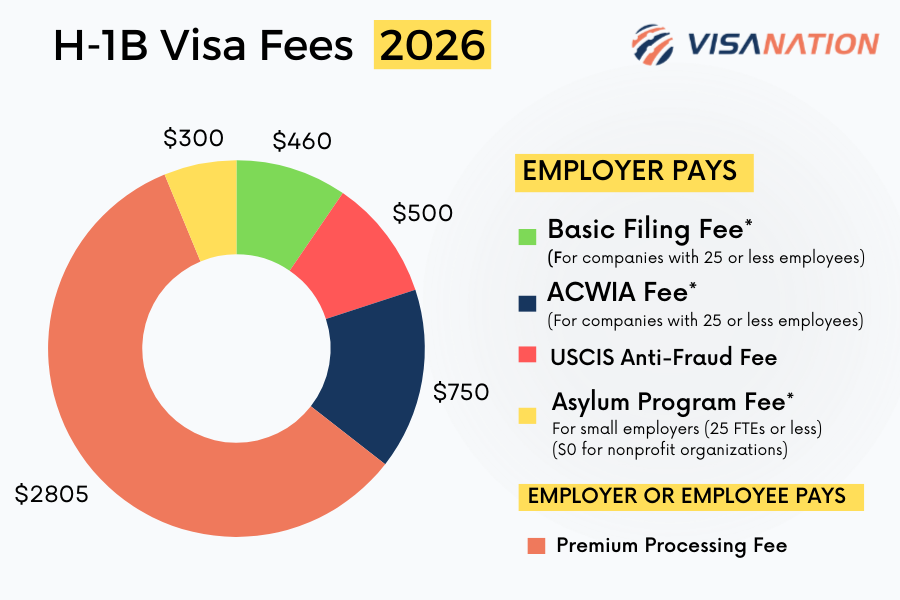
The basic fees for an H-1B are listed below. The costs below are paid by the employer. The optional fees that would be relevant to a nurse would be certain attorney costs since some employers might not cover them, any credentialing and licensing fees relevant to the nursing position, and premium processing if for personal reasons of the beneficiary.
Note that employers cannot require the nurse to pay for the mandatory H-1B fees.
- Registration fee: $215
- I-129 basic filing fee: The standard fee is $780; for small employers and nonprofits, this fee is $460
- ACWIA fee: $750-$1,500, depending on the number of full-time workers
- Fraud Prevention and Detection fee: $500
- Public Law fee: (applies to companies with 50+ employees with over half on H-1B or L-1 status) – $4,000; USCIS may exempt this fee
- Premium Processing (optional): $2,965, increasing to $2,965 on March 1, 2026
- Our attorney fees – VisaNation Law Group’s legal fees are tiered. It’s best to schedule a consultation to learn more.
If you were selected in the 2026-27 H-1B visa lottery, contact VisaNation attorneys for filing your H-1B petition.
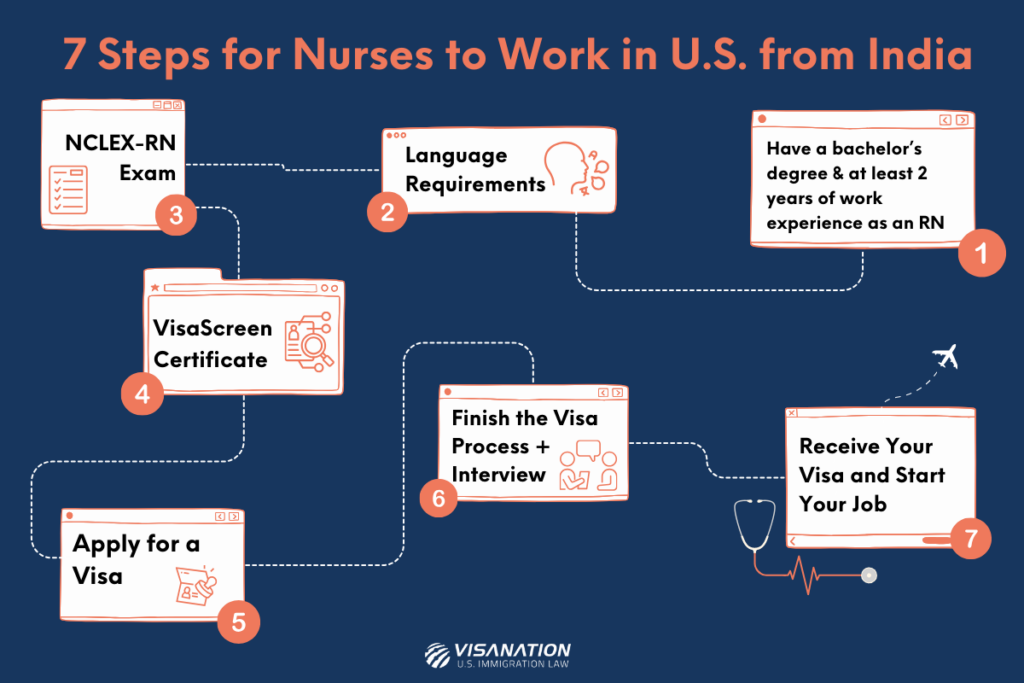
7 Steps for Nurses to Work in the U.S. from India
The requirements for any nurse from India to come and work in the U.S. are relatively the same as for any other foreign-trained nurse. Here is a quick summary of the steps that an Indian-trained nurse might have to take to work in the U.S.
- You must hold a bachelor’s degree in nursing, possess valid accreditation in India, and have at least two years of work experience as a registered nurse
- Quite often, foreign nurses must complete the IELTS exam and achieve at least 6.5 on the overall grade and 7 for the speaking portion.
- You must pass the NCLEX-RN Exam developed by the National Council of State Boards of Nursing in order to show the equivalency of your foreign education and work experience. The exam can be completed in India.
- It is essential to complete a VisaScreen Certificate, as this screening will allow you to be certain that you meet all of the required qualifications for work as a nurse in the U.S.
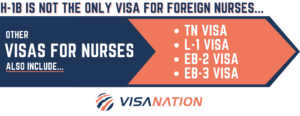
- At this point, you should already have a valid job offer from a U.S. employer. Your employer must then submit an application for an employment-based visa. Depending on your specific situation, this could include the H-1B, TN, L-1, or even permanent residency (EB-2/EB-3) visas
- You will need to attend an interview and submit a variety of documents during the process. You need to ensure you comply with all of the immigration regulations and finish the entire process.
- After you have received your visa, you can freely travel to the U.S. and start your new employment as a U.S. nurse. Find out how you can get your H-1B stamped in the U.S.
How VisaNation Can Help:
VisaNation Law Group’s immigration lawyers can advise foreign nurse practitioner clients on which work visa or immigration category is best suited based on the client’s qualifications and position requirements.
VisaNation Law Group lawyers are skilled in assisting clients with H-1B documentation and any supplementary evidence needed to support their case.
Contact us to have one of the qualified immigration attorneys provide a general overview of your visa options. If you are not eligible for an H-1B visa for nurses, there are many other visa options to be explored.
Schedule a Consultation with a VisaNation attorney