Background
When our client, Minh, arrived in the United States, she entered on an F-1 visa to pursue a Master’s degree in engineering. After she graduated, she landed a job with a major lab and successfully transitioned to an H-1B visa to begin her work as a scientist. She was in charge of leading the development of AI research on production risk, maintenance models, and system failures. So, if you ever wondered who does the testing for a hospital’s medical supply chain, it would be Minh to ensure that all the equipment works and to ensure that there is no system failure.
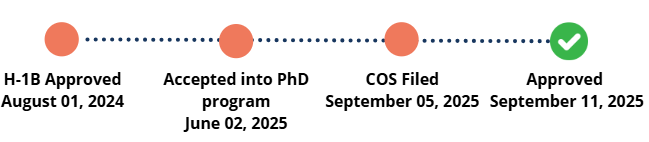
However, after a year of working as a Scientist, she decided that she wanted to pursue her education further and applied to PhD programs. She ended up getting into her alma mater, and Minh committed to a PhD program in industrial and systems engineering. She voiced that she would not be able to work full-time and attend school, and needed help securing her F-1 status. That is when she reached out to us!
VisaNation Case Strategy
Our legal team quickly determined that an H-1B to F-1 change of status was the best path forward, as Minh’s start date with her new school was September 2025. We would transition her from an H-1B to an F-1 student visa, via a change of status. It’s important to note that the H-1B visa allowed Minh to work, but it did not permit her to enroll in school full-time. An H-1B visa requires employment, and since Minh was planning on quitting her job, remaining on an H-1B status was not an option. An F-1 visa was the only way for her to continue her academic journey in the U.S.
One of the most crucial components in F-1 cases is the public charge requirement. Essentially, the U.S. government wants to ensure that international students can support themselves financially without relying on public assistance programs such as Medicaid or food stamps. For Minh’s case, we carefully assembled clear records of her funds, which included her savings, family support, and even fellowships that would provide funding to help cover some of her school costs.
After our team put together all the documentation, we wrote a letter explaining Minh’s financial stability, her academic goals, and the fact that this PhD opportunity would not be available to her in Vietnam. We clearly demonstrated that she would not impose a financial burden on the U.S. but would rather contribute to the U.S. through her research and own expertise.
Verdict
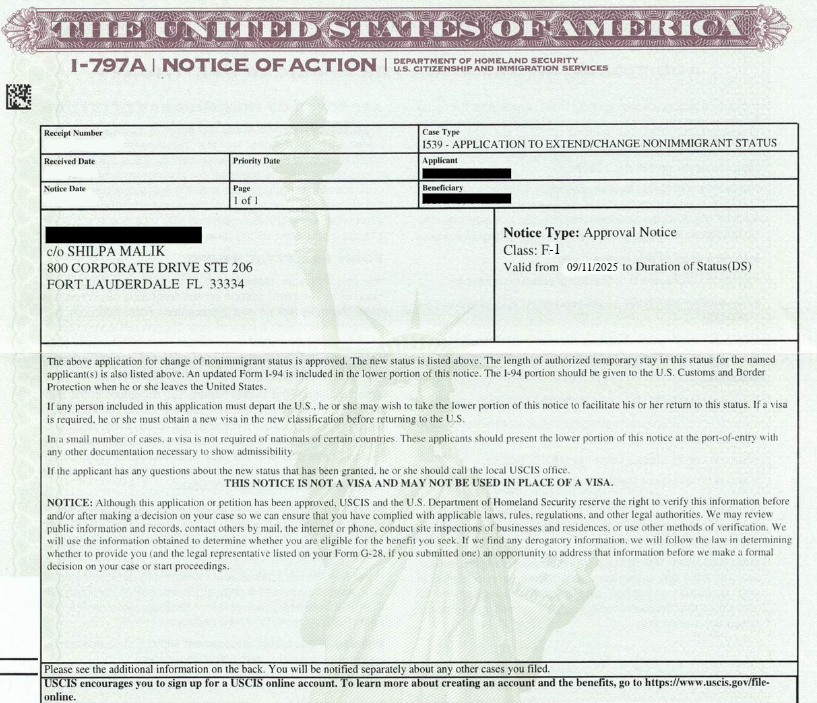
Within 6 days, USCIS approved the change of status! Now, Minh could attend her university and begin her PhD program without any worry about working.