




If you’re an H-1B visa holder, you may be looking for a way to transition from nonimmigrant status to permanent residency. Because the H-1B visa allows dual intent, you can apply for a green card while continuing to live and work in the U.S. In this guide, you’ll learn the H-1B to green card process, including steps for the best chances of approval.
Get support transitioning to a Green Card with an Experienced VisaNation Attorney
In the video below, VisaNation Attorney Shilpa Malik discusses the different immigration pathways to transition from an H-1B to a green card and what changes current H-1B holders should be aware of.
What Is The H-1B to Green Card Process?
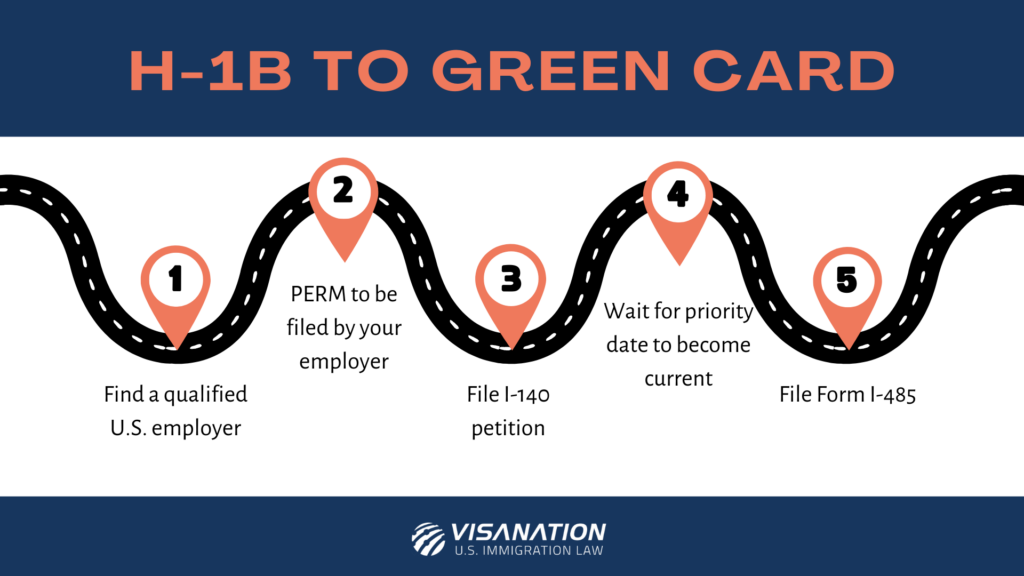
With no mandatory waiting period, you can begin the green card process immediately upon starting your H-1B employment. The process of applying for a green card if you are on an H-1B visa are broken down into the following stages:
- Step 1: Find a Qualified U.S. Employer
- Step 2: PERM Labor Certification to Be Filed By Your Employer
- Step 3: Form I-140 Petition
- Step 4: Wait for the Priority Date to Become Current
- Step 5: File Form I-485
Step 1: Find a Qualified U.S. Employer
Unless you are marrying a U.S. Citizen or permanent resident, you need an employer willing to sponsor your green card under an employment-based category, such as the EB-1, EB-2, or EB-3.
The employer can be your current H-1B employer or a different employer. Some requirements must be met before an employer can qualify to sponsor an employee’s green card application. You may need to switch jobs or take on more responsibilities to qualify.
If you qualify for the E-B1A or EB-2 NIW, you do not need a U.S. Employer – you can self-petition.
VisaNation Tip:
If qualified, the EB-2 generally has an advantage over the EB-3 in terms of shorter wait times. Additionally, you should start planning early, as the PERM labor certification and I-140 approval can take several months to years.

Step 2: PERM Labor Certification to Be Filed By Your Employer
The Program Electronic Review Management (PERM) ensures that no qualified U.S. workers are available for the job. It involves:
- The employer first files a prevailing wage determination with the Department of Labor (DOL).
- The employer conducts an extensive recruitment process to confirm that no qualified U.S. workers are available.
- The employer files ETA Form 9089 with the Department of Labor (DOL).
Step 3: Employer Files Form I-140 Immigrant Petition for Alien Worker
The Form I-140, also known as the Immigrant Petition for Alien Worker, is a document filed with U.S. Citizenship and Immigration Services (USCIS). It starts the process of obtaining lawful permanent resident status (a green card) based on employment for a foreign employee.
- Once the PERM is approved, your employer must file a Form I-140 petition for alien worker.
- Your employer must demonstrate that they are in good financial standing to pay the salary for the job position.
- The petition must be submitted with the approved PERM certification and I-140 filing fee.
- If approved, USCIS issues an Approval Notice, allowing you to proceed to the next step.
I-140 Processing Time:
- Regular Processing: 7.9 months based on USCIS data.
- Premium Processing (optional): Reduces processing time to 15 business days after confirmation of receipt ($2,965)
Step 4: Wait for Your Priority Date to Become Current
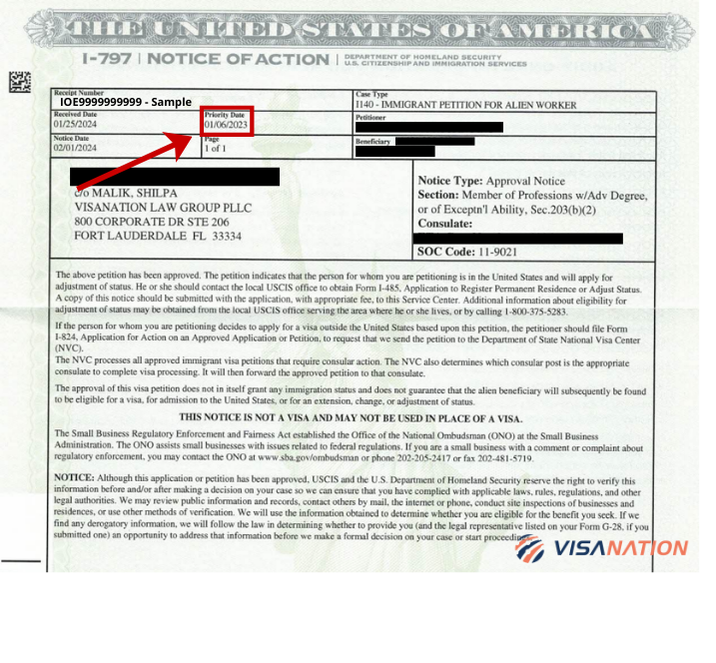
Your priority date determines when you can apply for a green card. The priority date is the date your employer filed the ETA-9089 PERM application, or the I-140 if PERM is not required.
The priority date must be cross-referenced with the latest Visa Bulletin, which is issued monthly by the U.S. Department of State.
How to Check Your Priority Date:
- Visit the Visa Bulletin.
- Compare your priority date to the latest filing and final-action dates.
- Compare these dates to your priority date to determine when to file the green card application.
How Long Does It Take?
The time it takes for your priority date to become current varies depending on green card preference level (EB-1, EB-2, EB-3) and country of chargeability (where you were born). Generally, the higher the preference level, the less time you have to wait. Furthermore, countries with significant backlogs (particularly India and China) must wait longer for a green card to become available.
Step 5: File Form I-485 Application to Register Permanent Residence or Adjust Status
Once your priority date is current, you can apply for an adjustment of status by submitting the I-485 form with the USCIS. If it is approved, then you will receive your green card. The processing time is 7.2 months according to USCIS data
Key Considerations Before Filing I-485
- Foreign nationals may extend their H-1B status in one-year increments if their Labor Certification or I-140 was filed 365 days before reaching the six-year H-1B limit (accounting for recaptured time abroad).
- If you have an approved I-140, but your priority date is not current (or if your Labor Certification has been pending for a year), you qualify for unlimited H-1B extensions until your priority date is current.
- Check your I-797 Approval Notice from USCIS for your priority date.
 What’s Next?
- Start tracking eligibility for U.S. citizenship (typically after 5 years).
If you need support transitioning to a Green card, VisaNation attorneys can provide expert guidance and help you with your case.
H-1B to Green Card Processing Times
The H-1B to green card timeline in 2026 is approximately 7 months to 2.5 years in the best-case scenario. However, the timeline for obtaining a green card from an H-1B Visa varies significantly based on:
- Your country of birth. Countries like India and China have significantly higher wait times, particularly for EB-2 and EB-3 green cards.
- Whether you are applying for an EB-1, EB-2, EB-3, or other category.
- Processing times for various phases of the process, including the PERM process, I-140 immigrant petition, and I-485 adjustment of status.
Here’s a general estimate of the various stages:
The PERM Labor Certification Processing Time – ~16 months
The PERM labor certification processing times have increased over the years, and your case can be delayed if the Department of Labor conducts an audit. For this reason, it’s crucial to submit all appropriate evidence. Working with an experienced attorney can support this. This step is skipped for EB-1 and EB-2 NIW green cards.
The I-140 Petition: Eight months
- Premium processing can reduce this significantly to 15 business days and has a fee of $2,965
Waiting for Priority Date to Become Current – Varies greatly
This step depends on your country of birth and visa category. While an EB-1 Green card applicant may not have to wait at all, an EB-2 applicant from India has to wait 10+ years. It’s key to view the most recent visa bulletin to see where your priority date falls.
I-485 Adjustment of Status – 7.2 months
- The I-485 Adjustment of Status processing time is around 7.2 months according to USCIS data, but varies depending on the USCIS service center’s workload. See the current wait times.
- If the priority date is current, a concurrent I-140 and I-485 filing can speed up the process.
Ultimately, the processing times vary greatly. An EB-2 applicant from Mexico may be able to transition from H-1B to green card status much faster than an Indian EB-3 applicant, who will most likely find themselves waiting over a decade for their green card to process.
To get a better grasp of waiting times for your particular situation, consult with an immigration attorney.

H-1B to Green Card Fees
The fees associated with getting a green card will vary depending on the path, but these are some possible fees:
Form I-140 (Immigrant Petition for Alien Worker) Fee
Fees associated with the I-140 are paid by the employer.
- $715 for standard filing
- $2,965 total if you choose optional premium processing (expedited processing in 15 business days).
- Asylum Program Fee:
- $600 (required for most employers).
- Nonprofits: $0
- Small Employer or self-petitioner: $300
I-485 Adjustment of Status Fee
The final step in the process. Fees are paid by the green card beneficiary.
- $1,440 (for applicants aged 14-78).
Medical Examination Fee
You may be required to undergo an exam and receive vaccinations against vaccine-preventable diseases for the green card application. Fees vary.
- Rates vary by designated physicians (“civil surgeons”)
- Many civil surgeons do not accept insurance, and
- Insurance may not cover many portions of an immigration medical examination.
Translation and Document Costs: If any documents need translation or if additional documentation is required, there may be associated costs.
Attorney Fees:
Attorney fees can vary depending on the lawyer and green card category. Reach out to your attorney to learn the relevant fees.
Your Green Card Options After H-1B
There are several different avenues you can take after being on the H-1B visa:
- EB-1 – Reserved for individuals with extraordinary ability, outstanding professors and researchers, and multinational executives or managers.
- EB-2 – Requires either an advanced degree or exceptional ability in your field.
- EB-3 – Includes skilled workers, professionals with bachelor’s degrees, and other workers with less than two years of experience.
- Family-Based Green Cards – If you have close family members who are U.S. citizens or permanent residents, they may be able to sponsor you for a family-based green card.
- EB-5 – Requires a significant investment in a new commercial enterprise that creates jobs in the U.S. It can lead to a green card for the investor and their immediate family.
- Diversity Visa Lottery – This is a random lottery that provides a limited number of green cards to nationals of countries with low rates of immigration to the U.S.
If you need support transitioning to a Green card, VisaNation attorneys can provide expert guidance and help you with your case.
When to Apply for a Green Card After H-1B
As an H-1B holder, you can start your status adjustment to green card status as soon as your employer is ready to sponsor you. Each year, tens of thousands of employment-based green card applications are submitted for processing.
This process involves various organizations, including the Department of Labor (DOL) and the United States Citizenship and Immigration Services (USCIS). On average, the entire DOL PERM process takes around 2 years, and the USCIS process also takes several months.
A look into the DOL statistics for PERM Labor Certification FY 2026 Q1 shows the top 10 occupations included:
-
Software Developers – 32.4%
-
Computer Systems Engineers/Architects – 5.4%
-
Information Technology Project Managers – 4.0%
-
Electronics Engineers, Except Computer – 3.4%
-
Software Quality Assurance Analysts and Testers – 3.1%
-
Computer Systems Analysts – 2.8%
-
Computer and Information Systems Managers – 2.7%
-
Physical Therapists – 2.5%
-
Operations Research Analysts – 2.2%
-
Data Scientists – 2.2%
Tip: Preparation work should be started as early as possible. You should also factor in the possibility of an audit review of your application, which can further extend the processing time to more than a year. For this reason, it may be costly to delay your application, as you could be out of status if your H-1B expires when you haven’t commenced your green card application process.
Benefits of the H-1B Visa for Transitioning to a Greencard
Some temporary visas lock you into the same status when it comes time for renewal. Others only allow you to switch to a different temporary status. And for some, there’s no option at all – once they expire, you have to leave the U.S.
That’s where the H-1B stands out. Unlike many other nonimmigrant visas, it offers flexibility. You can renew it, transfer it to another employer, or even transition to a green card. This makes it one of the most versatile options for skilled workers looking to stay in the U.S.
Adjustment of status
Individuals under H-1B or L-1 status are frequently eligible to apply for a green card for the right to live and work permanently in the United States. This process is known as adjustment of status. Obtaining an employment-based green card consists of multiple steps and a specific application process.
Going through the employment-based green card process while under H-1B status has many benefits, especially if you have an approved I-140.
If you need support transitioning to a Green card, VisaNation attorneys can provide expert guidance and help you with your case.
EB-2 vs EB-3 Immigrant Visa
EB-2 and EB-3 visas are quite popular options for green cards:
Employment Second Preference (EB-2 Green Card Process)
The EB-2 green card is for professionals with advanced degrees or individuals with exceptional ability in the arts, sciences, or business.
What is required?
Generally, a job offer and PERM labor certification from the Department of Labor (DOL) are required, with the U.S. employer filing an I-140 petition on behalf of the applicant. However, individuals may self-petition for an exemption from these requirements through a National Interest Waiver (NIW) if they can demonstrate that their work provides substantial benefits to the U.S.
The NIW is available to a wide range of professionals, including scientists, researchers, entrepreneurs, and business leaders. Applicants must provide strong evidence that their work is of national importance and that waiving the job offer and labor certification requirements would benefit the U.S. Those pursuing an EB-2 visa should consult with an EB-2 visa lawyer to identify which option would result in approval for your case.
Employment Third Preference (EB-3 Green Card Process)
The employment third preference category is for skilled workers, professionals holding bachelor’s degrees, and individuals and other workers that do not require specialized training and are not seasonal or temporary
What is required?
Third Preference applicants require an approved I-140 petition filed by the prospective U.S. employer, evidence of having experience in the desired field, and one of the following items:
- PERM Labor Certification
- Schedule-A Designation
- Evidence that they qualify for one of the shortage occupations in the Labor Market Information Pilot Program.
Skilled workers must have at least two years of experience in their relevant fields while unskilled workers may suffice with on-the-job training and the ability to perform unskilled labor. It is important to note that the “unskilled workers” subcategory has a different set of priority dates from the other EB-3 subcategories.
If you are making the transfer from H-1B to green card status, then your employer should have already obtained a PERM Labor Certification on your behalf.
If you need support transitioning to a Green Card, VisaNation attorneys can provide expert guidance and help you with your case.
H-1B to Citizenship
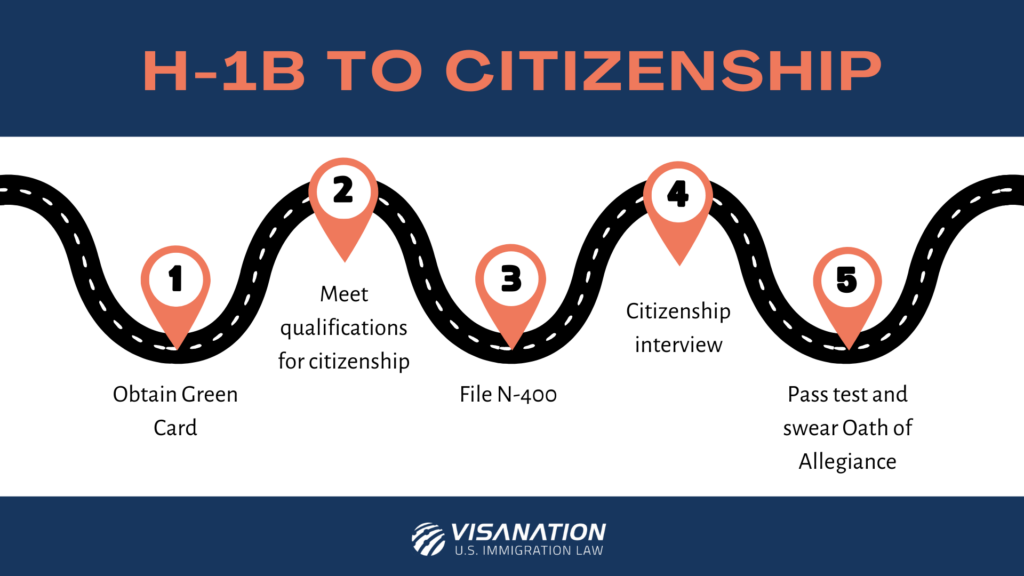
The process to become a citizen:
- Obtain a Green Card – Secure lawful permanent residency through an employment-based green card (EB-2 or EB-3).
- Meet Residency Requirements – Hold a green card for 5 years (or 3 years if married to a U.S. citizen) or qualify through U.S. military service.
- Apply for Naturalization – Submit Form N-400 and attend a biometrics appointment if required.
- Complete the Citizenship Interview & Test – Demonstrate proficiency in English and pass a civics test covering U.S. history and government.
- Take the Oath of Allegiance – Upon approval, attend a naturalization ceremony to officially become a U.S. citizen.
Frequently Asked Questions:
How soon can I apply for a green card after H-1B?
You can apply for a green card immediately after you secure an H-1B visa, as soon as your employer is ready to sponsor you. The employer is responsible for filing the initial paperwork for an employment-based green card, including the labor certification and Form I-140 Immigrant Petition for Alien Workers. Notably, the process is complex and lengthy. Review the above article to learn more.
When to ask about green card sponsorship for H-1B employees?
Determining when to ask your employer to sponsor you for a green card involves the right timing. However, in many cases, if you wait too long or postpone the process, you may confront additional and unwanted delays.
On the other hand, employers may hesitate with this request because oftentimes, foreign workers leave their place of work after receiving approval for their green card.
Can I stay with the same employer and do EB-3 to EB-2 porting?
In some cases, you can stay with the same employer, but know that it will be more heavily scrutinized by USCIS because it has been exploited in the past. The EB-2 job should also be 50% different from the EB-3 job.
Be prepared to defend yourself against the following questions:
- Does this promotion make sense? Are you being promoted from “Marketing Analyst” to “Marketing Manager” or to “Senior Product Manager”?
- Is the job a well-established position within the company?
- Is your employer actively searching for a worker to replace your EB-3 position?
- How many other employees has your employer helped with EB-3 to EB-2 porting?
Speak with your immigration lawyer if you are considering this delicate process.