




As we enter the H-1B visa 2026-27 cap lottery season, U.S. employers and their attorneys are busy preparing their registrations and entering the annual H-1B lottery. One way to make your registration stand out in the upcoming season is to enter the H-1B master’s cap degree exemption, a separate lottery for those who possess advanced degrees from eligible U.S. institutions. The master’s degree route gives individuals a better chance of being selected for the H-1B visa because there is only a limited number of visas available each year. It may sound simple, but there are precise requirements to follow when applying. So let’s delve into the H-1B advanced degree cap, how it can benefit you, and how you can enter
If you are interested in registering for the H-1B visa lottery, contact VisaNation attorneys.
Latest H-1B News and Updates
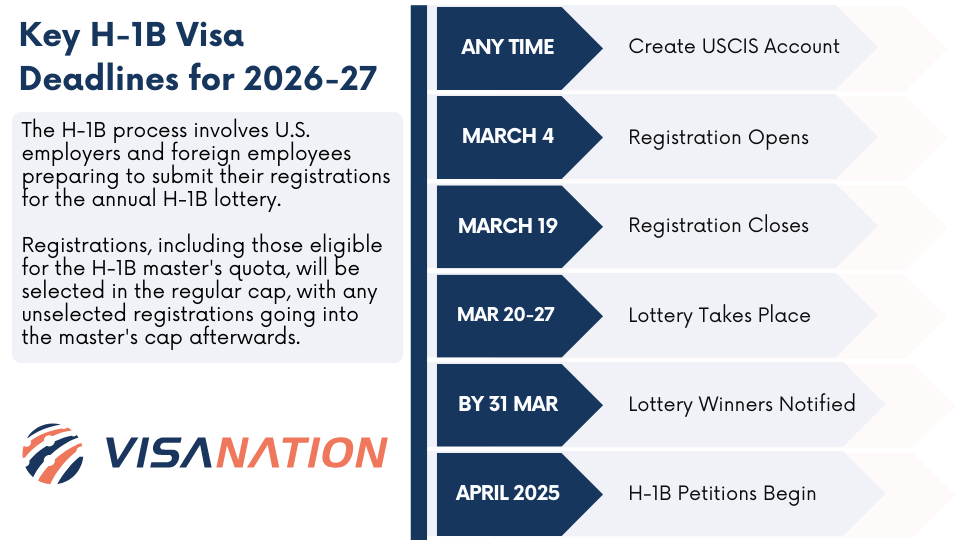
- Breaking news: USCIS announced that the initial registration period for the fiscal year 2026-27 H-1B cap lottery will open at noon Eastern on March 4 2026 and run through noon Eastern on March 19, 2026.
- DHS officially implemented weighted selection for the FY 2026-2027 H-1B lottery on 12/29/25. This has serious implications for US employers and foreign workers. Learn how to navigate the new rules successfully.
- Trump introduced a $100,000 Fee for New H-1B Petitions for those that require consular processing. Read about the exclusions and best strategies to navigate.
- Premium processing for the H-1B will increase from $2,805 to $2,965 on March 1, 2026.
- A new version of the I-129 form went into effect on January 17, 2025.
What is the H-1B Master’s Cap in 2026–2027?
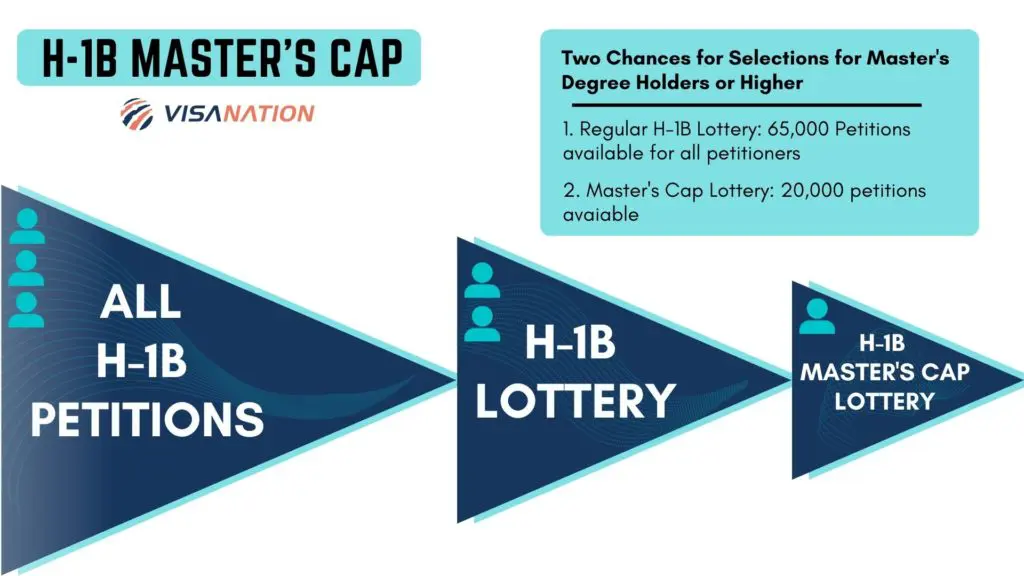
USCIS issues 65,000 visas in the regular H-1B cap (those who do not qualify for the master’s degree exemption) and an additional 6,800 spots for Chilean and Singaporean residents. Another 20,000 places are available to candidates with a U.S. master’s degree or higher from eligible universities or institutions. For applicants with a Master’s degree, you get to enter both lottery rounds. Later on, you’ll see how this impacts your odds.
What Are the H-1B Advanced Degree Exemption Eligibility Requirements?
The primary advantage of the H-1B advanced degree exemption is that it provides applicants with two opportunities to be selected for the H-1B visa. If you are not selected in the standard cap, your application will be entered into the H-1B master’s pool for the next chance to be chosen. This gives applicants with advanced degrees a better chance of having their H-1B visa approved compared to those who only have a bachelor’s degree. Additionally, the H-1B master’s cap usually receives fewer applications, this will generally improve your chances of being selected.
For you to qualify for the H-1B master’s degree exemption, there are two main requirements:
- You must have earned a master’s degree from an institution accredited by a nationally recognized agency.
- The U.S. institution should also be public or non-profit in nature.
You can find a complete list of eligible H-1B Master’s Cap universities and programs on the United States Department of Education’s website. Similarly, the National Center for Education Statistics (NCES) provides a useful tool offering key information regarding the classification of university types (e.g., for-profit, nonprofit, public, or private institutions) to ensure your institution of interest meets the public or non-profit requirements.

Above are the key sections to pay attention to on the National Center for Education Statistics (NCES) tool.
Some Formally Recognized Accrediting Organizations Include:
- Accrediting Commission of Career Schools and Colleges
- Accrediting Council for Continuing Education and Training
- Accrediting Council for Independent Colleges and Schools
So, if the institution where you received your degree is unaccredited or happens to be a for-profit university, your petition will be denied. Please note that you’re also subject to all the other H-1B requirements.
Likewise, if you failed to meet that requirement and USCIS denied your petition, you also won’t be eligible to count towards the regular (65,000) cap. For that reason, it’s crucial to ensure you meet the statutory requirements before filing. Failure to do so only causes delays and additional frustration.
Ineligible Institutions for H-1B Advanced Degree Exemption
Don’t assume all U.S.-based institutions are accredited; it may lead you astray. The government shut down the University of Northern Virginia in 2013 after it lost its accreditation due to violations. Graduates couldn’t file under the H-1B master’s cap but could under the regular H-1B quota.
Tip: Another common issue is universities not being public or non-profit. Proprietary schools, being for-profit, aren’t eligible under the criteria.
If you are interested in registering for the visa lottery, contact VisaNation attorneys
How to Register for the H-1B Master’s Quota?
- Ensure you have an eligible U.S.-based Master’s degree or higher from an accredited institution.
- Your employer must create an online account with USCIS to submit the registration on your behalf.
- Your employer submits basic details about you and the company and pays the $215 fee.
- Ensure your employer submits the registration before the deadline.
- If selected in the lottery, your employer can file a full H-1B petition.

What Are Your Chances in the H-1B Master’s Cap?
In the upcoming FY 2026-27 H-1B lottery, the process has shifted from a random lottery to a wage-weighted lottery. Thus, the odds of selection, even for Master’s graduates, are now highly influenced by the Occupational Employment and Wage Statistics (OEWS) level, which determines how many entries you receive in the lottery:
- Level IV – 4 entries
- Level III – 3 entries
- Level II – 2 entries
- Level I – 1 entry
The DHS projects, based on the weighted selection process, that the probability of being selected to file an H-1B cap-subject petition will be as follows:
|
Level I |
Level II |
Level III |
Level IV |
|
|
Estimated number of beneficiaries |
89,911 |
177,216 |
37,928 |
15,657 |
|
Probability of Selection |
15.29% |
30.58% |
45.87% |
61.16% |
Selection rates for the upcoming H-1B Master’s Cap lottery are strongly influenced by:
- The Introduction of Wage-Weighted Selection and OEWS Wage Levels
- Demand for H-1B visas
- Accurate and timely registration by employers
- Ever-increasing filing costs for employers
- And even USCIS addressing fraud
While Master’s degree holders still benefit from the “advanced degree exemption,” the wage-level weighting applies to both lottery rounds. For example, a Master’s graduate with a Level III wage offer essentially receives 3 “lottery tickets” in both the regular and master’s pools, making their combined odds much higher than they were under the previous random system. On the other hand, Master’s graduates in entry-level (Level I) positions now face much steeper competition, as they only receive one entry while competing against higher-wage candidates with up to four.
Impact of the $100,000 H-1B Fee on Master’s Graduates
In the upcoming H-1B lottery season, a significant new development is the introduction of a $100,000 fee for specific H-1B petitions. It specifically applies to new H-1B petitions where the candidate is outside the U.S. and requires consular processing. However, candidates already in the U.S. (such as those on F-1 OPT) who are doing a “Change of Status” are not subject to this fee.
Importantly, multiple ongoing legal challenges argue that this fee is unauthorized, including:
-
Chamber of Commerce v. DHS
-
Global Nurse Force v. Trump
-
State of California v. Noem
In our H-1B predictions post, Managing Attorney Shilpa Malik predicts that the upcoming lottery will likely see fewer overall registrations in reaction to the newly introduced fee and weighted selection rule, with companies shifting toward fewer filings that reflect genuine business necessity, defensible wages, and roles that are critical to operations.
FY 2026-27 Registration Period for H-1B Master’s Quota
USCIS announced the registration period for the FY 2026-27 lottery, during which employers could submit registrations between Noon ET on March 4, 2026, and Noon ET on March 19, 2026. Petitioners, including those for the Master’s Cap, found out if they were selected in the lottery by March 31st, 2026.
See our full H-1B lottery timeline
How the H-1B Master’s Cap Works
- When the H-1B quota candidate pool exceeds 65,000, USCIS uses a wage-weighted selection process to choose 65,000 registrations, prioritizing those with higher OEWS wage levels.
- USCIS identifies H-1B Master’s cap-eligible registrations from the pool of all registrations not selected in the regular cap round.
- If there are more than 20,000 Master’s cap-eligible applications remaining, USCIS conducts a second weighted selection round to fill the 20,000 advanced degree spots, again giving more entries to candidates in higher wage levels.
- USCIS sends letters to individuals whose registrations are selected. These sponsors will then file I-129 petitions on behalf of their beneficiaries.
- Registrations not selected in the regular or Master’s cap will be designated as “not selected” in the online portal. USCIS will not refund the registration fee.
- Selected petitioners will receive their USCIS case number to stay up-to-date on H-1B processing times.
When Are the Master’s Cap Lottery Results Released?
USCIS announces lottery results, including the Master’s cap, by March 31st, 2026. They will do this by changing the status of your online registration to one of four statuses:
- Selected: This means that USCIS chose your registration in the lottery, and your sponsor can submit a petition.
- Denied: The “denied” status appears if USCIS reviewed the registration and found issues with eligibility or compliance.
- Not Selected: USCIS will conduct the lottery after and select the required registrations for the regular cap and the advanced exemption. Any not selected will remain in the “Submitted” status until the end of the fiscal year. If USCIS needs to fill more spaces throughout the remaining six months, it will draw from this pool. Otherwise, all unselected petitions will change to “Not Selected.”
- Submitted: This just means that USCIS has received your registration. If your petition is not selected but also not denied, it will remain in “Submitted” status until October 1st. After which, it will change to “Not Selected.”
See our full H-1B lottery timeline
What is the Selection Process for H-1B Master’s Cap Quota?
H-1B petitioners need to register their beneficiaries before the opening of the lottery window. Here is how it will work:
- Before the H-1B filing window, employers must register their beneficiaries with the USCIS organization account.
- The USCIS will then use the lottery system to select registered beneficiaries.
- The petitioners whose beneficiaries were selected in the lottery will then file petitions.
According to USCIS, this method expedites the process because it avoids having to sift through tens of thousands of petitions every year, making the filing process less expensive for employers.
After the lottery selection, USCIS will notify employers if their registration was chosen, and the subsequent filing steps will take place. The employer will need to file the complete H-1B petition, and the entire package of documents will be sent to the designated service center, where it will then be rejected or approved. Each petition is given a USCIS case number and a tracking identifier.
Reason for H-1B Master’s Cap Denials
If your H-1B master’s petition is rejected, then you may simply need to fix the error and refile the petition next season if your registration is selected again. However, if your petition is denied, you may be able to file a legal motion.
There are two types of these legal motions:
- Motion to reopen: If you have new evidence to bring to the table that might change the evaluating officer’s mind.
- Motion to reconsider: When you and your immigration lawyer believe that the evaluating officer was wrong in their assessment of your case.
Because they are both legally delicate matters, neither of these should be attempted without the help of an experienced immigration attorney. As an aside, you will likely receive an H-1B denial letter that prohibits any appeals to a third party.
Additionally, a second registration cannot be submitted for the same beneficiary. A single sponsor can only submit one registration for each beneficiary in any given fiscal year. If this rule is violated, all registrations for the beneficiary filed by the guilty sponsor will be denied.
However, keep in mind that a beneficiary can have multiple registrations filed on their behalf by different sponsors. Also, a single sponsor can submit registrations for various beneficiaries.
What is the H-1B Denial Rate?
Based on the first three quarters of data in FY 2025 released by USCIS, the H-1 B denial rate was 2.15%. Of 363,526 petitions received, only 6,339 were initially denied, giving an approval rate of 98%
With other visas, a small mistake might delay your visa by a few weeks or months. However, with the time constraints placed on the H-1B, a small error may cause you to have to wait until the next fiscal year to try again.

Tips to Increase Your Chances of Securing an H-1B Visa:
1. Qualify for the Master’s Cap
- If you have a U.S. master’s degree from an accredited institution, you get two chances: first in the 20,000 cap lottery for advanced degree holders, and if not selected, another chance in the regular 65,000 cap.
2. Secure a high-paying wage
- By securing a level III or IV OEWS wage level position, your odds of selection in the lottery dramatically increase. Importantly, your experience must justify the higher wage level, as USCIS may scrutinize the position to ensure the offered salary matches the job’s complexity and your professional background.
3. Ensure Accurate and Timely Filing
- USCIS rejects incorrect or incomplete applications. Make sure your employer files correctly and on time to avoid disqualification.
4. Work with an Experienced Immigration Attorney
- A lawyer can help ensure your petition is properly filed and explore backup options if you’re not selected.
5. Seek Cap-Exempt Employers
- Certain employers (universities, nonprofit research organizations, and government research institutions) are exempt from the H-1B cap, meaning they can file an H-1B petition at any time without going through the lottery.
H-1B Master’s Cap FAQs
Below you will find answers to the most frequently asked questions about the master’s cap in the H-1B lottery process:
Which is first, the H-1B Master’s cap or regular cap?
The first step of the H-1B lottery process is the regular cap, followed by the Master’s cap. Applicants with a Master’s degree not chosen in the regular cap are automatically moved to the Master’s Cap.
What is the difference between the bachelor’s and master’s caps?
The key difference is that the Bachelor’s cap is open to applicants with a bachelor’s degree or higher, while the Master’s cap is exclusively for those with a U.S. master’s degree or higher. The Bachelor’s cap has 65,000 available visas, whereas the Master’s cap offers an additional 20,000 visas specifically for Master’s degree holders. This gives those with a master’s degree an advantage, as they can enter both the Master’s cap and, if not selected, still have a chance in the Bachelor’s cap.
Will premium processing help my case?
No, premium processing only expedites H-1B petition decisions to 15 business days for an additional fee. It does not increase the probability of USCIS approving your petition if they select your registration in the lottery. Instead, it only serves to shorten your petition’s processing time. The service fee for premium processing is $2,805. This will increase to $2,965 on March 1st, 2026.
Can I apply for a Green Card as an H-1B visa holder?
If you successfully earn an H-1B visa, you have a prime spot for an EB-2 green card. This has the advantage of generally having a much shorter waiting time than the EB-3, which is the green card most H-1B employees qualify for.
Does the Master’s exemption exempt me from the cap?
No, it doesn’t. The term “exemption” simply means you get an extra opportunity, not that you’re completely excluded from the cap. If you qualify for the H-1B Master’s Cap, your registration will go through two lottery rounds:
- The regular lottery for 65,000 visas.
- If not selected, it moves to the Master’s Cap lottery for an additional 20,000 visas.
This gives you two chances to be selected, increasing your odds. The only way to avoid the H-1B lottery entirely is by getting a job offer from an H-1B Cap-Exempt company, such as certain universities, non-profits, or government research organizations.
Do I have to register before the H-1B cap?
All employers who plan on filing petitions on behalf of H-1B beneficiaries will have to register. However, employers will only file a full H-1B petition if the registration is selected in the lottery. Registration is the first step, and filing the petition comes afterward if selected.
Do I have to file a petition in the lottery this year?
No, sponsors don’t file petitions to enter the lottery anymore. Instead, employers must register the beneficiary (the person they’re sponsoring) with USCIS.
USCIS will then select registrations through the lottery, and only if registration is selected will the employer need to file a full H-1B petition.
Will there be registration every year?
Yes, USCIS plans to hold registration annually as part of the H-1B process. However, the USCIS can suspend the registration process for any year if they encounter technical difficulties or other unforeseen challenges. We will keep you updated on any suspensions.
How does the H-1B master’s cap order increase my chances of selection?
USCIS will first enter your Master’s registration into the regular cap along with all other registrations. This means USCIS will select some Master’s registrations from the regular cap without entering the H-1B Master’s Cap. All unselected Master’s registrations will enter the Master’s lottery, which will have less competition because USCIS has already chosen some Master’s registrations in the Regular Cap.
This is understandably confusing, so we always encourage you to work with your immigration attorney to make an educated decision about your case.
Where can I find an H-1B sponsor?
If you do not have an H-1B sponsor, databases are available to find a suitable one. Disclaimer: We do not take ownership or responsibility for the information found on H-1B sponsor sites. This site allows you to filter your search by visa job title, NAICS industry, work city, and visa rank. The information on that visa sponsor database is based on LCAs and Labor Certifications. Another good place to search for qualified H-1B jobs is at U.S. academic institutions because they’re not subject to annual cap restrictions.
What is the prevailing wage?
The prevailing wage, provided by the Department of Labor under the Occupational Employment Statistics program, is the average wage for employees who perform the same (or similar) jobs in the same area. The Labor Certification Application indicates the prevailing wage. In addition, most employment visas, including the H-1B visa, require by law the employer to pay their alien employees this wage as a minimum. Therefore, the DOL will determine the prevailing wage when your employer files for a Labor Certification Application.
Are my chances better as an MBA graduate?
Having an MBA instead of any other type of advanced degree does not directly help your chances during the H-1B Master’s Cap. However, earning an H-1B for MBA graduates can make you more qualified for the position you’re applying for and likely improve your chances of USCIS approving your petition if they select your registration in the master’s cap or the regular cap.
What is consular processing?
Consular processing applies to H-1B petitioners selected in the lottery who have an approved, complete H-1B package but live outside of the United States. Note that if this is your case, you will need to make an appointment at the U.S. consulate/embassy in your home country and bring with you the paid DS-160 nonimmigrant application, receipt that you paid the $205 cost for this form, and be ready to answer any questions the consular officer may ask you. For example, the interviewer may ask you about your job, employer, qualifications, work history, and travel history. If you don’t know the answer to one of their questions, always be honest, and it’s perfectly okay to say, “I don’t know,” if you’re unsure.
Can my spouse get a visa?
Yes, your spouse can be eligible for an H-4 visa. Learn about the difference between an H-4 and an EAD in this post.
What other options do I have if I don’t qualify for the H-1B lottery?
If you’ve reviewed all the criteria above and find that you are not eligible for the H-1B visa, you do have other options apart from the H-1B master’s cap and regular lottery pool.
- For example, the L-1B visa, like the H-1B, is also a nonimmigrant visa. It allows employers who have offices both in the United States and overseas to transfer employees from their overseas offices to those in the U.S. for up to five years.
- Another option is the J-1 visa, intended for government-approved programs for positions like nannies, students, counselors, doctors, etc.