



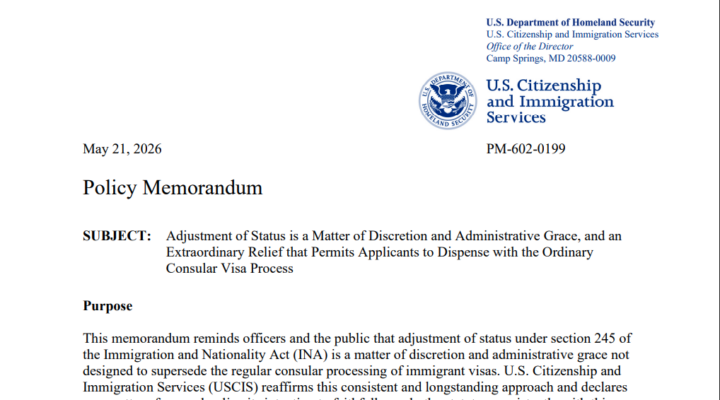
On May 21, 2026, USCIS released the memo PM-602-0199 strongly reaffirming that obtaining a green card inside the United States via Adjustment of Status (“AOS”) is an “extraordinary” discretionary benefit and an act of “administrative grace.” In other words, USCIS officers are being encouraged to take a new discretionary approach to adjudicating green card applications – with a mindset that it is not an automatic right, even if the applicant meets all eligibility criteria. This is an ongoing, developing situation that should be navigated carefully under the guidance of legal professionals.
USCIS Memo Background
When an individual on a valid non-immigrant visa who is currently living in the United States has the opportunity to transition to permanent residency, they use “adjustment of status,” a process completed entirely from within the United States.
It is a widely used pathway for U.S.-based professionals and immediate relatives (spouses, children, parents) on temporary work visas and others who are already living in the U.S. Overall, it provides the benefit of avoiding the high cost of traveling back to the individual’s home country, and for many, it offers the continuation of employment and studies.
Another route for permanent residency in the United States is via consular processing. Through this route, the green card applicant applies at an embassy within their home country. This route is commonplace for those who already live abroad.
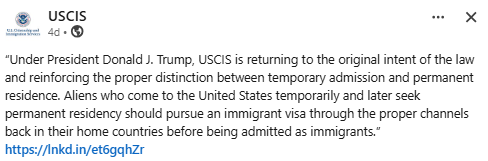
In this newly released memo and press release, USCIS is essentially announcing its preferred route as consular processing, despite the many limitations and suspended visa processing affecting over 75+ countries as outlined by USCIS.
Some immigration attorneys have questioned whether the USCIS memo goes against the immigration and Nationality Act, and in the following weeks expect the policy to face legal challenges, preventing the memo’s instructions from going into effect.
What Are The New Rules For Adjustment Of Status
Technically, there aren’t any “new” statutes or rules related to adjustment of status. Rather, USCIS agents are receiving instructions that use a far more discretionary posture when adjudicating adjustment of status cases.
The attorneys at VisaNation suggest that applicants should expect more RFEs and detailed discretionary review as officers build records supporting adjudications.
This new memo highlights greater risks to specific categories, such as F-1 students planning on rapidly transitioning to an employment green card or B-1/B2 visitors adjusting status. These cases will likely face closer examination regarding original intent, compliance history, and overall equities.
The Role of “Totality of Circumstances”
The USCIS memo instructs USCIS officers to take a holistic view of all factors, both negative and positive, when reviewing cases before making a decision. They must weigh the totality of the circumstances and use their discretion before granting an approval or issuing a denial.
What Counts As Negative Factors?
- Violations and compliance issues, such as a criminal infraction or visa overstay
- Unauthorized employment
- Using a visa in a way that goes against its intended purpose
What Counts As Positive Factors or “Equities”
A few positive factors include, but are not limited to:
- A history that shows all immigration laws and visa conditions have been followed
- Tax compliance
- Family ties, including family within the U.S., and especially any hardship that could be caused by leaving
- Community involvement
- Property
- Specialized education
- Stable employment history
Which Adjustment of Status Applications Invite Higher Scrutiny?
Visas with a single intent are among those likely to invite the highest scrutiny, according to the USCIS memo. These include
- F-1
- B-1/B-2 tourist and business visas
- Potentially TN visas
These types of visas were developed as temporary visas with specific purposes, and while transitions have typically been possible, the memo states:
“Nonimmigrants, like students, temporary workers, or people on tourist visas, come to the U.S. for a short time and for a specific purpose. Our system is designed for them to leave when their visit is over. Their visit should not function as the first step in the Green Card process. “
How Does the USCIS Memo Impact Dual Intent Visa Holders like L-1 and H-1B?
The memo explicitly states that filing for Adjustment of Status while on H-1B or L-1 status is not against the rules. That being said, playing by the rules and maintaining status may no longer be viewed as a sufficient positive factor to approve an adjustment of status petition, and adjudicating officers will weigh the totality of factors before making a decision.
USCIS spokesperson Zach Kahler also added that “People who present applications that provide an economic benefit or otherwise are in the national interest will likely be able to continue on their current path,” Kahler explained, adding that others “may be asked to apply abroad depending on individualized circumstances.”
What are the Next Steps for those applying for Green Card?
For those planning on applying through adjustment of status, it’s key to understand that this is an ongoing situation in the early stages. USCIS has stated that it may provide policy guidance specific to certain adjustment of status categories.
At the moment, it is impossible to fully understand how USCIS officers will apply this memo. It is vital to seek legal counsel for those planning on applying for an adjustment of status.
Our team advises keeping pending cases active, as this memo does not mean pending I-485s are automatically denied. Furthermore, for those going forward with AOS petitions, it is vital to build and showcase a strong record of positive factors, including lawful status history, employment, tax compliance, family ties, and community involvement. Successful filings need to both meet all eligibility criteria and present a persuasive argument of the applicant and their equities.