



As a small business owner, you may have job openings that no U.S. employee is willing to take or have a nonimmigrant employee whom you’d like to make a permanent worker. If you are facing either of these two scenarios and are wondering if your small business can meet the eligibility requirements for sponsoring a green card, the EB-3 process may be ideal for your situation.
A small business can sponsor a green card for a prospective employee or a worker who is already employed. However, the Department of Labor (DOL) and the United States Citizenship and Immigration Services have specific criteria for sponsoring a green card as a small business owner.
Requirements for Small Business EB3 Sponsorships
Before you can sponsor an employment-based green card, you will need approval from both the Department of Labor and the USCIS.
Here are the steps to follow:
PERM Labor Certification
PERM labor certification is a multip-step process that involves a prevailing wage determination, recruitment, and labor certification. It must be completed before a small business can file an EB-3 immigration petition on behalf of its intended employee.
Prevailing Wage Determination
The employer starts the process by electronically submitting a prevailing wage determination request to the Department of Labor website using the ETA 9141 form on the FLAG system.
The request will contain the requirements for the job and workstation location. The minimum salary for a particular job in a specific geographic area is set by the National Prevailing Wage Center (NPWC).
Recruitment
After receiving the wage determination, the employer must conduct a series of recruitment steps to test the U.S. labor market. You will need to advertise for the position to show the DOL officers that there are no available, qualified, and willing U.S. workers for the job, hence the necessity to bring in a foreign worker.
At a minimum, employers must place:
- A 30-day job order with the State Workforce Agency (SWA) where the job is located.
- Two Sunday newspaper ads in a paper of general circulation.
- A Notice of Filing (NOF) is posted at the worksite for at least 10 business days.
For professional jobs, employers must also complete at least three additional recruitment steps (such as posting on the employer’s website, online job boards, professional journals, or using campus recruiting).
ETA 9089 Form
If no qualified, willing, and available U.S. worker is found after recruitment, the employer can move to the final stage of the PERM Labor Certification process by filing an ETA 9089 form. Your application will be adjudicated in around 16 months, and you will get a notice of either approval or denial. Audits can delay this timeline.
If your petition is approved, you will continue the process by filing an I-140 with the USCIS. Please note that there are a few cases where PERM labor certification is not required. See the details in the types of employment-based cards below.
I-140 Immigrant Petition for Alien Worker
Having acquired the PERM labor certification for the employee, the next stage is to file an I-140, Immigrant Petition for Alien Worker.
The I-140 has different sections that require information about the employee’s competence, qualification, and experience for the position, as well as your company’s financial status. You will need to submit proof that includes your company’s profit and loss statement, balance sheet, and other relevant documents.
As a small business owner, you should allow your immigration attorney to help you file this form. The I-140 must be filed within six months after the approval of the PERM application. This may take 4 to 6 months to be processed.
Types of Employment-Based Visas a Small Business Can Sponsor
There are different types of employment-based green cards you can file on behalf of an employee. The nature of the employment and the employee’s qualifications or abilities will determine the type of immigrant visa to file. The employment-based green cards available to eligible foreign nationals are divided into four different categories:
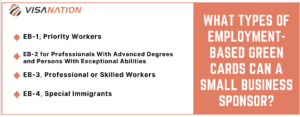
EB-1: Priority Workers
The EB-1 priority workers green card is divided into three subcategories: the EB-1A for workers of extraordinary abilities, the EB-1B for outstanding researchers and professors, and the EB-1C for multinational executives and managers.
This is known as the first preference employment-based immigrant visa, and does not require a PERM labor certification. This makes it relatively faster and easier to process compared to other employment-based visas. Both the petitioning employer and the beneficiary employee can save around two years by avoiding the PERM process.
However, the EB-1 comes with higher standards, which makes it very difficult to obtain for the employees of most small business owners. To discover if your own small business has the qualifications to sponsor this green card category, it is a good idea to work with your immigration attorney.
EB-2: Professionals With Degrees or Exceptional Abilities
This is known as the second preference level of employment-based green cards, and it is intended for foreign workers who hold advanced degrees or possess exceptional ability in a specific field.
It requires a PERM Labor Certification, but this may be waived by filing for a National Interest Waiver (NIW). However, you must demonstrate to the immigration officers that waiving the PERM will be in the best interest of the United States.
While this may not be relevant when it comes to sponsoring an employee, getting an NIW is ideal for small business owners to be able to sponsor themselves for their own green cards. However, you must be able to show that your work contributes to the benefit of the U.S.
EB-3: Professional or Skilled Workers
The EB-3 green card is the third preference level and is meant for three sets of foreign workers: skilled workers, professionals, and unskilled workers. This category has more eligible foreign nationals because the requirements are less stringent than those for the EB-1 and EB-2.
All that the EB-3 requires is a few years of work experience or an undergraduate degree. For the unskilled workers subcategory, those who only have vocational training are also permitted provided they can demonstrate that they have the capabilities for the job and that the job is not seasonal or temporary.
Find out how to get a green card without sponsorship.
EB-4: Special Immigrants
The EB-4 green card for special immigrants is as unique as its name implies because the process is different from other types of employment-based visas. The fourth preference level of employment-based green card is for eligible special immigrants who are:
- Religious workers;
- Special immigrant juveniles;
- International broadcasters;
- NATO-6 or G-4 international organization employees and their family members;
- International employees of the U.S. government abroad
- Armed forces members
- Panama Canal Zone employees
- Certain physicians
- Iraqi and Afghan translators
- Afghans and Iraqis who have rendered faithful service in support of U.S. operations
An EB-4 green card does not require a PERM labor certification, and unlike other categories which require an I-140 petition, the form you will need to file as a petitioning employer for EB-4 is an I-360.
Eligibility Requirements for Employees Sponsored by Small Businesses
Each of the above employment-based categories has different requirements. It is imperative that you carefully study the employee’s qualifications in relation to the vacant position before you begin the application process.
Also, as an employer, there are conditions that you must meet for each of the categories. Sponsoring a visa category that you or the beneficiary are not qualified for will be a waste of time and money. Your application will be scrutinized, and if the requirements are not met, your request will be rejected.
Key Insights for Small Businesses Sponsoring Employment-Based Visas
As stated above, the visa category will determine different factors. It is important that you always consult your immigration lawyer before sponsoring an employment-based green card. As a small company, your options may be limited compared to multinational companies and other larger U.S. enterprises.
Typically, employment-based visa categories involve a multi-step process for both the sponsor and the beneficiary. As a small business owner, you may need to go through a more demanding process to convince both DOL and USCIS officers that you have the qualifications necessary to sponsor an employee’s green card.

How to Prove Ability to Pay Wages for EB3 Sponsorship
Regardless of the size of your business, you may be qualified for green card sponsorship if you present the following documents:
- A complete copy of the annual reports of your business
- A complete copy of your audited financial statements
- A complete copy of your individual or corporate U.S. federal tax income returns
If the employee is currently working for you, you will need to include the following documents:
- Evidence of the wages you have been paying the employees
- The employee’s beneficiaries’ W-2 form, Wage, and Tax Statements
- The employee’s 1099-MISC form
- The employee’s pay vouchers
- Your own Employer’s Quarterly Federal Tax Form (Form 941), and the state’s unemployment compensation report form
- Your profit/loss statements
- Your bank account records
- Your personnel records
If you are a sole proprietor or individual employer, demonstrating the ability to pay the required wages will require more proof. Your supporting evidence may include showing the ability to continue meeting the expenses needed to sustain yourself and your household. A statement listing your monthly living household expenses and personal liquid assets will be required. You may need to present your household expenses on the following:
- Rent or mortgage
- Food
- Car payments
- Insurance
- Utilities
- Credit cards
- Student loans
- Clothing
- School and daycare
- Gardener, house cleaner, and nanny
- Any other recurring expenses
What to Do if Your EB-3 Visa Sponsorship Application is Denied
The size of your business doesn’t determine the success or failure of your application to sponsor a green card. Sometimes, even multinationals and other big companies experience green card denials.
Whether you have a small or a big business, if you fail to convince the immigration or DOL officers that both the business and the employee are eligible for a green card, then your petition will most likely be denied.
Ensure that you pay attention to every detail in your petition forms and present every required document right from the outset to avoid delays or denials. However, if for any reason your petition is denied, you can contact an immigration lawyer for guidance on how to move forward.

EB-3 sponsorship is not limited to only large-scale businesses. In fact, small businesses can benefit greatly from seeking talent outside of the U.S. workforce (especially for industries that suffer labor shortages like hospitality, healthcare, skilled trade, etc.) Seeking talent overseas also gives these businesses an advantage over their competitors that source labor solely from the United States, which ultimately promotes growth.
Understanding the PERM certification process is crucial for this process, however. This process ensures full compliance with labor laws and some layer of governmental oversight. The PERM certification is the first step in the overall process.
After the approval, the employer will file the I-140 petition (this shows that they can pay the offered wage by providing tax returns, annual reports, and other financial documents. Premium processing is available for this to expedite the turnaround time.
Frequently Asked Questions
Below you will find answers to commonly asked questions about sponsoring an employee for a small business.
Can a restaurant sponsor a green card?
There are a number of ways a restaurant could recruit talent from countries outside of the U.S. If for example there is a chef that has international notoriety and demonstrates extraordinary ability, they could qualify for the O-1B classification. Another option is through the J-1 culinary training program which more closely resembles an internship where the individual circulates through different positions in the kitchen. A third option is to recruit hospitality or seasonal workers on the H-2B visa. With this option, a labor certification is required.
Can you get a green card by opening a business?
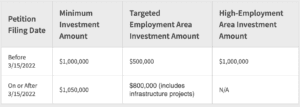
Yes, you can with an immigration path called the EB-5 Immigrant Investor Program. The minimum amount of capital required to invest is $1,050,000. To apply, you’d file Form I-526. Once that’s approved, you will either file DS-260 or Form I-485 with USCIS, then file Form I-829, Petition by Investor to Remove Conditions on Permanent Resident Status, within the 90 days before the second year of your admission as a conditional permanent resident.
Can a company sponsor a green card?
Yes, a company can sponsor a green card. Review the various employment-based sponsorship options in this article for the most suitable option for your company.
What is the point of the petition for my employee?
The purpose of the petition is to show immigration officials you have the intention to hire the foreign employee and also to prove the legitimacy of the employer-employee relationship and that the eligibility requirements are met. It also establishes the employer’s place in line or ‘priority date’ so that when a visa becomes available, they can come to the United States to work.
Can my relative sponsor me on an employment visa if they have a business in the U.S.?
This is an extremely tricky subject and should be approached with extreme caution due to the potential consequences. Some people might think this is a better option due to the long wait times for family-based green cards but it does come with many hurdles to overcome.
First is the PERM labor certification process. The second is that you must answer yes in the application portion (on Form ETA 9098) where it asks “Is the employer a closely held corporation, partnership, or sole proprietorship in which the [sponsored person] has an ownership interest, or is there a familial relationship between the owners, stockholders, partners, corporate officers, incorporators, and the [sponsored person]?”
You absolutely cannot lie on this question if you are somehow related, by marriage or blood. The Department of Labor will look at all the factors and circumstances and decide if the familial relationship could be influencing the hiring decision. Discuss this further with your immigration attorney.