




Getting a green card through employment is one of the most popular methods of immigration into the United States. However, for most green card options, you need to have a U.S. employer sponsor you for your immigrant visa. However, if you are a business owner, do not have an occupation that is conducive to this setup, or would simply like to immigrate without going through an employer, there are a few options available. Two such options are the EB-1 green card and the National Interest Waiver. In this post, we’ll discuss the similarities and differences between these two paths and which may be better for your situation.
Speak with an experienced immigration attorney
Overview of Categories
Find below an overview of both the EB-1 and EB-2 NIW:
The EB-1 Green Card
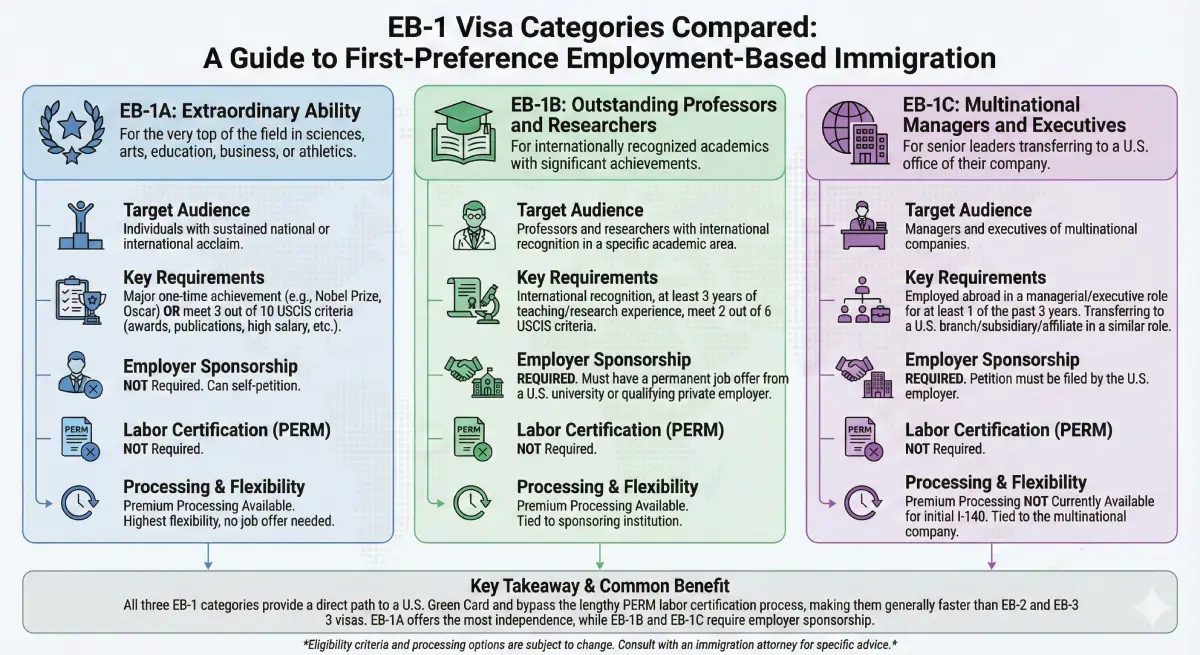
The EB-1 green card is the most prestigious employment-based green card available. It covers a wide variety of potential applicants and is broken down into three subcategories:
- EB-1A: This subcategory is for aliens with extraordinary achievements in the areas of business, science, art, athletics, and education. To prove this achievement, you will need to show adequate documentation and evidence showing things such as awards, high compensation, national recognition, or publications in your field in order to qualify.
- EB-1B: This is for outstanding researchers and professors. Those who have made significant contributions to their scientific and educational fields and are recognized internationally are qualified for this subcategory.
- EB-1C: This subcategory is for the executives and managers of multinational companies. Because the EB-1C requires applicants to have a sponsoring employer, we won’t be using this subcategory to compare with the National Interest Waiver.
The National Interest Waiver (EB-2 NIW)
The National Interest Waiver (EB-2 NIW) allows individuals with advanced degrees or exceptional ability to bypass the standard job offer and labor certification requirements if they can demonstrate that their work benefits the United States significantly enough to be in the national interest.
Difference Between NIW vs EB-1 Green Card
1. Eligibility
-
EB-1 (Extraordinary Ability): Requires proof of sustained national or international acclaim and recognition as one of the top individuals in your field.
-
EB-2 NIW: Requires an advanced degree or exceptional ability and evidence that your work benefits the U.S. national interest.
2. Waiver of Job Offer/Labor Cert
- The waiver of a job offer is available only for EB-1A (self-petition)
- For NIW, it is always waived (self-petition).
3. Evidence Required
-
EB-1A: Must meet at least 3 of 10 criteria (e.g., major awards, original contributions, publications, critical roles).
-
EB-2 NIW: Must pass the NIW three-prong test (listed in detail below).
4. Processing Times
One of the main differences between the NIW vs EB-1 is the processing time. The EB-1 and EB-2 NIW processing time is broken up into three main stages:
I-140 Petition
The first stage involves having an I-140 petition processed. According to USCIS data, this takes 7.9 months to process on average. Petitions for the EB-1 and EB-2 NIW can be expedited through premium processing by filing form I-907, reducing I-140 processing to just 15 business days for the EB-1A and EB-1B, or 45 days for the EB-1C and EB-2 NIW.
Priority Date Stage
The second stage involves waiting for priority dates to become current. When an employment-based green card petition is received by the USCIS, this date is established as the petition’s priority date. Every month, the Department of State releases a visa bulletin with a series of “final action dates” for each type of green card and based on the country of origin. When the final action date in your category matches or passes your priority date, a green card will become available. Depending on the category and country of origin, this can take several years or no time at all.
One of the most significant differences between the NIW vs EB-1 green cards is the waiting time due to the priority dates stage. EB-1 visas are higher priority, with final action dates frequently listed as current for most countries, excluding China or India, and even those have relatively shorter waiting times. On the other hand, EB-2 NIW final action dates take closer to one and a half years to two years for most countries, but 10+ years for India, and 4+ years for China.
Green Card Processing
The third stage depends on whether you are currently in the U.S. under a valid nonimmigrant visa status, such as an H-1B or O-1 visa, or if you are outside the U.S.
- For those in the U.S, you will adjust your status by filing an I-485 and waiting around 6-12 months for it to be processed
- For those outside the U.S., you will get your green card through consular processing, which has a varying processing time based on the caseload of the U.S. consulate or embassy.
5. Typical Applicant Profile
-
EB-1: Individuals at the top of their field (e.g., acclaimed scientists, major award winners).
-
EB-2 NIW: Professionals working on projects with broad U.S. impact (e.g., public health, climate science, national security).
EB-1 vs NIW Benefits
Although the requirements between the NIW and EB-1 differ, a person may qualify for both. However, those who do qualify for both have a choice to make based on the benefits.
- An EB-1 may be easier to have approved than an NIW, depending on your situation, as NIW cases are carefully examined and the rates of denial have increased in recent years.
- The EB-1 has the potential to have a much shorter waiting time due to the visa bulletin and priority dates, particularly for India and China.
- With an EB-1, you do not need to be actively working to qualify, which is not the case for the NIW.
VisaNation Tip:
If you are fortunate enough to find yourself in a position where you can choose between an EB-1 and an NIW, either option may be better for you depending on your circumstances. It may be wise to file both petitions simultaneously. The best course of action is to bring the choice before an immigration attorney to review your case.
The main benefit of both the EB-1 and NIW lies in the fact that they don’t require a PERM Labor Certification, which in total takes ~2 years. The PERM is a process put in place by the Department of Labor in order to prevent employers from abusing the green card process and displacing U.S. workers. It requires employers to go through an extensive recruiting process for the job of the beneficiary to ensure that no qualified U.S. workers are available for the position.
If you do not have an employer, then you will not be able to acquire a PERM and so will not be eligible for a green card. However, because the EB-1 does not require it, those without sponsoring employers can apply. That being said, the EB-1C still requires you to have an employer, even though it does not require the PERM.
What is a National Interest Waiver?
Just a step down from the EB-1, the EB-2 green card is meant for those with either exceptional ability or an advanced degree. However, unlike the EB-1, a standalone EB-2 requires PERM labor certification along with a sponsoring employer, two major limitations.
Fortunately, the National Interest Waiver (NIW) was created to allow EB-2 applicants to waive the PERM requirement if they meet the requirements and therefore waive the need for a sponsoring employer and PERM process.
Who Would Benefit from an NIW?
This makes the NIW ideal for anyone who does not have an employer to sponsor them but can prove that their work would benefit the national interest. This is an excellent opportunity for self-employed entrepreneurs as well as doctors with their own practice.
NIW Requirements
To get an NIW, you will need to make sure you and your work qualify under the following three stipulations:
- You must show that your work will contribute substantially to the U.S. in the areas of business, science, culture, education, health, and technology. While you don’t need to show a measurable projected impact on these areas from your work, it could help your case to illuminate the impact.
- You will need to prove that you are in the best position to advance your work. It must be apparent that you are uniquely qualified to make your work as beneficial to the nation as possible. This can come in the form of degrees, certifications, or licensures directly related to your work.
- You must show that the U.S. will benefit “on the balance” by granting you an NIW. This phrase is used because upholding the PERM benefits the U.S. Making sure that employers do not take advantage of the green card process is in the best interest of U.S. workers. Therefore, waiving the PERM requirement usually does not benefit the nation. So you must show that the U.S. benefits more from waiving the PERM requirement for you than it does by upholding it. This is what it means for the U.S. to benefit “on the balance”.
Keep in mind that, in addition to qualifying for the NIW, you will also need to qualify for an EB-2 by showing that you either have exceptional ability or an advanced degree. Also, getting an NIW for physicians has different requirements.
EB-1 and NIW Petitions
National Interest Waivers and extraordinary achievements petitions enable the most skilled foreign nationals to obtain a green card without looking for sponsorship. These petitions differ from other green card application processes because applicants do not need to have been given a job offer in the United States for their petitions to be successful. These cases are also ideal for applicants with high levels of expertise in their areas of specialty.
An extraordinary achievement petition can be a great route to take for immigration if you have vast experience in your field. This can include achievements in sports, arts, entrepreneurship, and many other fields such as medicine, engineering, and science. However, petitions for National Interest Waivers must have national importance and substantial merit for the proposed endeavor.
Watch the video below to hear how VisaNation Attorney Quindemil breaks down the significance of the proposed endeavor in an EB-2 NIW filing.
EB-1 Petitions
The extraordinary achievements petition is for people with extraordinary abilities in their areas of specialization and who have proven to be the best in that field. You do not need a job offer to obtain permanent residency in the U.S. if you are considered a person with extraordinary achievements. Although you can make a self-petition for your green card, you must prove that you are traveling to the United States to work in your area of specialization.
Self-petition green cards can be a good avenue for businesses to bring their start-ups to America. This petition is also for people who are recognized publicly for their achievements in different fields such as arts, sciences, education, and sports. While you can make a self-petition, a petition filed by your employer is likely to be approved.
However, you still need to prove your extraordinary abilities by demonstrating international or national acclaim, by showing receipt of internationally recognized awards. If you do not meet these requirements, then you will have to provide the following evidence to the USCIS:
- Membership in bodies that demand outstanding achievement in your field.
- Published articles or books detailing your professionalism in your field.
- Performance of your work in a reputable company that led to an increase in sales.
- Display of your work at various exhibitions.
See the complete EB-1 eligibility criteria.
National Interest Waivers Petition
The evidence required for an NIW is not as clear as that of EB-1. So, for an NIW petition, the immigration steps will be as follows:
- Prove that the labor certification requirements and the job offer will be beneficial to the United States. You should also demonstrate that America will benefit from you if you continue working there, even if there are other competent U.S. employees.
- Demonstrating that you are ready to pursue funding for your project or progress with your business plan while furthering your skills and education in the U.S.
- Demonstrate that your proposed work has national importance or substantial merit. For substantial merit, USCIS will consider findings that advance scientific knowledge; for national importance, the impact of your work will be looked at.
Bear in mind that, unlike NIW, self-petition green cards will require you to present a strong petition with evidence and documentation of your accolades and expertise in your field.
Speak with an experienced immigration attorney
Frequently Asked Questions
Below are some of the most frequently asked questions in regards to Eb-1 vs NIW differences and similarities.
Does the NIW allow for premium processing?
Yes, the NIW does allow for premium processing. You can expect a decision on your EB-2 NIW application in 45 business days
What is a final merits determination?
The burden of proof falls on the applicant to demonstrate that they meet the high level of expertise outlined in the eligibility requirements. An immigration attorney will best be able to help you build a well-rounded case so that there is no concern from the immigration officer.
Is a job required for the EB-1 green card?
For the extraordinary ability category (EB-1A), a job offer is not required. However, for outstanding professors/researchers and multinational managers/executives, a job offer and sponsorship from a U.S. employer are necessary.
What are the advantages of the EB-1 Green Card?
EB-1 Green Card holders can bypass the lengthy labor certification process, and priority dates are usually current, leading to faster processing times compared to other employment-based categories.
What type of evidence is required to prove “extraordinary ability” in the arts for the EB-1 category?
Evidence may include a significant record of exhibitions, critical reviews, awards, recognition from experts or organizations, and international recognition for artistic achievements.
Can an entrepreneur with a successful startup apply for an EB-1 Green Card as an outstanding businessperson?
Yes, an entrepreneur with a successful startup can potentially qualify for the EB-1 Green Card if they can demonstrate their outstanding achievements, impact on the industry, and substantial contributions to the U.S. economy. It’s best to discuss more details about this with an immigration professional.
Can a researcher’s work on a niche scientific topic qualify for a National Interest Waiver if it has limited mainstream recognition?
Yes, as long as the research is of significant importance and the applicant can demonstrate the broader implications and potential benefits to the U.S., even niche scientific work can qualify for an NIW.
For those who are going with a sponsor, the employer usually does most of the work and pays for most of the fees. However, for the EB-1 and EB-2 NIW, those responsibilities will fall on you as the sponsor and the beneficiary. To ensure that you are making the best decision for your case and filling out all the forms correctly, it’s almost always a good idea to have an immigration attorney handle your case.