The H-1B visa has been the most popular long-term work visa in the United States for years because of the host of benefits that it gives relative to other work visa categories. From its accessibility to its lengthy stay period, it’s easy to see why so many foreign professionals apply for the H-1B visa each year. Read below to learn all about the pros and cons of the H-1B visa.
Speak with an experienced H-1B Attorney
What Are the Benefits of the H-1B Visa for Foreign Workers?
The H-1B visa offers foreign professionals a stable, multi-year path to work in the United States that can eventually lead to a green card. Here are some of the key benefits:
Broad Requirements
The first H-1B visa benefit, and perhaps the main reason for its popularity, is the general requirements associated with qualifying for this visa.
While many other working visas require the beneficiary to have a managerial position, a master’s degree, or an investment of thousands of dollars, the H-1B simply requires:
- A bachelor’s degree
- A job offer from a U.S. company for a specialty position that requires your bachelor’s degree.
Of course, finding an employer that has a job opening available for a position related to your educational background may not be simple, but these requirements are much easier to fulfill than the requirements for visas such as E-2, which requires significant investment, the L-1 which requires you to be an employee for a foreign branch for at least one year in the last three before transferring to the U.S., and O visa classifications that require extraordinary ability.
Of course, finding an employer with an opening related to your background may not be simple. However, these requirements are much easier to fulfill than those for other visas, such as the E-2 investor visa, which requires significant investment; the L-1 intracompany transferee visa, which requires prior employment at a foreign branch; or O visa classifications, which require proof of extraordinary ability.
Find out about H-1B Salary Requirements.

Learn about H-1B Cap Exempt Employers in this guide!
If you are selected in the H-1B visa lottery, contact VisaNation attorneys for filing your H-1B petition.
Visa Validity Period
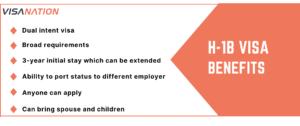
Another benefit of the H-1B visa is the time you are initially granted when you receive your visa. In contrast to other visas, such as B-1, which grants you six months, and the J-1, which can sometimes grant you as little as one year, the H-1B allows holders to stay for three years initially and can easily be extended another three years.
Furthermore, if you decide to pursue a green card, you can renew it until your permanent residency is granted.
Ability to Change Employers and Work for Multiple Employers
Unlike the rigid regulations surrounding some other work-related visas, the H-1B visa gives holders the ability to transfer from one employer to another during their stay. The new employer must file the I-129 petition on your behalf. The H-1B has a unique “portability” rule that allows a worker to start working for a new employer as soon as the new H-1B transfer petition is filed, rather than waiting for full approval.
The H-1B also allows them to work part-time and for multiple employers at the same time.
Anyone Can Apply
One of the biggest H-1B benefits is that foreign professionals from all over the world can apply. While the E-2 visa can only be obtained by people from treaty countries and the TN is reserved for Canadians and Mexicans, the H-1B visa is available to nationals and citizens of any country.
Check out our H-1B Predictions for the Year.
Spouses and Dependents Can Come With You
With the H-1B, You can bring your spouse and children over as dependents under the H-4 visa. Their stay will be as long as the principal holder, and extensions can be acquired for each H-4.
The visa also allows for dependents to attend school (full or part-time), obtain a driver’s license, open bank accounts, and travel. Additionally, if the H-1B holder has an approved I-140, H-4 spouses can work in the U.S. after obtaining Employment Authorization Documents.
Dual Intent
One of the H-1B’s many benefits is the fact that it is a “dual intent” visa. This means that you can pursue legal permanent residency while under H-1B nonimmigrant status. This is a significant advantage over some other visas, such as the TN and J-1 classifications.
Recommended: H-1B to Green Card: Process, Steps & Timeline
What Are the H-1B Visa Benefits for U.S. Employers?
Foreign professionals are not the only ones who stand to grow from the H-1B benefits. Employers have much to gain as well. This visa, which caters to people with educational backgrounds in science, technology, engineering, and mathematics (or STEM for short), allows the best of the world’s professionals to enter the U.S. and work for your company.
The H-1B Addresses Local Labor Shortages
Many employers are located in areas that have a labor shortage and may not have access to qualified U.S. workers who are willing to move permanently to your area.
The H-1B process gives employers the opportunity to hire temporary professionals from overseas to complete projects or fill specialty positions.
The H-1B Increases the Global Competitiveness of the United States
These days, to compete with today’s market, you need to have a global presence. Hiring H-1B employees can strengthen your competitiveness abroad and could also provide quality permanent workers if you are willing to sponsor applicants for employment-based green cards.

Disadvantages of the H-1B
Unfortunately, the H-1B visa is not without its cons. Work with your immigration attorney to weigh the pros and cons of this visa class to determine if it is the right choice for you.
The H-1B Visa Requires You To Enter a Competitive Lottery
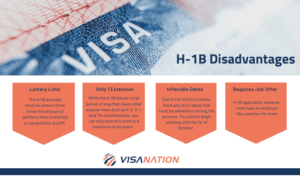
The first and greatest drawback of the H-1B visa is the fact that there is an annual limit on how many petitions are approved each year. The H-1B visa regularly receives up to three times more registrations than the annual H-1B cap. Thus, even if you have a job offer, you are not guaranteed a position unless your registration is selected in the lottery.
Unless you qualify for a cap-exempt position, you must participate in the H-1B lottery. The lottery is based on weighted selection, and if you are an entry-level employee right out of university, your chances might be slim – DHS projects registrations with level one wage levels to have odds around 15.29%.
Limit of Six Years Unless the Employer is Willing to File a Green Card Petition
Among the most important restrictions of the H-1B visa is the time limit of six years. If you wanted to continue working in the U.S. after those six years, you would have to be out of the U.S. for one year before you could reapply for another H-1B visa.
There are exceptions to this; if, for example, your employer filed a PERM Labor Certification or an I-140 petition at least 365 days before your 6-year limit expires, you can renew your H-1B in one-year increments while that application is pending.
Additionally, if your I-140 is already approved but you cannot yet apply for a Green Card because of backlogs in your priority date, you can receive H-1B extensions in three-year increments.
Find out How to Change Jobs After I-140 Approval.
The H-1B has Inflexible Dates
Due to the lottery process, there are strict dates that must be adhered to during the process. For example, your petition cannot be filed until April 1st. Also, if your petition is selected and approved, you cannot begin working until on or after the 1st of October of that same year. This also limits the benefits that the premium processing service has on your case.
On the other hand, other visas allow a more fluid timeline for petitioning and starting employment.
The H-1B Requires a Job Offer
While it is one of only two major requirements for an H-1B visa, it can also be a drawback since finding a sponsoring employer can be difficult. In contrast, the E-2 and O-1 visas do not require a job offer, so beneficiaries are able to petition on their own behalf. H-1B applicants, however, must have an employer file a petition for them.
The H-1B Has High Costs
Even though all H-1B petitioning fees must be paid by your employer, they are steep and sometimes disincentivize employers from sponsoring you. Overall, your employer could end up paying $3,000+ in fees for your H-1B visa.
Additionally, Trump’s new 100,000 H-1B fee proclamation for beneficiaries living outside the United States that require consular processing impacts its feasibility.
In contrast, the TN visa can cost as little as $56
Additional Administrative Tasks
For every employee, employers must maintain a Public Access File. This includes documentation of the Labor Condition Application (LCA), salary details, prevailing wage documentation, proof of notice, and more. This adds additional administrative work that may not work for some employers..
H-1B Alternatives
Due to the highly competitive nature of the H-1B visa and the requirements, it may not be the most suitable option for you. Below are H-1B alternatives, which you should discuss with your immigration attorney in further detail:
How VisaNation Can Help
Have additional questions about the H-1B visa or alternatives available to you? Choosing the right visa for your case can be a difficult task. That’s why we never recommend anyone navigate immigration law without a qualified attorney at their side.
VisaNation Law Group H-1B lawyers can assess your immigration case and help you come to an informed decision about how to enter the U.S.
Speak with an experienced attorney today!