Background
Our client works for a rapidly growing drone technology manufacturer. The company had established itself as a leader in the aerial robotics industry. With a team of over 100 employees, they were looking to onboard our client, Kristy. She is a systems engineer and specializes in hardware integration and flight control systems. Essentially, if you ever wondered who worked to ensure that your motors, sensors, cameras, and batteries worked properly, that is exactly what our client was doing.
Kristy was already in the U.S. on an H-1B visa through a previous employer. Her transition to the drone company was going to be straightforward, as we needed to file an H-1B transfer under the new company.
VisaNation Case Strategy
Our team filed an H-1B transfer and extension petition to continue Kristy’s employment without interruption. Shortly after filing Kristy’s H-1B extension, USCIS issued a Notice of Intent to Deny (NOID), citing concerns about her maintenance of status at the time of filing. They questioned whether Kristy had remained in lawful status during the transition from her previous employer to her new role.
At the core of the NOID was an allegation that Kristy may have been working without authorization. This was an extremely serious charge, and if left unaddressed, would result in disruption for both Krsity and the company.
The primary issue raised by USCIS was whether Kristy had properly maintained her H-1B status during the transition period to the new employer. USCIS questioned whether there was a gap between her previous employment ending and the new H-1B petition being filed. They were essentially saying that Kristy was working unauthorized.
In reality, Kristy’s previous employment had ended just before the new petition was filed, but everything occurred within the 60-day grace period granted to H-1B holders. This grace period allows certain visa holders to remain in the U.S. legally, even after employment ends, giving them time to secure new employment or make necessary travel or immigration arrangements.
Unfortunately, the USCIS officer overlooked the timing of the filings.
We replied, explaining the timeline of Kristy’s employment with her previous H-1B employer and transition into the new role at her new employer. It was important to clarify that Kristy was not employed without authorization. We included the receipt notices to prove that USCIS confirmed that the grace period was a period of authorized stay.
Verdict
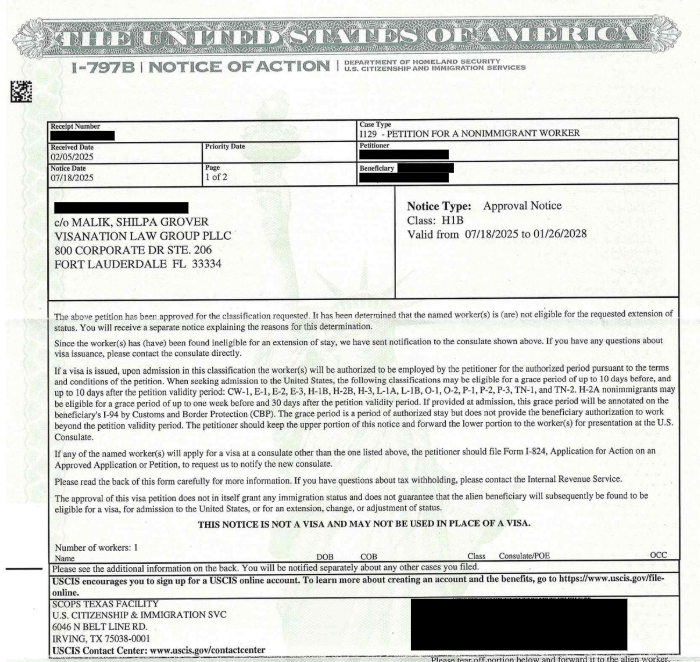
USCIS approved the H-1B transfer within 5 months, and within a week of the NOID notice, the petition was approved!