


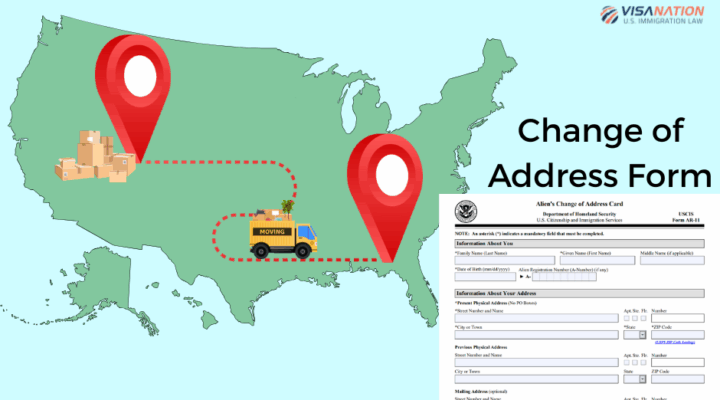
The AR-11, also known as the Alien’s Change of Address Card, is required for nearly all non-citizens to notify USCIS of a change of address. While the process may seem simple, filing it incorrectly or late can lead to serious issues with USCIS or the Department of State.
This guide will help you know when, how, why, and where to fill out the AR-11.
What is the AR-11, Alien Change of Address Card
Whenever you move from one address to another, you need to inform USCIS of your move, and you can do so by filing the AR-11 form. By filing this form, you are letting the authorities know where to send any correspondence regarding your immigration cases. Alternatively, you can speed up the process by updating your address by using a USCIS online account.
It is a common misconception that notifying the U.S. Postal Service (USPS) of your change of address is sufficient notice to the government. However, the Department of Homeland Security, USCIS, and the Executive Office of Immigration Review do not receive any information from USPS about a change of address.
Who must file an AR-11 form?
Every non-citizen (Non-immigrants and lawful permanent residents) in the U.S. who changes their residential address must file an AR-11 to update their address on file or use the online portal.
When must you file an AR-11 form?
You have 10 days after moving to notify USCIS about your change of address with an AR-11 form.
Why must you file an AR-11 form?
Filing the AR-11 ensures that the Department of Homeland Security and USCIS know where to send important information regarding your immigration/citizenship case.
What Happens If You Don’t Fill Out an AR-11
The AR-11 is required by law, specifically 8 U.S.C. § 1305, and if you fail to file an AR-11 or update your address when you move, there can be consequences.
Consequences
Failure to fill out and submit the form can lead to severe consequences, including the following:
- $200 fine
- Up to 30 days in jail
- Deportation
- Delays in processing your application
If authorities try to cite you for failing to submit an AR-11, you can be excused if you prove that your error wasn’t willful and is reasonably excusable.
While the consequences may seem steep, it is uncommon for authorities to pursue enforcement action if you forget to submit an AR-11 due to a lack of resources and priorities. Additionally, if you miss the 10-day deadline, you should still submit the form and save a copy of the submission.
How to Submit the AR-11 Form to Change Address
You can alert the government of your change of address in two ways: through your USCIS online account or by mail.
Tip: By filing online, your address is automatically updated, and avoids the need to file a paper form.
File Online
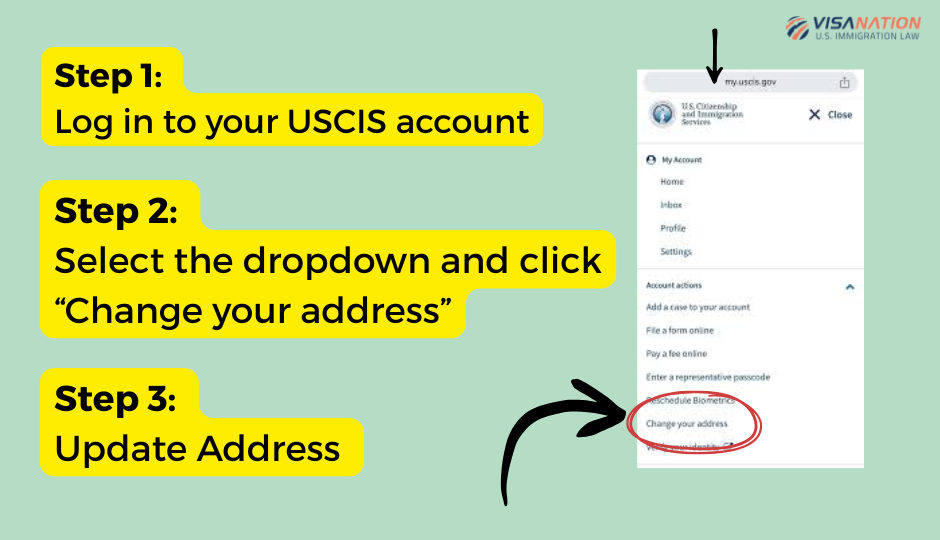
- Step 1: Go to the official USCIS Change of Address page
- Step 2: Log in to your USCIS account
- Step 3: Update your address
- Step 4: Review your entry
- Step 5: Save and print your confirmation page for your records
Filling Out AR-11 When You Don’t Have an Immigration-Related Application or Petition
If you don’t have an immigration-related application or petition, you’ll need to provide the following information:
- First and last name
- Birthdate
- Alien registration number, if you have one
- Current country of citizenship
- Whether you are a permanent resident, visitor, student, or other
- Your old address
- Your new address
- Your mailing address, if it’s different from your new address
- Your email address
- Information about who filled out the form, if it wasn’t the applicant or petitioner
Filling Out AR-11 If You Filed an Immigration-Related Application or Petition and Have Not Yet Received a Decision Notice, Card, or Document
If you have an open application or petition, you’ll need to provide everything in the section above and the following information:
- Any form numbers related to your application or petition
- The form subtype for each form
- The receipt number for each form
- The zip code used when you filed
Using The USCIS Enterprise Change of Address (E-COA) Self-Service Tool
Now, you can update your address directly on your USCIS account using the self-service tool. You will log in to your USCIS account and then select “Change your address” from the menu dropdown. Once you enter the new address, you are done!
File by Mail
Although there is an online form to update your address, there is also a physical form. However, only people under specific categories need to fill out and mail the physical form.
If you have to fill out the physical form, you should use certified, registered, or return receipt mail.
Abuse Waivers
If you filed an I-751 Abuse Waiver, you need to mail the AR-11. The three letters at the beginning of your I-751 receipt number dictate where you’ll send the form.
|
Receipt Prefix |
Mail to |
|
EAC |
USCIS Vermont Service Center, Attn: Humanitarian Division, 38 River Rd., Essex Junction, VT 05479-0001 |
|
LIN |
USCIS Nebraska Service Center, Attn: I-918, P.O. Box 87918, Lincoln, NE 68501-7918 |
|
MSC |
National Benefits Center, P.O. Box 648006, Lee’s Summit, MO 64002 |
|
SRC |
USCIS Texas Service Center, 6046 N Belt Line Rd., Suite 751, Irving, TX 75038-0001 |
|
WAC |
USCIS California Service Center, Attn: WS 13057, P.O. Box 10751, Laguna Niguel, CA 92607-1075 |
|
YSC |
Potomac Service Center, 6046 N Belt Line Rd., Suite 114, Irving, TX 75038-0020 |
Domestic Violence Victims, Trafficking, and Other Crimes
Applicants who filed under VAWA, T, and U visa categories must also mail their AR-11. This includes those who submitted:
- Form I-360, Petition for Amerasian, Widow(er), or Special Immigrant (as a VAWA self-petitioner);
- Form I-485, Application to Register Permanent Residence or Adjust Status (as an abused spouse under the Cuban Adjustment Act; as an abused spouse, parent, or child under VAWA; or as a T or U nonimmigrant);
- Form I-765, Application for Employment Authorization, filed by VAWA self-petitioners and T/U nonimmigrants;
- Form I-765V, Application for Employment Authorization for Abused Nonimmigrant Spouse;
- Form I-914, Application for T Nonimmigrant Status;
- Form I-914, Supplement A, Application for Family Member of T-1 Recipient;
- Form I-918, Petition for U Nonimmigrant Status;
- Form I-918, Supplement A, Petition for Qualifying Family Member of U-1 Recipient; or
- Form I-929, Petition for Qualifying Family Member of U-1 Nonimmigrant
Categories that Need to Notify Change of Address Through Other Means
The AR-11 is the way most need to notify USCIS of a change of address. Keeping your address current helps prevent missed USCIS notices and possible case delays. However, others need to communicate a change of address through other forms or other means.
U.S. Citizens
If you are a U.S. citizen who submitted an affidavit of support for someone, you must file and submit Form I-865, Sponsor’s Notice of Change of Address, within 30 days of moving. This I-865 ensures that USCIS can contact you about your financial sponsorship obligations.
You need to provide the following information when filling out your Form I-865:
- Your full name
- New physical address
- New mailing address
- Full name of the immigrants you’re sponsoring
- Alien registration number of the immigrants you’re sponsoring
Civil Surgeons
Civil surgeons should send an email to the email address where they received their approval to see the change-of-address notification instructions.
Attorneys and Registered Representatives
Any accredited attorney or legal representative must alert USCIS to an address change. They can either fill out Form G-28, Notice of Entry of Appearance as Attorney or Accredited Representative, or mail a letter on office stationery to USCIS.
If attorneys use the G-28, they need to submit one for each of their pending cases. If they choose the method of mailing a letter on official stationery, it needs to state “Attorney Change of Address” on it, along with a spreadsheet of every pending case, form type, alien registration number, receipt number, and applicant’s full name.
Although most attorneys and registered representatives are aware of this requirement, we advise confirming with your attorney that they have alerted USCIS of your move.
How to Avoid Notifying USCIS of a Change of Address
There is only one way to avoid having to notify USCIS of every move, and that is when you are a U.S. citizen. As a U.S. citizen, you will not need to notify USCIS of your address change. If you satisfy all the requirements, it might be time to think about becoming a citizen.