
Background
Drishti arrived in the U.S. at the age of 11 years. Born and raised in Mumbai, she and her family moved to the U.S. after her dad secured an H-1B visa with a prominent technology company. This visa is reserved for skilled professionals, and as a child (dependent) of an H-1B visa holder, she was granted an H-4 visa. An H-4 visa is given to spouses and unmarried children under the age of 21 years of an H-1B visa holder. The H-4 visa allowed Drishti to attend school and live in the U.S. up until the age of 21 years.
For nearly a decade, Drishti embraced the American culture, navigating her pre-teen, teenage, and early adult years in the U.S. The U.S. had become her new home. After high school, Drishti started college to pursue neuroscience. She was driven by the desire to understand the human brain, as she lost both her grandparents to Alzheimer’s disease, and wanted to work on preventative care for brain diseases. She was entering her third year of college, and this was also when she was about to turn 21 years old.
However, under the H-4 laws, once a child on an H-4 visa turns 21, they are no longer considered a dependent and must obtain their legal immigration status to remain in the U.S.
VisaNation Case Strategy
With her 21st birthday four months away, Drishti and her family faced a time-sensitive dilemma. If she did not change her immigration status before turning 21 on her H-4 visa, she would lose her legal status to remain in the U.S., and even study at her university.
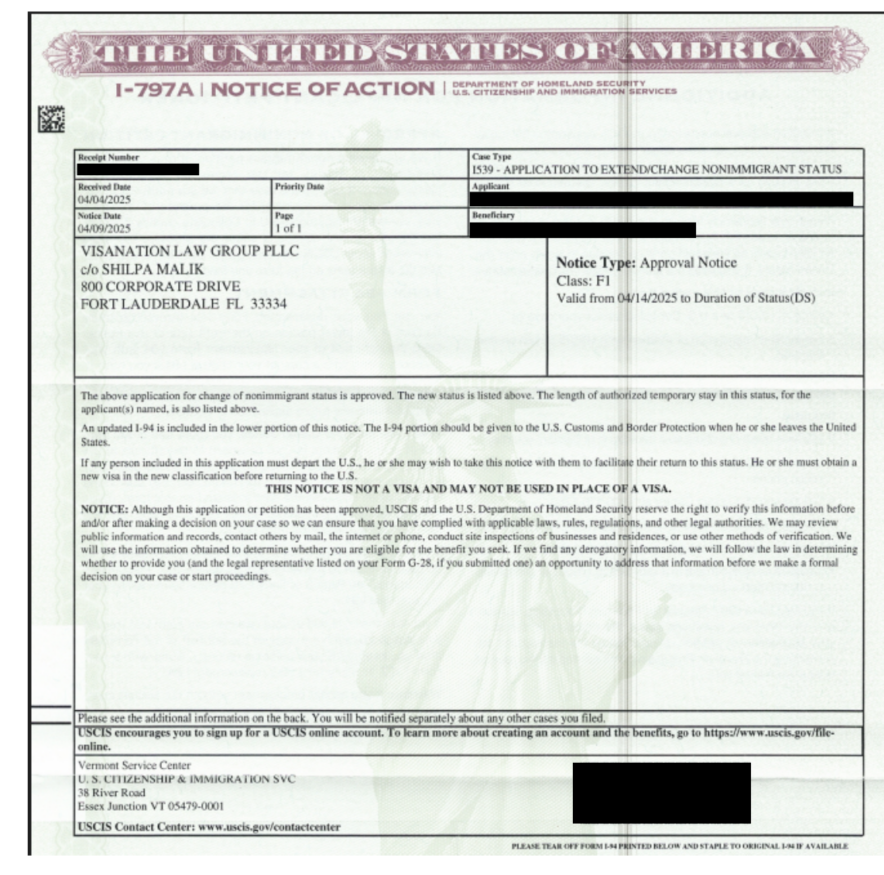
The family approached our team, and once we evaluated the case, we determined that the appropriate solution would be to transition her to an F-1 student visa. This visa is the most common amongst international students who are enrolled in full-time academic programs in the U.S. We immediately began preparing the petition. We filed the I-539 Form, which is the application to change a non-immigrant status on her behalf. One of the most critical components of this application was the SEVIS (Student and Exchange Visitor Information System) Form I-20. This must be issued by the U.S. college or university that the student is attending. We worked closely with Drishti’s university to ensure that all SEVIS requirements were met and that the I-20 form was properly prepared and submitted with the application.
Timing was everything. We had to demonstrate that Drishti was still in a valid H-4 status at the time of the application and that her F-1 student status would begin as soon as the change was approved. This transition required meticulous planning and documentation.
Verdict
Within 8 days, Drishti’s F-1 student visa was approved.


