Background
Our client is a highly specialized Food Scientist with an impressive academic background and significant experience in food safety, product formulation, and shelf-stability. At the time of filing the EB-1B petition, she was employed by a prominent U.S.-based food manufacturing corporation where she led research initiatives. To secure permanent residency, the petitioning employer retained our services for the complex immigration process.
The primary hurdle in this case was satisfying the rigorous two-part Kazarian test. Under this standard, we first had to prove the client met at least two of the six regulatory criteria for EB-1B. Secondly, we had to succeed in the “Final Merits Determination,” convincing USCIS that the client is internationally recognized as outstanding in their specific academic field. Lastly, we had to provide documented proof that the employer met the statutory requirement of employing at least three full-time researchers.
VisaNation Case Strategy
In this case, our attorneys curated a series of testimonial letters from independent experts and former supervisors. These letters showcased evidence of original scientific research. Separately, our team translated complex scientific language into “plain English” for the USCIS officer, explaining how her research solved specific industry problems regarding food pathogens, food scarcity, and preservation. A quote from one of her former supervisors highlights her extraordinary work:
“Her work utilizing Extrusion Manufacturing technology to develop a plant-based alternative to meat is truly revolutionary. It holds promise in addressing global issues such as nutrient deficiency and food scarcity, particularly in impoverished regions.”
We also submitted detailed documentation of the client’s proprietary formulations and process improvements, including technical reports and evidence of the commercial success of products she developed. Overall, this helped overcome the Final Merits Determination.
Aside from letters showcasing satisfy the peer review criterion, we also provided proof that she had experience as a peer reviewer for the in the Nutrition and Food Science Journal. We included formal invitations and completion certificates to prove she had reached a level of expertise where she could critique the work of other PhD-level researchers.
Although an EB-1B green card petition only requires that the beneficiary meet two criteria, we submitted three because of the strength of our client’s profile. We submitted evidence of the authorship of articles in scientific journals. Our client had published multiple articles on subjects including upcycled foods, proteins, and bioplastics. As these articles all received widespread professional interest, we provided metrics showing the viewership, downloads, and citations that demonstrated a tangible impact on the U.S. food supply chain.
Lastly, our attorneys compiled payroll records and organizational charts to prove the petitioning company maintained a permanent research department with more than three full-time researchers, as required for the EB-1B classification.
The Verdict
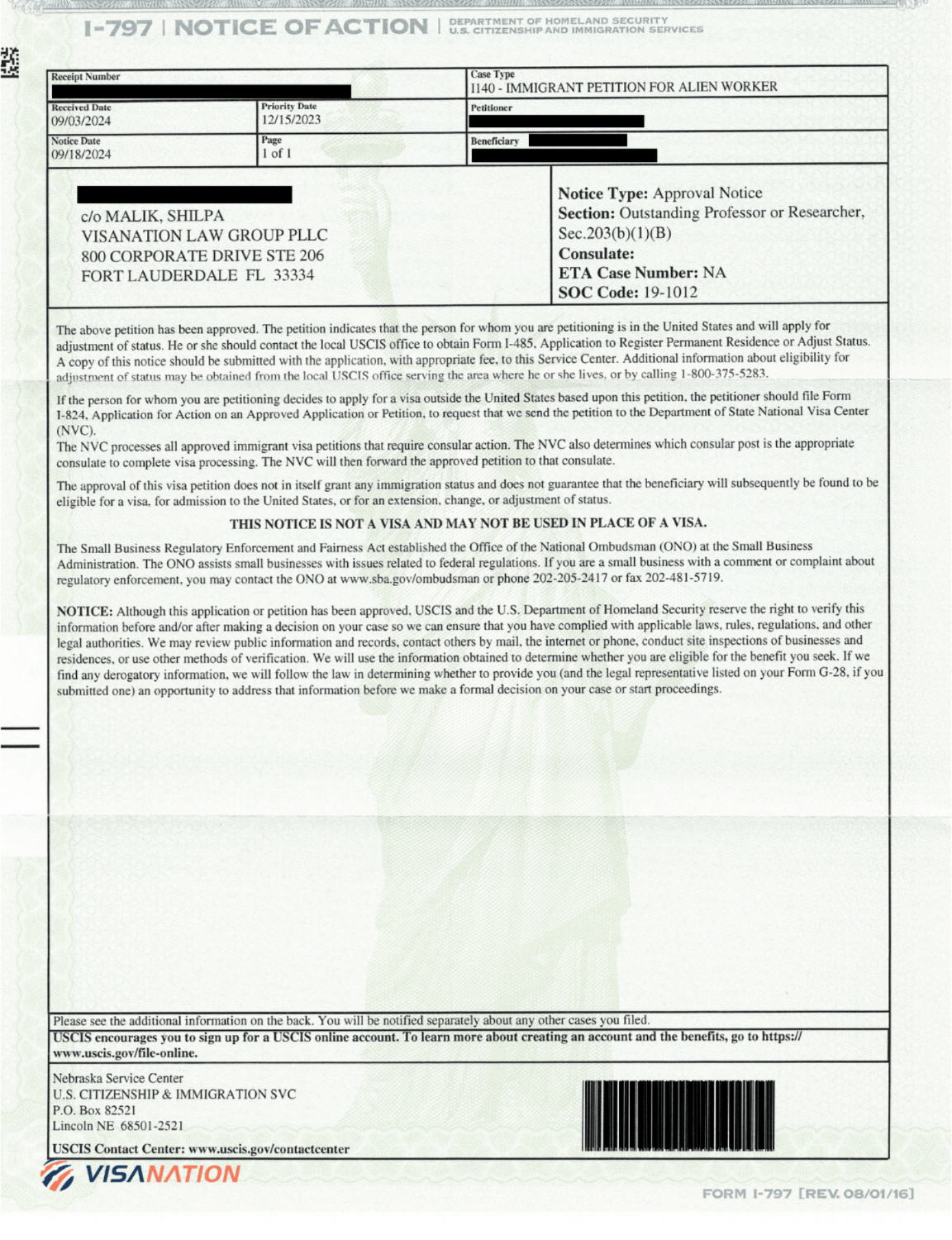
We filed with the EB-1B petition with Premium Processing, which led to an approval in 15 days. Our legal team received an approval notice without a Request for Evidence (RFE). The client’s I-140 was approved, allowing the client and her family to secure permanent residency and continue critical research in the American food industry.